
Automatically apply for jobs with Zippia
Upload your resume to get started.
Manager, product research and development skills for your resume and career
15 manager, product research and development skills for your resume and career
1. R
R is a free software environment and a language used by programmers for statistical computing. The R programming language is famously used for data analysis by data scientists.
- Developed an entirely new category of toddler toys for an exclusive launch at Toys R Us.
- Develop and streamline R code for data evaluation and statistical analyses performed on data collected from experiments and from outside sources.
2. Product Development
Product development is the complete procedure of creating a product from concept until release of the final product. Product development has many stages after which a product is released into the market. Identifying the need, creating the opportunity, conceptualizing a product, and providing a solution, all are different stages of product development.
- Ensured adherence to corporate standards and procedures for hardware and software product development and overall management plans.
- Managed product development of frozen value-added seafood products from conceptual stage through full-scale production runs.
3. Market Research
Market research is a collective effort to collect information related to a consumer's needs and wants. It is a systematic approach that involves recording and analysis of both qualitative and quantitative data. Market research helps a business to identify a target market correctly and identify the gaps in potential consumer's expectations.
- Recruited, mentored and helped promote market research analysts to support New Product Planning and Business Development functions.
- Conducted market research, identified trends, and created competitive analysis.
4. Manage Cross
- Manage cross-functional teams during product planning, development, in-house verification, external validation and transfer to manufacturing.
- Manage cross-product team projects enhancing website functionality while maintaining and making recommendations for existing functionality.
5. Product Quality
Product quality is the basic element of a business. It means to add features in a product or service in such a way that it meets the needs and wants of the customers. Enhancing the product quality also means improve the goods from any existing defects to ensure customer satisfaction.
- Introduced new policies and procedures that reduced time to market, improved product quality, and added metrics to company performance.
- Collaborated on cross-functional teams, managing product development, improving manufacturing processes while maintaining product quality, integrity and price points.
6. Product Management
Product management is a part of an organization's function that deals with product development, planning, pricing, forecasting, launching, and marketing the product.
- Served as Director of product management until relocated to the USA.
- Developed portfolio performance tracking and reporting in conjunction with Product Management teams to communicate product status across key stakeholder constituents.
7. Product Design
Product design can be described as a process of imagining, creating, and iterating products that solve user's problems and talk about the specific needs of users in the market. Product design is an engineering disciple and it is the basic design and idea that goes before the mass production of the product.
- Approved and reviewed engineering drawings and specifications on product design control and production assemblies and sub-assemblies.
- Streamlined new product design times through the introduction of 3D parametric modeling software (ProE).
8. Development Projects
Development Projects include all contracts, constructions, and projects that may develop an area for housing or commercial construction. These projects frequently require multiple departments to prepare the space for construction projects, including how the construction will take place, who will finance the project, and whether any refurbishments or renovations will be needed.
- Provide product feedback to designers/draftsmen on development projects, customer problems and needs.
- Lead global ophthalmic medical device development projects according to applicable standards and regulations with emphasis on global regulations and guidance.
9. QA
QA, or Quality Assurance is a procedure that entails all of the steps taken to avoid any errors in the manufacturing process or in the production of the goods that a company produces. It can also include ensuring the consistency of the services rendered. Quality assurance ensures that the quality of the service delivered to consumers meets or exceeds the promised expectations. This greatly aids in the prevention of any complications that might arise after the goods or services have been distributed. It makes sure that customers are satisfied.
- Managed up to 18 developers, directed up to 75 developers, QA engineers and Information and Documentation Developers.
- Worked closely with QA on the resolution of software defects, taking in account risk management and change management.
10. Direct Reports
- Developed 3 direct reports with an overall responsibility of product managers and engineers assigned to the gas category.
- Managed engineering staff of direct and indirect reports in a fast-paced, innovation driven environment.
11. D Product
- Developed product manuals and technical documents for field installation and commissioning.
- Contributed and organized product technical training and workshops for global distributorships.
12. Cost Savings
- Worked closely with customer's advanced engineering group to resolve several issues related to mechanism function and design-for-manufacture cost savings.
- Identified opportunities for design improvements and cost savings.
13. Prototyping
- Conduct major iteration reviews by prototyping to all stakeholders after each major phase.
- Introduced Prototyping capability to better serve our customer needs.
14. Sigma
In Greek alphabets, sigma is the 18th letter that means "to sum up". In statistics, the lower case symbol of sigma is the unit of measurement for standard deviation which is used to assess the variability in a given set of data. While the upper case symbol is for summation notation means to add up all the given numbers in the data set.
- Utilized Yellow Belt, Lean Six Sigma - quality assurance software localization streamlining project.
- Trained on Six Sigma and Lean concepts.
15. Technology Development
- Earned Award for new technology development achievement.
- Led team meetings for the next generation technology development.

What skills help Managers, Product Research And Development find jobs?
Tell us what job you are looking for, we’ll show you what skills employers want.
What skills stand out on manager, product research and development resumes?
Davide , Ph.D. Bolchini Ph.D.
Professor and Chair, Director, Human-Computer Interaction Program, Indiana University
What manager, product research and development skills would you recommend for someone trying to advance their career?
Matthew Lopresti
Associate professor of Philosophy and humanities, Hawaii Pacific University
These are the core competencies of the discipline of philosophy. Top-notch communication abilities begin with a depth of ability to understand nuanced, complex details, and then turn around and clearly communicate these complex ideas in easily digestible bits of information. It is no coincidence that students who graduate with philosophy degrees repeatedly dominate graduate and law-school entrance exams like the GRE and LSAT; they are often the sharpest thinkers with the quickest minds

What technical skills for a manager, product research and development stand out to employers?
Patrick Lindsay
Assistant Lecturer, Miami University
Similarly, they expect professional virtual audio-visual communication. It is not enough to just be on the Zoom call. The expectation is to be prepared, to be engaged, to be aware of the audio and video angles and backgrounds. To demonstrate active listening as well as enthusiastic, energetic, even animated talking. Body language and facial expression are even more enhanced in virtual communications.
If there was a positive outcome from being thrust into an academic world that was all virtual, it was the need to learn new technical skills, not only for classwork, but also for social interaction. This will not only be appreciated by employers, but for many, expected.
List of manager, product research and development skills to add to your resume
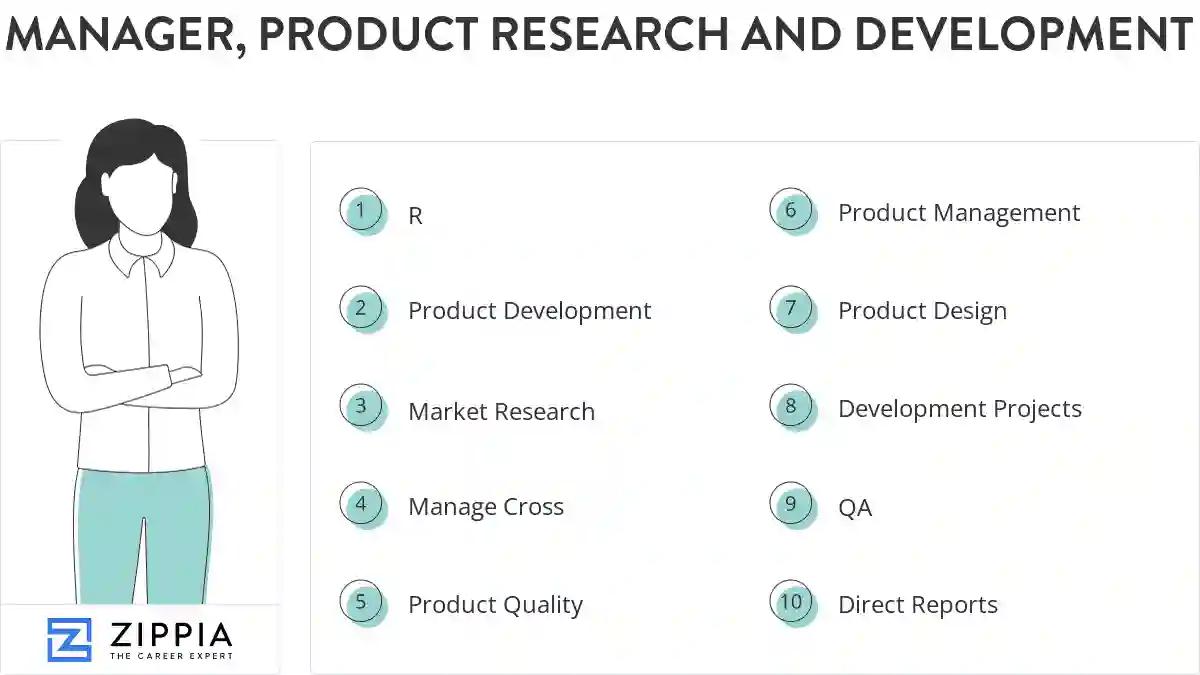
The most important skills for a manager, product research and development resume and required skills for a manager, product research and development to have include:
- R
- Product Development
- Market Research
- Manage Cross
- Product Quality
- Product Management
- Product Design
- Development Projects
- QA
- Direct Reports
- D Product
- Cost Savings
- Prototyping
- Sigma
- Technology Development
- FDA
- Product Specifications
- Software Products
- CAD
- Product Line
- ISO
- GMP
- Competitive Landscape
- Business Plan
- Process Improvement
- Competitive Analysis
- ROI
- Approval Process
- Test Results
- Plant Trials
- Patent Applications
- Product Launch
Updated January 8, 2025
