Explore jobs
Find specific jobs
Explore careers
Explore professions
Best companies
Explore companies
Job outlook for market development managers in the United States
Market development manager job growth summary. After extensive research, interviews, and analysis, Zippia's data science team found that:
The projected market development manager job growth rate is 10% from 2018-2028.
About 33,700 new jobs for market development managers are projected over the next decade.
Market development manager salaries have increased 8% for market development managers in the last 5 years.
There are over 24,091 market development managers currently employed in the United States.
There are 173,901 active market development manager job openings in the US.
The average market development manager salary is $111,159.
Are market development manager jobs in demand?
Market development manager job and salary trends over time
Market development manager jobs over time
Market development manager job growth rate over time
| Year | # of jobs | % of population |
|---|---|---|
| 2021 | 24,091 | 0.01% |
| 2020 | 23,139 | 0.01% |
| 2019 | 22,677 | 0.01% |
| 2018 | 20,730 | 0.01% |
| 2017 | 18,994 | 0.01% |
Average market development manager salary over time
Market development manager salary by year
| Year | Avg. salary | Hourly rate | % Change |
|---|---|---|---|
| 2026 | $111,159 | $53.44 | +3.9% |
| 2025 | $107,000 | $51.44 | +1.9% |
| 2024 | $104,998 | $50.48 | +1.6% |
| 2023 | $103,388 | $49.71 | +0.8% |
| 2022 | $102,567 | $49.31 | +1.9% |
Market development manager jobs by state
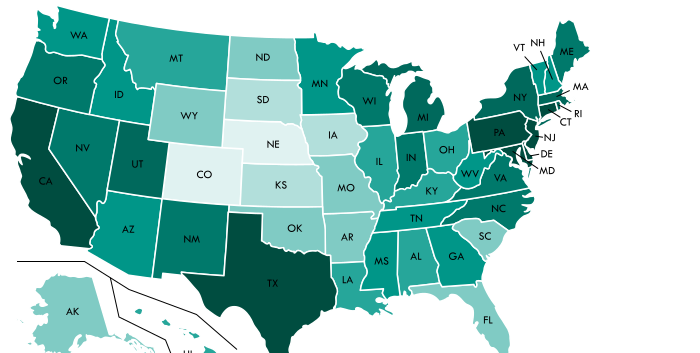
Most common states for market development managers
| Rank | State | Population | # of jobs | Employment/ 1000ppl |
|---|---|---|---|---|
| 1 | District of Columbia | 693,972 | 582 | 84% |
| 2 | Minnesota | 5,576,606 | 1,927 | 35% |
| 3 | Massachusetts | 6,859,819 | 2,334 | 34% |
| 4 | Montana | 1,050,493 | 334 | 32% |
| 5 | North Dakota | 755,393 | 211 | 28% |
| 6 | Wyoming | 579,315 | 164 | 28% |
| 7 | Washington | 7,405,743 | 1,980 | 27% |
| 8 | Oregon | 4,142,776 | 1,123 | 27% |
| 9 | Rhode Island | 1,059,639 | 274 | 26% |
| 10 | Utah | 3,101,833 | 782 | 25% |
| 11 | Nebraska | 1,920,076 | 489 | 25% |
| 12 | Alaska | 739,795 | 188 | 25% |
| 13 | Pennsylvania | 12,805,537 | 3,064 | 24% |
| 14 | Georgia | 10,429,379 | 2,519 | 24% |
| 15 | South Dakota | 869,666 | 212 | 24% |
| 16 | Vermont | 623,657 | 150 | 24% |
| 17 | Illinois | 12,802,023 | 2,946 | 23% |
| 18 | Virginia | 8,470,020 | 1,954 | 23% |
| 19 | New Mexico | 2,088,070 | 479 | 23% |
| 20 | Texas | 28,304,596 | 6,121 | 22% |
Most common cities for market development managers
| Rank | City | # of jobs | Employment/ 1000ppl | Avg. salary |
|---|---|---|---|---|
| 1 | Waltham | 3 | 5% | $114,673 |
| 2 | Bloomington | 3 | 4% | $104,801 |
| 3 | Benicia | 1 | 4% | $130,339 |
| 4 | Carlsbad | 3 | 3% | $115,828 |
| 5 | Eagan | 2 | 3% | $99,997 |
| 6 | Framingham | 2 | 3% | $114,818 |
| 7 | Annapolis | 1 | 3% | $124,644 |
| 8 | Baltimore | 6 | 1% | $124,752 |
| 9 | Atlanta | 3 | 1% | $102,911 |
| 10 | Charleston | 1 | 1% | $88,789 |
| 11 | Frederick | 1 | 1% | $124,399 |
| 12 | Boston | 3 | 0% | $114,786 |
| 13 | San Jose | 2 | 0% | $129,845 |
| 14 | Austin | 1 | 0% | $124,656 |
| 15 | Chicago | 1 | 0% | $96,588 |
| 16 | Dallas | 1 | 0% | $122,075 |
Market Development Manager job outlook: Expert opinions
Our panel of market development manager experts

University of Houston - Downtown
University of Saint Mary

University of West Georgia

The Pennsylvania State University
Berea College
What general advice would you give to a Market Development Manager?
Andrew Spicer: Resiliency is a particularly important skill for international business and career progression. Resiliency – the ability to recover quickly in the face of obstacles and failures – has always been a critical part of successful international assignments. The only constant of working abroad is that there will be miscommunication and mistakes. Successful international business careers depend on the ability to learn from these inevitable setbacks to improve over time. The constant change in the global business environment also leads to the demand for resiliency among international business specialists. An important role for those with a global mindset is to help companies adapt to the massive disruption to the global business environment for international trade and investment presently taking place across the world.
What will help Market Development Managers increase their earning potential?
Barbara Ribbens: Developing your poise and experience through college activities is essential beyond doing well in classes. Getting involved in student organizations, doing case competition teams, getting involved in consulting projects and taking on leadership roles are all good examples of ways to develop your skills. Doing a study abroad and an internship are both important steps to being ready to negotiate a good salary for that first job. Being able to clearly communicate your goals and how your experiences have prepared you for your career is key to successfully negotiating that first job and starting your career with a job that pays well and offers development opportunities.
Dr. Richard Conde Ph.D.
Assistant ProfessorUniversity of Houston - Downtown
Marilyn Davies College of Business
What soft skills should all Market Development Managers possess?
Dr. Richard Conde Ph.D.: The need for soft skills are consistent through time. With our societal focus on social media, texting, emojis, etc. It appears to me companies are looking for the following:
- Active listening skills
- Willingness to be self-reflective and accept feedback
- Accept different perspectives. The collision of ideas creates knowledge
- Communicate to the listener (at their level). Flex communicators
- Cultural intelligence. Demographics changes will require better understanding of team member's, boss', customer's, etc. cultural context
Dr. Mark Harvey Ph.D.
Associate Professor, Director of Graduate and Undergraduate Programs, Coordinator of All-University Honors ProgramUniversity of Saint Mary
Division of Business and Information Technologies (DBiT)
What soft skills should all Market Development Managers possess?
Dr. Mark Harvey Ph.D.: First, critical and creative thinking. Employers value problem solvers. A Business Development Managers' problem usually is finding growth opportunities. Candidates need to learn to take the initiative to figure out how to solve problems like those.
Second, writing. The best employees know how to communicate in writing. More and more communication occurs through email and other forms of social media and apps, and as such, this skill is absolutely critical. You don't need to be a creative writing genius, but you do need to know how to write in a professional tone, present your ideas in an organized way, get to the point, and avoid errors. There is a direct line between a student's ability to write an academic essay with a clear thesis and an employee's ability to write a good email or proposal. If you can't do those things, then you risk embarrassment and possibly limited options for promotion.
Third, speaking. The American business world discriminates against introverts-sometimes at their own peril. Everyone needs to know how to give a quality speech, but more importantly, you need to sound confident and assertive in a board room during meetings. You need to be confident in front of clients. Fake it if you have to. The way you present yourself is absolutely critical.
Fourth, social skills. You need to be friendly. Get to know co-workers and clients. Find out what they like and show an interest. Find common ground. Your undergraduate degree hopefully exposed you to a wide diversity of topics you may have thought were irrelevant at some point. Now is the time to remember that stuff and use it to connect with people. Nearly everything you learned will have some application someday. It will help you connect with others. In addition, put away your cell phone when you are at work or on social occasions. To some people, a preoccupation with a cell phone communicates a lack of interest in the person you are with. It can alienate bosses, co-workers, and clients.
What hard/technical skills are most important for Market Development Managers?
Dr. Mark Harvey Ph.D.: Familiarity with software-basic windows packages, particularly MS Word and Excel. Candidates should not be afraid of quantitative data analysis. Analytics are necessary to figuring out what your business is doing and how it can grow. Also, familiarity with whatever social media platforms are used in that industry can be very important.
What skills will help Market Development Managers earn the most?
Dr. Mark Harvey Ph.D.: One consideration is, does the position pay commission? If so, the soft skills listed above are extremely important because the more you apply those skills, the more likely you are to grow your business.
When a manager is not on commission, there's little correlation between skills and pay while doing the job. The employer will hire you at a given salary level, and it is your job to negotiate to the best position. Once they have chosen you-that's the moment when you have the most leverage. You will never get a raise that is as substantial as what you might be able to ask for upon hire. After that, most raises are not going to be tied mechanically to performance and skills. Your next chance at a raise will be when you move or are promoted to a new position. Thus, those soft skills can affect your ability to negotiate.
I will repeat a previous theme: education and experience are probably more important than skills in terms of making more money. An employer can't really tell what your skills are from your resume. Just because you say you have a skill doesn't mean that you really do. They can reasonably guess that somebody with a degree is responsible enough to have accomplished something big. Somebody who makes it through a graduate program is probably very good at what they know. And somebody who has been in the industry and/or in a similar job is more likely to be able to walk in with little orientation and know what they are doing. Employers take risks on employees and hope that they can deliver. Thus, with more education and more experience, you are able to apply for higher-level jobs, which usually come with higher salaries.
What skills stand out on Market Development Manager resumes?
Dr. Mark Harvey Ph.D.: Resumes are hard. It is very difficult to predict what any employer is looking for on any resume. The "skills" section of a resume is probably not the first thing most employers are looking at. The first consideration is probably education. Those with a bachelor's degree will be sorted first in fields-such as those who have business degrees, or particularly sales and marketing majors. Those with MBAs will be placed on the top. Those who have MBAs and marketing concentrations will likely be valued the most. The second consideration would probably be experience. Someone with several years of experience in business development or sales and marketing will be moved to the top. Someone with a bachelor's degree who has a lot of experience might beat out a fresh MBA. However, MBA plus experience beats almost everything. Someone with an MBA going for an entry-level position with little experience needed will likely beat out all bachelor challengers. For new graduates, getting some kind of internship in sales and marketing can differentiate them from those who do not.
Most hiring managers will probably assume that somebody who has sales and marketing education and/or experience probably has the skills necessary to do the job. An interviewer may probe on specific skills. I'll comment more specifically on other kinds of skills below, but it's also fair to say that a candidate's soft skills should shine in the interview. Simply saying that you have certain skills on a resume doesn't mean that you actually have them.
I think that the best thing a candidate can do is to research the company they hope to work for and tailor their resume to that employer. What does the business do? What kinds of things do you think that development manager is going to do in that particular industry? How do your skills as a candidate match what you guess they're looking for? The more you customize your resume, the better chances you have of resonating with the company. Employers are impressed when you already know something about the job and the industry.
Dr. Sooho Lee
Director, Master of Public Administration (MPA) Program, Professor of Public Administration and PolicyUniversity of West Georgia
Department of Civic Engagement & Public Service
What skills will help Market Development Managers earn the most?
Dr. Sooho Lee: It depends on the nature of the job. Generally speaking, analytical competence, communication, strategic planning, and leadership skills will greatly help one earn more.
James Wilkerson Ph.D.
Business Program Coordinator, Project and Supply Chain Management Program CoordinatorThe Pennsylvania State University
Business Department
What skills stand out on Market Development Manager resumes?
James Wilkerson Ph.D.: Skills, experience, knowledge, and abilities that matter especially strongly include target market analysis (including market research skills and knowledge), product/service positioning within competitive field, project work or coordination with sales staff, major client relationship management, and enough general business and industry knowledge to be able to relate business development to operational/production realities.
What soft skills should all Market Development Managers possess?
James Wilkerson Ph.D.: Verbal skills (both speaking and writing), negotiation skills, unfailing honesty, ability to empathize with clients' wants, and teamwork skills suitable for working collaboratively with sales and operations staff.
What hard/technical skills are most important for Market Development Managers?
James Wilkerson Ph.D.: Spreadsheet (Excel) skills (including graph production from data), basic statistical knowledge, and online information search skills.
What skills will help Market Development Managers earn the most?
James Wilkerson Ph.D.: Skill at rapidly learning market trends, relating business development to product development, and persuading major prospective clients when brought in to help with closing sales. Bottom line: the business development manager must be on the cutting edge of new market conditions and new business opportunities to help the firm organically grow its sales, especially in new markets or product/service lines.
J. Ian Norris Ph.D.
Professor of Marketing and Fellow, American Council on EducationBerea College
Economics and Business Department
What certifications/licenses/courses can have the biggest impact for Market Development Managers?
J. Ian Norris Ph.D.: Digital marketing skills are essential for any area of marketing. Luckily there are many online certifications available for this purpose. On the research side, Google Analytics offers a certification. It will also be valuable to know the analytics platforms on social media sites such as facebook, Instagram, and TikTok. Conversely, all of these sites also offer training on digital advertising and promotion, such as Google AdWords. Any coursework in digital marketing that provides instruction in Search Engine Marketing (SEM) will also be highly valuable. Finally, digital video and editing skills are also quite valuable, as all kinds of companies and organizations are using the short video format for storytelling and brand advertising.