
Automatically apply for jobs with Zippia
Upload your resume to get started.
Microstrategy developer skills for your resume and career
15 microstrategy developer skills for your resume and career
1. Dynamic Dashboards
- Created Customer behavior dynamic Dashboards and Spending pattern Scorecards involving graphs and statistical calculations.
- Created interactive Dynamic Dashboards and Scorecards for different users with drill down capabilities.
2. BI
- Identified improvement opportunities, defined and deployed BI improvements, including streamlining Business Intelligence processes.
- Defined, implemented and refined the BI solution development methodology based on industry best practices.
3. Templates
- Created standardized templates and documentation around reporting.
- Created MicroStrategy objects metrics, filters, prompts, templates, consolidations, transformations, and custom groups using MicroStrategy Desktop.
4. Schema
- Implemented application life cycle by copying and comparing application, schema, and configuration objects using MicroStrategy Object manager.
- Helped Lawson Financial System Support in troubleshooting and correcting schema defects and develop reports for inter-company consolidation reporting.
5. ETL
- Created logical views, table alias and role attributes in MicroStrategy to support the new requirements without ETL changes.
- Worked closely with DW ETL group to report data issues by providing new requirements for development and update.
6. SQL Server
- Created views in SQL Server and also logical views in MicroStrategy to support varying requirements from the business users.
- Assisted the company with migrating from MS SQL Server 2000 to SQL Server 2005 64-bit Edition.
Choose from 10+ customizable microstrategy developer resume templates
Build a professional microstrategy developer resume in minutes. Our AI resume writing assistant will guide you through every step of the process, and you can choose from 10+ resume templates to create your microstrategy developer resume.7. Data Analysis
- Analyzed the new projects and translated functional requirements into technical specifications and supported data analysis and validation.
- Performed data analysis and validation to ensure the development accuracy of MicroStrategy reports and dashboards.
8. PL/SQL
- Worked with Data Warehouse Architect to write Type-2 Dimension Incremental Loading test scripts using SQL and PL/SQL.
- Developed PL/SQL Business Functions, which were used with MicroStrategy Reports.
9. Data Warehouse
Data warehouse, often abbreviated as either DW or DWH is a system used in computing for data analysis as well reporting. The DW is also considered to be an integral component of business intelligence as they also provide storage facilities for both real-time and historical data. ETL and ELT are the two driving forces behind a data warehouse system.
- Experience in MicroStrategy metadata which is a repository to store MicroStrategy object definitions and information about your data warehouse.
- Planned historical data conversion, migration, validation and mapping to integrate data with existing data warehouse.
10. Teradata
- Worked with creating of views in TeraData.
- Analyze, design and build business intelligence solutions using MicroStrategy platform and databases technologies like Teradata.
11. Data Warehousing
- Project Name: Corner Stone MOC is a customized Data warehousing application based on micro Strategy tool and Oracle database.
- Used different data warehousing concepts for data mining techniques such as integrity constraint and indexing techniques for data storage.
12. Microstrategy Desktop
- Involved in developing complex reports Like Market Basket Analysis through MicroStrategy Desktop Created logical tables and aggregated tables/Views.
- Created Customized Auto Styles to allow reports in MicroStrategy Desktop and MicroStrategy Web to apply customized formats.
13. Visualization
- Designed and developed interactive Dashboards using out-of-box tools and advanced visualizations such as ESRI maps by integrating Visual Insights visualization.
- Developed suite of MicroStrategy dashboards that were rendered using Visual insights that enabled self-service visualization.
14. Microstrategy Web
- Developed and delivered business user training and workshops on MicroStrategy report development and MicroStrategy Web.
- Designed and deployed customized reports and Documents into MicroStrategy web.
15. Metadata
Metadata is a combination of two words, meta and data. Meta is a prefix defined as more comprehensive, and data means collection of data. Metadata is defined as the data that describes other data. It is used to summarize data about data to make the data easier to analyze.
- Identified and fixed a major Metadata corruption, which is happened due to inconsistency of MicroStrategy by directly contacting MicroStrategy support.
- Monitored and modified MicroStrategy environment configurations, data models, metadata, cubes and drill through reports to optimize performance.
5 Microstrategy Developer resume examples
Build a professional microstrategy developer resume in minutes. Browse through our resume examples to identify the best way to word your resume. Then choose from 5+ resume templates to create your microstrategy developer resume.

What skills help Microstrategy Developers find jobs?
Tell us what job you are looking for, we’ll show you what skills employers want.
List of microstrategy developer skills to add to your resume
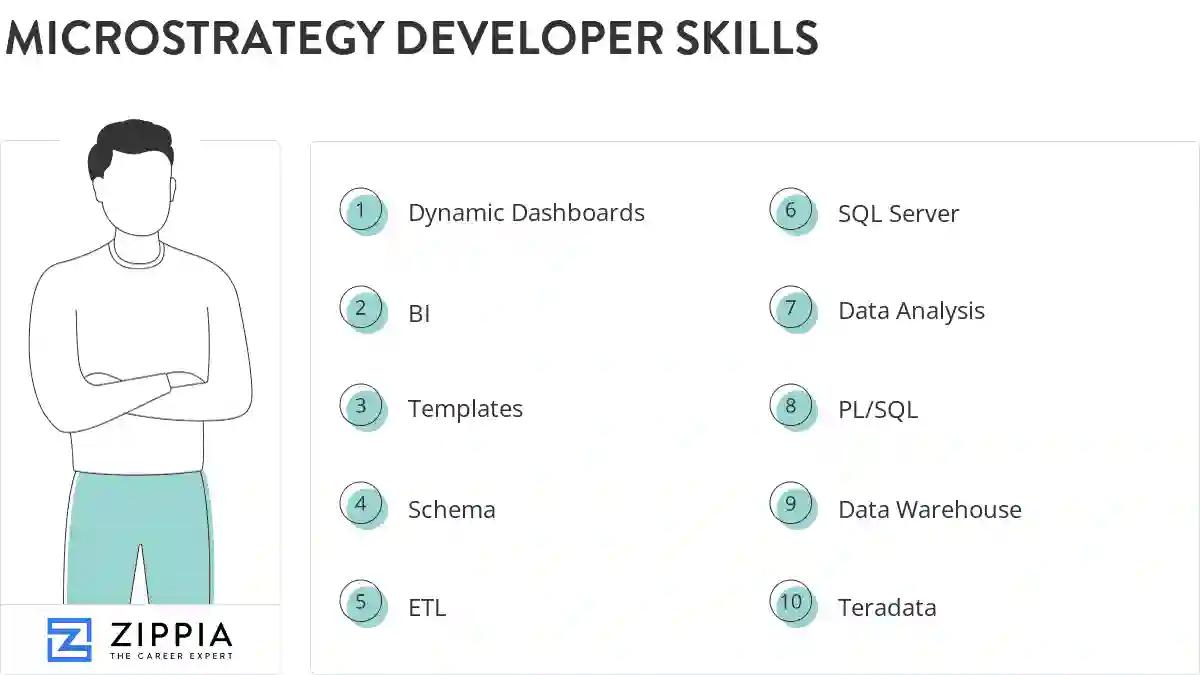
The most important skills for a microstrategy developer resume and required skills for a microstrategy developer to have include:
- Dynamic Dashboards
- BI
- Templates
- Schema
- ETL
- SQL Server
- Data Analysis
- PL/SQL
- Data Warehouse
- Teradata
- Data Warehousing
- Microstrategy Desktop
- Visualization
- Microstrategy Web
- Metadata
- Widgets
- Windows XP
- OLAP
- Ad-Hoc Reports
- Scorecards
- Report Development
- Informatica
- Production Environment
- Vldb
- SDK
- Application Objects
- QA
- UI
- Generate Reports
- Business Analysis
- Toad
- Logical Data Model
- UAT
- Java
- Snowflake
- Level Metrics
- Unix
- Interactive Dashboards
- HTML
- DB2
- Intelligent Cubes
- Oracle 10G
- Business Analysts
- Thresholds
- Oracle Sql
- Cache
- Security Filters
- Grid Reports
- Netezza
Updated January 8, 2025
