What does a mine engineer do?
A mining engineer specializes in planning and overseeing mining operations. Their responsibilities revolve around conducting extensive research and analysis in collaboration with other experts, designing methods and equipment, assessing risks, liaising with external agencies, and managing budgets. A mining engineer must also take part in creating safety policies and regulations, training the workforce, and developing solutions to any issues or concerns. Furthermore, it is essential to lead and encourage crews to reach goals, all while implementing the company's policies and regulations to maintain a safe and productive work environment.
Mine engineer responsibilities
Here are examples of responsibilities from real mine engineer resumes:
- Manage exploration RC drilling program in a remote location.
- Manage daily dragline operations and weekly repair schedules.
- Conduct time-and-motion studies and performance of truck-and-shovel analysis and efficiently allocate trucks to shovels and attain optimum productivity.
- Mine production 2 million TPY and 12 million CY excavate per year.
- Coordinate construction projects with independent contractors and performing altimeter ventilation surveys.
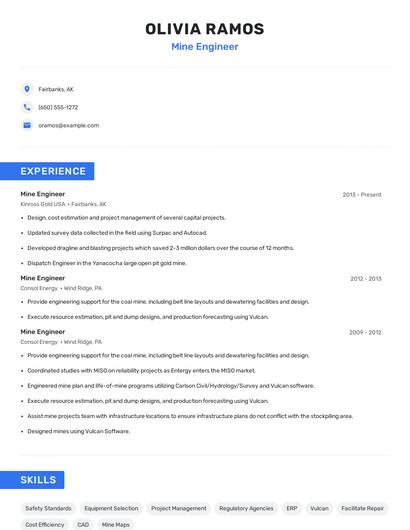
- Engineer mine plan and life-of-mine programs utilizing Carlson Civil/Hydrology/Survey and Vulcan software.
- Train new incoming geologist in RC logging.
- Create and update plant flow charts using AutoCAD.
- Maintain database of XRF values for determination of waste rock placement.
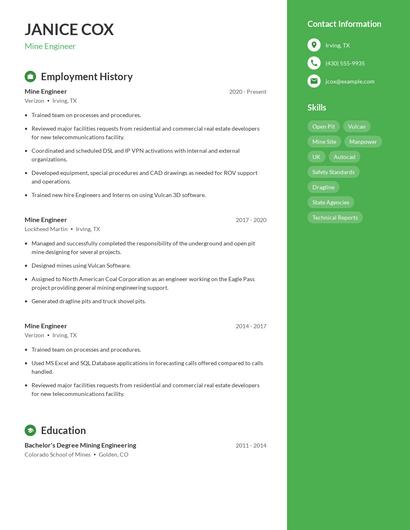
- Coordinate and schedule DSL and IP VPN activations with internal and external organizations.
- Execute resource estimation, pit and dump designs, and production forecasting using Vulcan.
- Identify RF and fix network upgrade requirements base on customer needs and system growth.
- Ensure compliance with various regulatory enforcement agencies: MSHA, EPA, TDEC, and TWRA.
- Mine engineering, surveying, and cad work for mining projects in southwestern Colorado and eastern Utah.
- Conduct daily production reports that consist of coal production, high wall miner production, and dragline production.
Mine engineer skills and personality traits
We calculated that 10% of Mine Engineers are proficient in Mine Planning, Ventilation, and Continuous Improvement. They’re also known for soft skills such as Writing skills, Problem-solving skills, and Analytical skills.
We break down the percentage of Mine Engineers that have these skills listed on their resume here:
- Mine Planning, 10%
Developed training programs for Indonesian Mining Engineers and technicians in engineering and short-term mine planning procedures.
- Ventilation, 10%
Conducted detailed ventilation studies of various underground mines using a computer model.
- Continuous Improvement, 7%
Implement continuous improvement projects for the engineering function.
- Project Management, 5%
Provided project management for a flood control structure involving contractors and mine employees.
- Safety Standards, 5%
Develop safety standards and procedures for underground operations and surface projects
- MSHA, 4%
Coordinated development of updated training materials for refuge alternatives to comply with new MSHA regulations.
Most mine engineers use their skills in "mine planning," "ventilation," and "continuous improvement" to do their jobs. You can find more detail on essential mine engineer responsibilities here:
Writing skills. To carry out their duties, the most important skill for a mine engineer to have is writing skills. Their role and responsibilities require that "mining and geological engineers must prepare reports and instructions for other workers." Mine engineers often use writing skills in their day-to-day job, as shown by this real resume: "ground control tours with contractor and writing up weekly report with follow-ups concrete recipe development for waste backfill strength and cost savings"
Problem-solving skills. Another essential skill to perform mine engineer duties is problem-solving skills. Mine engineers responsibilities require that "mining and geological engineers must explore for potential mines, plan their operations and mineral processing, and design environmental reclamation projects." Mine engineers also use problem-solving skills in their role according to a real resume snippet: "designed innovative solutions for remnant mining to optimize ore extraction. "
Analytical skills. mine engineers are also known for analytical skills, which are critical to their duties. You can see how this skill relates to mine engineer responsibilities, because "mining and geological engineers must take many factors into account when evaluating new mine locations and designing facilities." A mine engineer resume example shows how analytical skills is used in the workplace: "updated survey data collected in the field using surpac and autocad. "
The three companies that hire the most mine engineers are:
- Barrick Gold5 mine engineers jobs
- WorleyParsons5 mine engineers jobs
- Freeport-McMoRan4 mine engineers jobs
Choose from 10+ customizable mine engineer resume templates
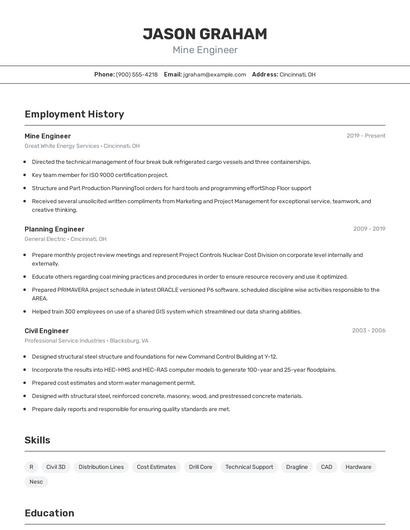
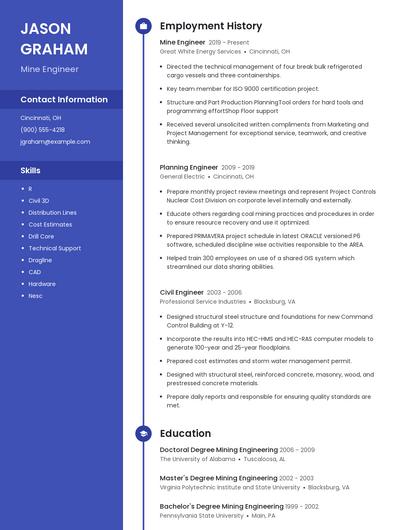
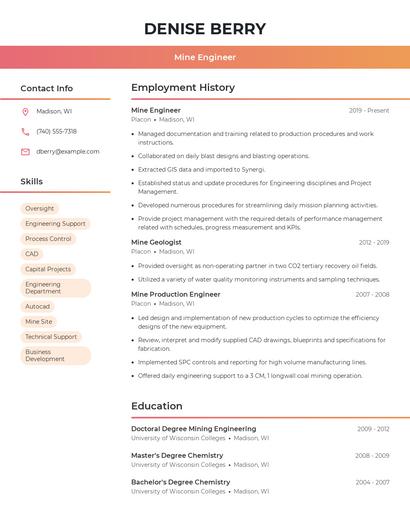
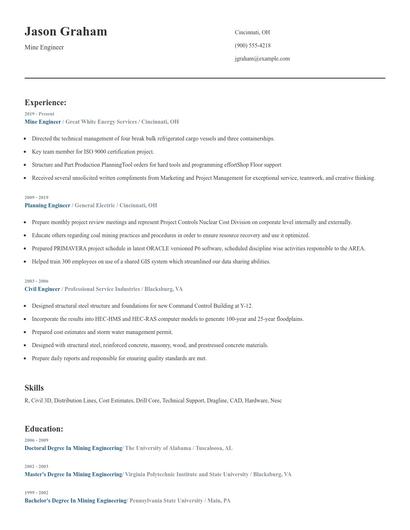
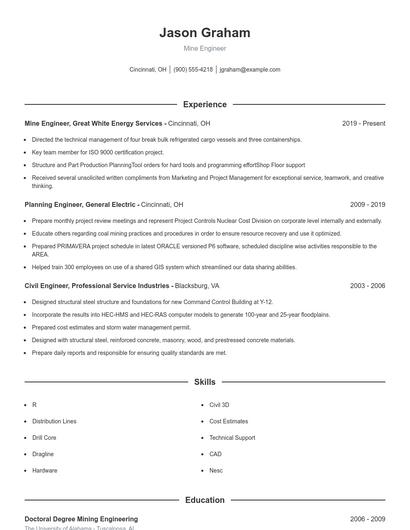
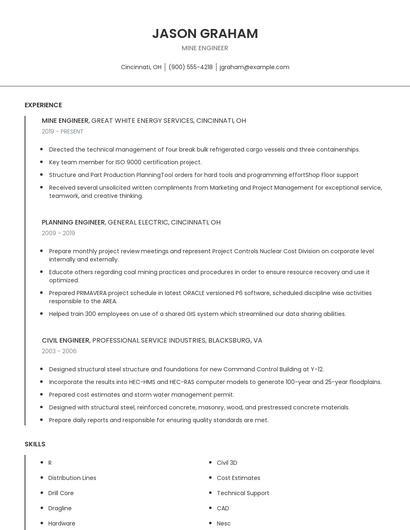
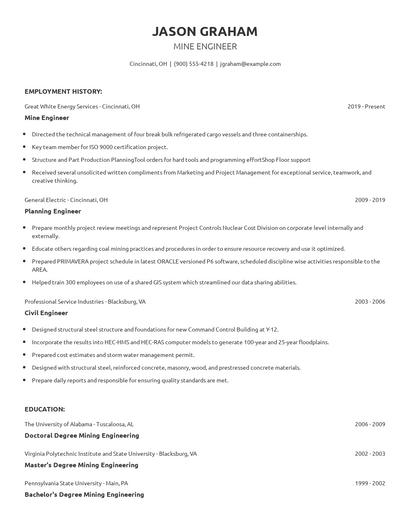
Build a professional mine engineer resume in minutes. Our AI resume writing assistant will guide you through every step of the process, and you can choose from 10+ resume templates to create your mine engineer resume.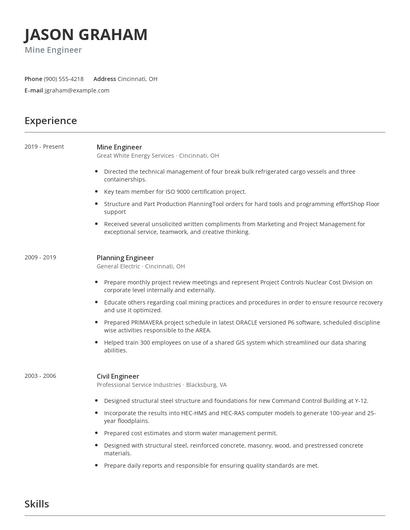
Compare different mine engineers
Mine engineer vs. Geological manager
There are some key differences in the responsibilities of each position. For example, mine engineer responsibilities require skills like "mine planning," "ventilation," "continuous improvement," and "project management." Meanwhile a typical geological manager has skills in areas such as "qc," "petra," "development programs," and "google earth." This difference in skills reveals the differences in what each career does.
The education levels that geological managers earn slightly differ from mine engineers. In particular, geological managers are 9.9% more likely to graduate with a Master's Degree than a mine engineer. Additionally, they're 3.6% more likely to earn a Doctoral Degree.Mine engineer vs. Mining consultant
In addition to the difference in salary, there are some other key differences worth noting. For example, mine engineer responsibilities are more likely to require skills like "ventilation," "continuous improvement," "project management," and "safety standards." Meanwhile, a mining consultant has duties that require skills in areas such as "sas," "financial models," "sql server," and "relational databases." These differences highlight just how different the day-to-day in each role looks.
Average education levels between the two professions vary. Mining consultants tend to reach higher levels of education than mine engineers. In fact, they're 8.2% more likely to graduate with a Master's Degree and 3.6% more likely to earn a Doctoral Degree.Mine engineer vs. Mine safety director
The required skills of the two careers differ considerably. For example, mine engineers are more likely to have skills like "mine planning," "ventilation," "continuous improvement," and "project management." But a mine safety director is more likely to have skills like "breakthrough strategies," "safety program," "epa," and "cold calls."
When it comes to education, mine safety directors tend to earn higher degree levels compared to mine engineers. In fact, they're 10.1% more likely to earn a Master's Degree, and 1.5% more likely to graduate with a Doctoral Degree.Mine engineer vs. Mine safety manager
Types of mine engineer
Updated January 8, 2025
