
Automatically apply for jobs with Zippia
Upload your resume to get started.
Mixer skills for your resume and career
15 mixer skills for your resume and career
1. Basic Math
- Perform basic mathematical calculations as needed to ensure product quantities are accurately packaged.
- Used basic math skills including fractions to calculate quantities of ingredients for partial batches.
2. Math
- Use extreme attention to detail due to handling liquid nicotine using syringes and strict math ratios.
- Used math skills to calculate ingredient levels for mixing cakes, pies, candy bars.
3. Mixers
- Mixed Silicone Caulk by measuring (weighing) different materials and operating Silicone Mixers.
- Operate machinery such as mixers, dough roller, cutter and conveyor belts.
4. Safety Procedures
Safety procedures are a set of standardized procedures, that ensures minimal to no risk to people, resources, and the work environment. A company follows the step-by-step safety procedures as it they not only keep the customers and the employees safe, but also help in avoiding legal claims.
- Followed all Safety Procedures as outlined by Orion Foods.
- Followed all GMP's and Safety Procedures as outlined by Mondelez/ Kraft Bakery.
5. Production Schedules
The project plan of a film or a documentary that highlights how a production budget will be spent over a given period until its completion is called a production schedule. The scheduling process starts with writing and analyzing the script, which is then broken down to determine and allocate the budget for each scene. The production schedule also includes several elements of the film including; cast actors, special effects, wardrobe, special equipment, stunts, extras, silent bits, production equipment, and many others.
- Executed daily mixing operations via production schedule.
- Work according to a tight production schedule that sets quotas for how many of a particular item they must produce each.
6. Lot Numbers
- Record lot numbers for ingredient verification.
- Record lot numbers and keep accurate records regarding ingredient additions, temperatures and proof time.
7. GMP
GMP stands for Good Manufacturing Practice. It is a system that ensures that all products like food, beverages, and medicinal drugs that are produced comply with the quality standards. It helps in minimizing the risks and hazards that cannot be eliminated after the testing of final products.
- Adhered to GMP (Good Manufacturing Practice) for FDA compliance.
- Follow all GMP'S and SOP'S.
8. Pallet Jack
- Mixed and prepared recipes for the line, inventory and stock, used pallet jacks and walk behind fork lifts.
- Operate and inspect heavy equipment, electric pallet jack, sit down forklift and manual pallet jack
9. Dividers
- Prepare mixes and keep full both dividers of dough.
10. Quality Standards
Quality standards are a specific level of standards of products that are set by the companies for the customers that have to be met and maintained throughout the process until the time of delivery. Quality standards are information that includes the customer's requirements, guidelines, and characteristics for the needed final product or service.
- Follow guidelines to mass produce high volumes of product to company quality standards, while maintaining efficiency.
- Maintained quality standards and safe and clean working environment.
11. Product Quality
Product quality is the basic element of a business. It means to add features in a product or service in such a way that it meets the needs and wants of the customers. Enhancing the product quality also means improve the goods from any existing defects to ensure customer satisfaction.
- Managed product quality to guarantee compliance with quality polices, procedures and systems.
- Assist in ensuring and maintaining management's efforts in product quality improvement.
12. Safety Regulations
- Filled orders and checked products to ensure accuracy and quality according to food safety regulations.Excellent references available upon request
- Adhere to all safety regulations by handling materials according to company regulations.
13. PPE
Personal protective equipment is an item of protective clothing such as goggles, helmets, or other garments meant to protect the body from injury.
- Required to use proper PPE when needed.
- Worked in appropriate personal protective equipment (PPE).
14. CIP
A Capital Improvement Plan (CIP) is a planning tool used to coordinate the timing and financing of capital improvements over a period of several years. It helps organizations make good budget decisions for large projects and purchases based on objectives and resources. The purpose of a CIP is to identify capital improvement projects, identify and forecast funding sources, prioritize improvements based on available funds, and estimate a timeline for completing the improvements.
- Position: Mix maker, CIP
- Operated double mixer (pasteurizing) In charge of all CIP and koshering of facility.
15. Computer System
- Monitored computer systems for malfunction alarms, cleaning the machines when build-up occurred.
- Used a computer system and software to produce the final product.

What skills help Mixers find jobs?
Tell us what job you are looking for, we’ll show you what skills employers want.
List of mixer skills to add to your resume
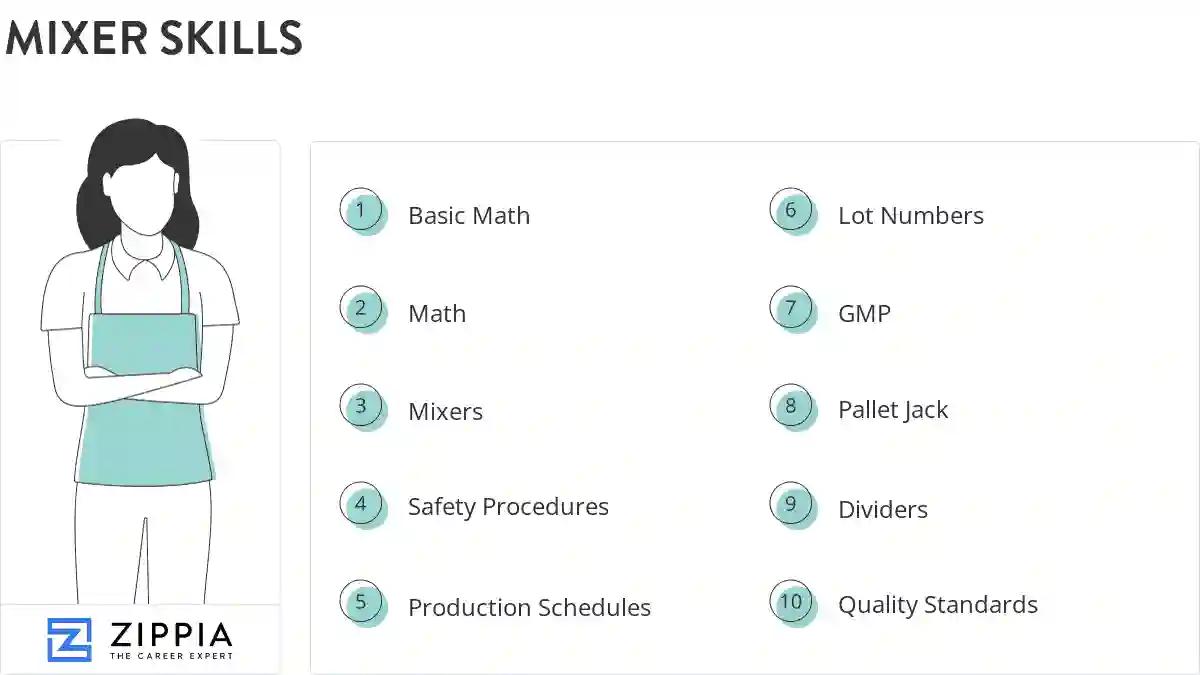
The most important skills for a mixer resume and required skills for a mixer to have include:
- Basic Math
- Math
- Mixers
- Safety Procedures
- Production Schedules
- Lot Numbers
- GMP
- Pallet Jack
- Dividers
- Quality Standards
- Product Quality
- Safety Regulations
- PPE
- CIP
- Computer System
- Batch Sheets
- QA
- FDA
- Blend Ingredients
- Test Results
- Production Lines
- Measure Ingredients
- Assembly Line
- Extruders
- Production Data
- Mix Ingredients
- QC
- Extrusion
- Mathematics
- Lockout Tagout
- Dry Ingredients
- Measure Materials
- USDA
- Ice Cream
- Fork Trucks
- Scoops
- Test Data
- Test Equipment
- Tow Motor
- Mix Chemicals
Updated January 8, 2025
