
Automatically apply for jobs with Zippia
Upload your resume to get started.
Mixer operator skills for your resume and career

15 mixer operator skills for your resume and career
1. Math
- Solve math equations quickly and accurately without calculator.
- Demonstrated mechanical abilities and shop math skills, used logic or a specific method to solve problem.
2. Food Safety
- Follow food safety guidelines, follow personal safety guidelines.
- Machine operator, power tool operation, packaging, food safety and handling, and general maintenance.
3. Cleanliness
- Maintain a high standard of cleanliness.
- Maintained cleanliness in the manufacturing area.
4. Production Schedules
The project plan of a film or a documentary that highlights how a production budget will be spent over a given period until its completion is called a production schedule. The scheduling process starts with writing and analyzing the script, which is then broken down to determine and allocate the budget for each scene. The production schedule also includes several elements of the film including; cast actors, special effects, wardrobe, special equipment, stunts, extras, silent bits, production equipment, and many others.
- Make sure all production runs meet expected quantities according to the production schedule.
- Read daily production schedule and process orders in the established sequence.
5. Basic Math
- Perform basic mathematical calculations as needed to ensure product quantities are accurately packaged.
- Perform basic math functions (addition, subtraction, multiplication, division, and fractions).
6. Mixers
- Clean Racks, Trays, Hoppers, Blenders, High Shear mixers and related equipment of mixing and blending area.
- Operate mixers and other machinery for the mass cake baking process - Attend weekly safety meetings and strive for zero injuries
Choose from 10+ customizable mixer operator resume templates
Build a professional mixer operator resume in minutes. Our AI resume writing assistant will guide you through every step of the process, and you can choose from 10+ resume templates to create your mixer operator resume.7. Safety Rules
Principles or regulations that ensure the protection of people, objects, or the environment are called safety rules. These rules can be governing actions, devices, or procedures that help in minimizing the risks of loss, injury, or damage.
- Understand and follow plant safety rules, including wearing of PPE, safe lifting techniques, safe machine operation.
- Experience with operating a forklift and electric pallet jack in which all safety rules were applied.
8. Quality Standards
Quality standards are a specific level of standards of products that are set by the companies for the customers that have to be met and maintained throughout the process until the time of delivery. Quality standards are information that includes the customer's requirements, guidelines, and characteristics for the needed final product or service.
- Maintained quality standards by verifying weight and contents of raw materials in warehouse bakery.
- Produced product that was scheduled to meet customer demand and quality standards.
9. GMP
GMP stands for Good Manufacturing Practice. It is a system that ensures that all products like food, beverages, and medicinal drugs that are produced comply with the quality standards. It helps in minimizing the risks and hazards that cannot be eliminated after the testing of final products.
- Mix operator of Wish Bone salad dressings and Unilever brand spices and blends following all GMP's.
- Fork lift certified, Lock out-tag out trained, Observe GMP protocol.
10. Safety Procedures
Safety procedures are a set of standardized procedures, that ensures minimal to no risk to people, resources, and the work environment. A company follows the step-by-step safety procedures as it they not only keep the customers and the employees safe, but also help in avoiding legal claims.
- Machine maintenance and enforcing FDA regulated safety procedures and equipment.
- Operated and worked around heavy equipment and followed safety procedures.
11. CIP
A Capital Improvement Plan (CIP) is a planning tool used to coordinate the timing and financing of capital improvements over a period of several years. It helps organizations make good budget decisions for large projects and purchases based on objectives and resources. The purpose of a CIP is to identify capital improvement projects, identify and forecast funding sources, prioritize improvements based on available funds, and estimate a timeline for completing the improvements.
- Pull up ingredients to make products, clean CIP tanks in preparation for new products, and clean Kosher tanks.
- Operate CIP processing equipment according to Quality system procedures.
12. PPE
Personal protective equipment is an item of protective clothing such as goggles, helmets, or other garments meant to protect the body from injury.
- Trained in proper PPE, Job Hazard Analysis, Safe Operating Procedures, and Lock Out Tag Out.
- Maintain a clean and safe work area at all time, And proper use of my PPE
13. Product Quality
Product quality is the basic element of a business. It means to add features in a product or service in such a way that it meets the needs and wants of the customers. Enhancing the product quality also means improve the goods from any existing defects to ensure customer satisfaction.
- Analyzed incoming product to determine appropriate temperature and content, made decisions to accept or reject, ensuring end product quality.
- Performed testing of dry and liquid producers to ensure product quality.
14. Quality Checks
Quality checks are a component of quality control aimed at ensuring that quality requirements are met. Internally, quality checks provide assurance to managers, and externally, it provides assurance to clients, federal departments, authorities, and certifiers.
- Mixed product, trained new operators, program batches, maintain paperwork, and perform quality checks on product.
- Operate Bosch machine, trained new operators, perform quality checks, and maintain paperwork.
15. Batch Sheets
- Produced and maintained required process documentation including batch sheets, operating logs, and system checks as required by management.
- Filled out batch sheet daily with the correct numbers listed on the ingredients bags or box.
5 Mixer Operator resume examples
Build a professional mixer operator resume in minutes. Browse through our resume examples to identify the best way to word your resume. Then choose from 5+ resume templates to create your mixer operator resume.

What skills help Mixer Operators find jobs?
Tell us what job you are looking for, we’ll show you what skills employers want.
List of mixer operator skills to add to your resume
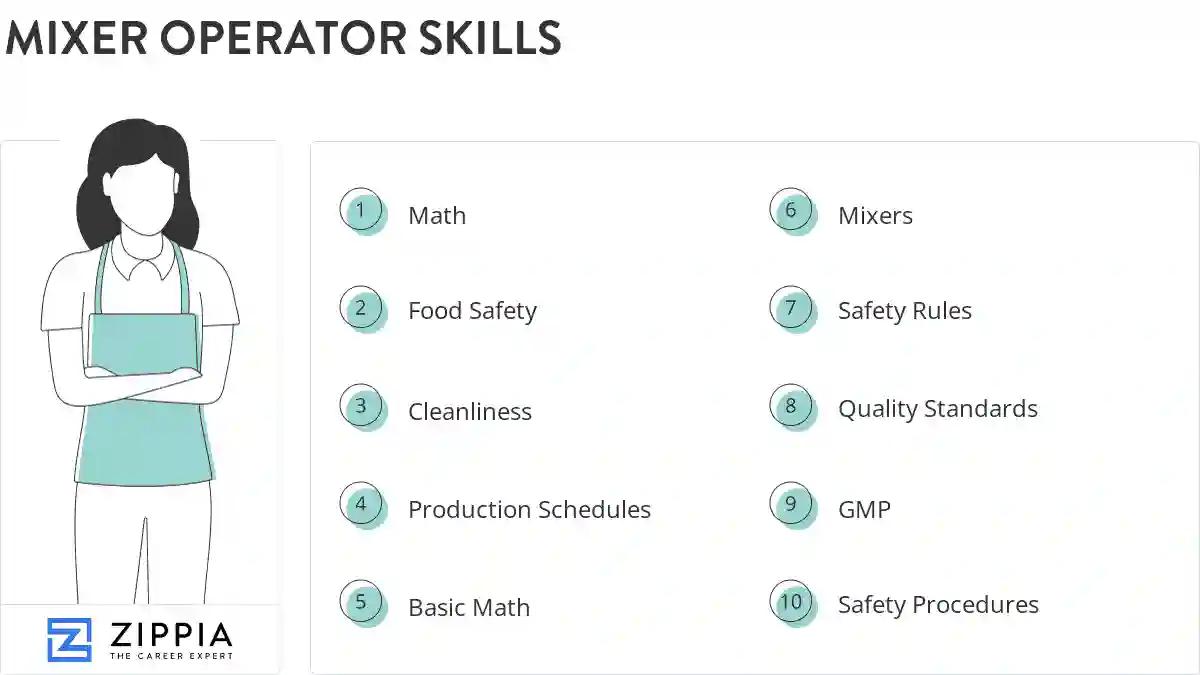
The most important skills for a mixer operator resume and required skills for a mixer operator to have include:
- Math
- Food Safety
- Cleanliness
- Production Schedules
- Basic Math
- Mixers
- Safety Rules
- Quality Standards
- GMP
- Safety Procedures
- CIP
- PPE
- Product Quality
- Quality Checks
- Batch Sheets
- Pallet Jack
- Extruders
- Lot Numbers
- QA
- Control Panels
- Lockout Tagout
- Safety Standards
- Dividers
- HACCP
- PLC
- Dry Ingredients
- PVC
- Processing Equipment
- Extrusion
- Measure Materials
- FDA
- Production Equipment
- Safety Guidelines
- Production Processes
- Blend Ingredients
- Production Data
- Measure Ingredients
- General Maintenance
- Safety Regulations
- USDA
- Scoops
- Test Results
- Production Lines
- Assembly Line
- Machine Operation
- ISO
- Augers
- Respirators
Updated January 8, 2025
