
Automatically apply for jobs with Zippia
Upload your resume to get started.
Model engine mechanic skills for your resume and career
15 model engine mechanic skills for your resume and career
1. C++
C++ is a general-purpose programming language that is used to create high-performing applications. It was invented as an extension to the C language. C++ lets the programmer have a high level of domination over memory and system resources. C++ is an object-oriented language that helps you implement real-time issues based on different data functions
- Develop framework allowing easy creation of new GUI and reusable control clusters (C++, M-language).
- Used both C++ and SQL skills to integrate clients, investigate data, and build predictive collectibility models.
2. Linux
Linux is a Unix-like operating system. Just like Windows, Mac OS, and IOS, Linux is an operating system used by millions across the globe. Android itself is powered by the Linux operating system. Linux manages all the hardware resources that are associated with your computer. The software is famous because of the protection it grants from viruses, malware, and crashes. The Linux operating system is entirely free and is an open-source software meaning it can be altered by those equipped with the knowledge to code.
- Developed softw are for Monte Carlo agent-based modeling and simulation of biological systems; used Objective-C SWARM ( under Linux).
- Supported customers on embedded or carrier grade systems to enable features provided in MontaVista Linux distribution.
3. LS-DYNA
- Performed low velocity LS-DYNA dynamic simulation to validate the response of 3/2 CARALL FMLs subjected to impact loading.
4. Prototyping
- Provide in-person supervisions and engineering modifications to technicians and lab personnel for prototyping builds, assembly, integration and testing.
- Monitored the latest innovations related to product development, including new component technologies, materials, manufacturing and prototyping processes.
5. In-House
- Shop drawings were used for in-house duct fabrication on a per project necessity.
- Shop drawings used for in-house duct fabrication and pipe spooling.
6. CATIA
- Utilized AutoCAD and Solid Works for drafting, learned CATIA for other engineering.
- Used CATIA V4/V5, Autodesk Inventor 9, and AutoCAD 2005.
7. Technical Reports
Technical reports are a type of document that is used to indicate either the progress, result, or process of scientific research or the state of problems occurring within such research. A technical report may also showcase the report's overall conclusion and may also include recommendations. This kind of report does not require a peer review and isn't published officially but distributed within the organizations where it was formed.
- Collected experimental data, performed statistical analyses, prepared graphs, and documented technical reports
8. Product Development
Product development is the complete procedure of creating a product from concept until release of the final product. Product development has many stages after which a product is released into the market. Identifying the need, creating the opportunity, conceptualizing a product, and providing a solution, all are different stages of product development.
- Coordinate efforts in a cross functional team environment interfacing with Purchasing, Manufacturing, Marketing, Industrial Design during product development.
- Simplified product development lead time by involving purchasing and manufacturing departments earlier in the design process and eliminating non-value added steps.
9. Fluid Dynamics
- Served as computational fluid dynamics engineer.
10. MATLAB
- Calculated electrical requirements using MATLAB, and determined the best material and manufacturing processes.
- Compare simulated and measured data using MATLAB for spectral power density analysis.
11. Profiling
- Utilized polymorphism, memory management and divide/conquer algorithm to drive 380% performance improvement measured by profiling tool (Valgrind).
12. Revit
Revit, also known as Autodesk Revit, is computer software used by architects, structural engineers, and designers to perform building modeling tasks. Revit was designed to facilitate users, draw building modeling structures in a 2D and 3D format. Creating such models allows architects and engineers to pre-planning, scheduling, estimating the life of the structure and the entire cost of construction.
- Create 3D drawings, using Revit, of Water Treatment plants in Peoria and Gilbert.
- Licensed 2015 AutoCAD, Civil 3D, Revit Structure.
13. BIM
BIM or Building Information Modelling is a process in which buildings, infrastructure, and other physical structures and places are translated into digital means, into various forms of computer files, 3D models, and digital plans.
- Provided clash detection support for electrical contractor during BIM coordination meetings for major new construction project.
- Coordinated with BIM managers and team consultants including architectural, structural, civil, and electrical to accommodate mechanical requirements.
14. CFD
CFD is the study and analysis of liquid flows by the use of numbers solution methods. The various fields involved include hydrodynamics and aerodynamics.
- Performed CFD analysis on various farm and construction vehicle systems including external and under-hood simulations.
- Completed a certification training in CFD
15. R
R is a free software environment and a language used by programmers for statistical computing. The R programming language is famously used for data analysis by data scientists.
- Developed an SPC program that performed X bar and R charts for implementing six sigma quality standards.
- Led trades studies for Antenna T/R placement, controller placement, EVA UHF patch antenna placement.

What skills help Model Engine Mechanics find jobs?
Tell us what job you are looking for, we’ll show you what skills employers want.
What skills stand out on model engine mechanic resumes?
Charles Jenckes
Assistant Professor, University of North Carolina at Charlotte
1.Where the candidate went to school and what was studied
2.GPA
3.Any successful internships
4.Projects completed by the student
What model engine mechanic skills would you recommend for someone trying to advance their career?
Dr. Yousef Sardahi
Associate Professor of Mechanical Engineering, Marshall University
Advanced Computational Skills: Proficiency in simulation and modeling software (like ANSYS, SolidWorks, or MATLAB) will be crucial as these tools become more integral in designing and testing complex systems.
Robotics and Automation: With industries moving towards automation, skills in robotics, automated systems, and knowledge of AI integration will be highly sought after.
Additive Manufacturing and 3D Printing: Expertise in 3D printing and additive manufacturing techniques will be valuable as these technologies revolutionize product development and manufacturing processes.
Renewable Energy Technologies: As the world shifts towards sustainable energy sources, mechanical engineers with knowledge in solar, wind, and other renewable energy technologies will be in high demand.
Data Analysis and IoT: Skills in data analytics and understanding the Internet of Things (IoT) will be important as more mechanical systems are connected and produce large amounts of data.
Materials Science: Knowledge in advanced materials, such as composites or smart materials, will be crucial for developing more efficient and sustainable products and systems.
Systems Engineering and Integration: The ability to understand and integrate various subsystems within a larger system will be key, especially in complex projects.
Project Management and Leadership: As projects become more complex, skills in project management and leadership will be essential for overseeing projects and leading teams effectively.
Interdisciplinary Collaboration: The ability to work effectively across disciplines, understanding aspects of electrical engineering, computer science, and even business, will be increasingly important.
Communication and Soft Skills: Strong communication skills, both for technical and non-technical audiences, along with teamwork and problem-solving skills, will always be invaluable in the engineering field.
What hard/technical skills are most important for model engine mechanics?
Mike DeVore Ph.D.
Professor & Program Chair, Cincinnati State Technical & Community College
-Knowledge of manufacturing processes
-A good mathematics foundation
-Technical communication
-Problem solving
List of model engine mechanic skills to add to your resume
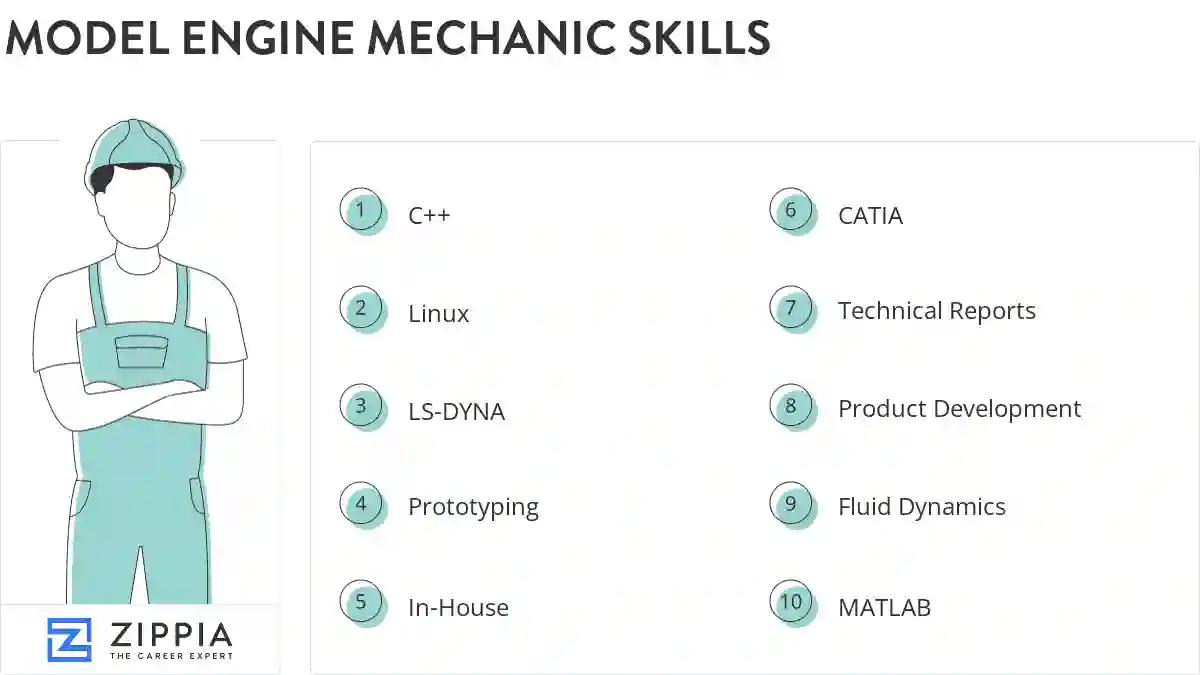
The most important skills for a model engine mechanic resume and required skills for a model engine mechanic to have include:
- C++
- Linux
- LS-DYNA
- Prototyping
- In-House
- CATIA
- Technical Reports
- Product Development
- Fluid Dynamics
- MATLAB
- Profiling
- Revit
- BIM
- CFD
- R
- HVAC
- Mass Production
- EMS
- Cost Reduction
- BOM
- Design Changes
- ECO
- Data Collection
- Design Reviews
- CNC
- Quality Checks
- Management System
Updated January 8, 2025
