
Automatically apply for jobs with Zippia
Upload your resume to get started.
Network design engineer skills for your resume and career
15 network design engineer skills for your resume and career
1. Network Design
- Integrated tenant network enclaves using OSPF/BGP using redundant design solutions minimizing network downtime and providing sustainable network design.
- Designed and implemented customer call-center support procedures and customer network design strategy for sales and marketing teams.
2. Switches
- Configured and activated Cisco routers and switches for new customer installation and troubleshooting.
- Worked closely with Cisco switches, routers, VPN, Firewalls and several of other type or peripheral equipment and software.
3. Juniper
Juniper Networks, Inc. develops and markets networking products and software which include routers, network management software, and network security products. Many large enterprises use Juniper products and software as part of their larger networking operating management suite.
- Experience and CLI understanding of JUNOS due to responsible for investigating traffic flow through the Juniper core.
- Developed new conversion plan documentation for global Cisco and Juniper routers for HDLC to MLPPP cell conversion.
4. Routers
A router is a device that gives a computing device the capability to connect to the internet and transfer data between different devices whether at a home or office. It may include several network ports to connect many devices at one go.
- Supervised implementation of Cisco routers to run OSPF over corporate enterprise backbone.
- Developed wiring/design standards for cell site aggregate routers within Cricket.
5. Network Infrastructure
- Managed network infrastructure projects and communication between IT and business partners to achieve high customer satisfaction
- Re-designed telecommunications and designed new network infrastructure to include WAN for other hospital remote locations.
6. Troubleshoot
Troubleshooting is the process of analyzing and fixing any kind of problem in a system or a machine. Troubleshooting is the detailed yet quick search in the system for the main source of an issue and solving it.
- Analyzed KPI's and PM counters using NPO, PCMD and MapInfo tools to troubleshoot and optimize the Sprint network performance.
- Coordinated and work with internal technicians and external service providers/engineers to test, accept, troubleshoot and resolve provision issues.
Choose from 10+ customizable network design engineer resume templates
Build a professional network design engineer resume in minutes. Our AI resume writing assistant will guide you through every step of the process, and you can choose from 10+ resume templates to create your network design engineer resume.7. QoS
- Raised productivity and number of car rentals, by designing and implementing a model for end-to-end QoS.
- Provided on-site consulting and knowledge transfer related to L2, L3, QoS and MPLS network.
8. BGP
The Border Gateway Protocol (BGP) is a procedure that facilitates the exchange of routing information among different networks connected through the internet. It also refers to the electronic language used among internet routers, to determine how a piece of information is sent from one router to the other over the network. This process is extremely quick that occurs within mini-seconds, enabling the internet to function properly.
- Developed and implemented policy based filtering strategies (BGP community and RPSL/IRR for traffic engineering) with peers.
- Configured BGP to establish mutually agreed upon peering links to other autonomous tier 1 network providers.
9. MPLS
- Involved in designing a MPLS network liaising with other ISP's and part of the network team for IP deployment.
- Designed and upgraded remote site networks and WAN connections utilizing MPLS, Frame relay, Point-to-Point, and ATM circuits.
10. OSPF
- Used OSPF as an internal LAN routing protocol that was redistributed into EBGP to Verizon Wan Service Provider.
- Redesigned and implemented a new OSPF scheme for existing and future OSPF areas.
11. Lan Wan
- Work on different networking concepts and routing protocols like OSPF and other LAN WAN technologies.
12. TCP/IP
- Design and implementation of Networks using TCP/IP.
- Provided expert recommendations for TCP/IP,tuning to maximize theoretical loads through high latency, high bandwidth circuitry.
13. VPN
A Virtual Private Network, VPN encrypts a device's internet access, activity, and identity through a secure server, making data theft and third-party traceability more difficult, and increasing the privacy and security of public and private networks, the internet, and Wi-Fi hotspots. The VPN is designed to protect one's system and network from being compromised.
- Resolved communications issues between VPN endpoints, web servers, applications servers, and databases.
- Led the testing with Vendor for the VPN, networking and utilities requirement.
14. Capacity Planning
Capacity planning is the process or method that balances the available hours of team members against the project or program that they need to accomplish. It comprises the resources to do the work or project and the necessities to complete a particular task. Capacity planning assesses the resources and the skill of the team to decide whether to hire or purchase additional resources, defer or delay the project, push through with it or cancel the project.
- Performed data trending and network simulations to calculate over-subscription ratio and capacity planning in exiting IP backbone
- Performed circuit tracking, circuit design, and capacity planning/forecasting.
15. EIGRP
- Key contributions include troubleshooting of complex LAN connectivity issues that includes configuring and troubleshooting EIGRP.
- Provided Cisco Router Configuration Support along with installation, Configured EIGRP.
5 Network Design Engineer resume examples
Build a professional network design engineer resume in minutes. Browse through our resume examples to identify the best way to word your resume. Then choose from 5+ resume templates to create your network design engineer resume.

What skills help Network Design Engineers find jobs?
Tell us what job you are looking for, we’ll show you what skills employers want.
What network design engineer skills would you recommend for someone trying to advance their career?
Dr. Wayne Wakeland Ph.D.
Professor and Systems Science Program Chair, Portland State University
What type of skills will young network design engineers need?
Les Atlas
Professor, University of Washington
Thus specializations will become more important, both in terms of depth and fit to the needs of an employer. Advanced graduate degrees will become more necessary. It seems very likely that filed which help understand data for epidemiology and disease forecasting and geographical hotspots will continue to be especially pertinent.
List of network design engineer skills to add to your resume
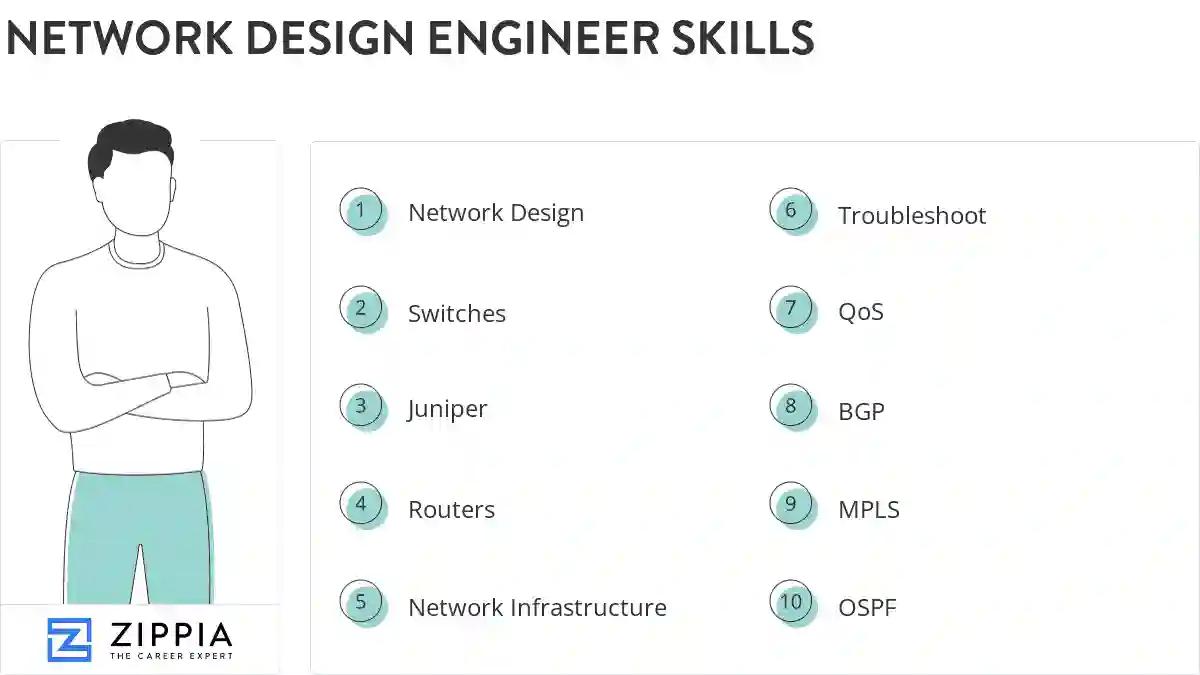
The most important skills for a network design engineer resume and required skills for a network design engineer to have include:
- Network Design
- Switches
- Juniper
- Routers
- Network Infrastructure
- Troubleshoot
- QoS
- BGP
- MPLS
- OSPF
- Lan Wan
- TCP/IP
- VPN
- Capacity Planning
- EIGRP
- Network Architecture
- Network Topology
- Visio
- Network Deployment
- Firewall
- IP
- VoIP
- DWDM
- Lan
- Network Troubleshooting
- RF
- Ethernet
- Network Performance
- DOD
- VLAN
- Emerging Technologies
- IPSEC
- DNS
- Technical Support
- Encryption
- F5
- IOS
- Fiber Optic
- Nexus
- ATM
- Provisioning
- Broadband
- Windows
- ASA
- SME
- HSRP
- DHCP
- Network Operations
Updated January 8, 2025
