
Automatically apply for jobs with Zippia
Upload your resume to get started.
Network operations analyst skills for your resume and career
15 network operations analyst skills for your resume and career
1. Network Operations
- Presided over troubleshooting of network operations problems related to customers and identifying appropriate solutions based on root cause analysis.
- Facilitated after Action Reviews for Network Operations teams supporting disaster response and recovery with regard to business continuity.
2. Troubleshoot
Troubleshooting is the process of analyzing and fixing any kind of problem in a system or a machine. Troubleshooting is the detailed yet quick search in the system for the main source of an issue and solving it.
- Coordinated outages with proper personnel to troubleshoot calls and engaged additional resources as needed to resolve service impacting events.
- Perform network evaluations and troubleshoot discrepancies while adhering to detailed company protocol.
3. Switches
- Isolated, troubleshot, resolved and documented various network issues affecting routers, hubs, switches, servers and communications circuits.
- Implemented networks by configuring switches, routers, and a server for the first exercise with our German Signal Battalion counterparts.
4. Linux
Linux is a Unix-like operating system. Just like Windows, Mac OS, and IOS, Linux is an operating system used by millions across the globe. Android itself is powered by the Linux operating system. Linux manages all the hardware resources that are associated with your computer. The software is famous because of the protection it grants from viruses, malware, and crashes. The Linux operating system is entirely free and is an open-source software meaning it can be altered by those equipped with the knowledge to code.
- Act as the team subject matter expert in support of the Linux application server environment.
- Verify that log files are being updated using Linux/Unix based command line.
5. Remedy
- Provide quality, timely and accurate end-to-end support of Remedy ticketing and notifications.
- Coordinate approvals from individual business units using Remedy and manual processes.
6. Routers
A router is a device that gives a computing device the capability to connect to the internet and transfer data between different devices whether at a home or office. It may include several network ports to connect many devices at one go.
- Produce documentation for installation of remote deployed Cisco routers.
- Selected to replace the VSAT backup with DSL connection and Cisco 1721 routers resolution related to zoning issues in metro locations.
Choose from 10+ customizable network operations analyst resume templates
Build a professional network operations analyst resume in minutes. Our AI resume writing assistant will guide you through every step of the process, and you can choose from 10+ resume templates to create your network operations analyst resume.7. NOC
NOC technicians supervise complex network elements that are responsible for network management. Daily they provide troubleshooting services while maintaining servers, networks, and telecom equipment of an organization. These technicians are the core support system of an IT function as they monitor administer, fix, and maintain client networks.
- Established comprehensive procedures for daily NOC operations encompassing basic operations and troubleshooting procedures.
- Created and managed training manuals for new NOC techs and lower level technicians on over 20 pieces of equipment and processes/procedures.
8. Technical Support
Technical support or tech support are the services provided by any hardware or software company to users. They help in solving the technical difficulties the customers face with their products or services. Moreover, the tech support employees maintain, manage, and repair the IT faults. They are also responsible for resolving the network problems, installing and configuring hardware and software.
- Provide engineering, technical support, supervision and formalized training to operators, field technicians/engineers and other MIS personnel.
- Provided reliable technical support with no direct supervision and monitoring internal platforms.
9. Customer Service
Customer service is the process of offering assistance to all the current and potential customers -- answering questions, fixing problems, and providing excellent service. The main goal of customer service is to build a strong relationship with the customers so that they keep coming back for more business.
- Collaborated and developed relationships with global, regional and local operations, business and IT stakeholders across Customer Services.
- Motivate individuals and teams to provide exceptional customer service.
10. TCP/IP
- FTP transmissions and TCP/IP connections verified, checked and restarted.
- Versed in Internet Protocols to include TCP/IP, HTTP, DNS and SMTP.
11. ITIL
- Manage incidents with ITIL v3 skills for all production problems for enterprise service that are monitored by Network Operation Center.
- Earned my Foundation Certification in ITIL.
12. Network Infrastructure
- Trained co-operative education students in level 1 troubleshooting, day to day operations and network infrastructure and technologies.
- Assisted enterprise level customers with software and network infrastructure including router/switch configurations and VPN setup.
13. VPN
A Virtual Private Network, VPN encrypts a device's internet access, activity, and identity through a secure server, making data theft and third-party traceability more difficult, and increasing the privacy and security of public and private networks, the internet, and Wi-Fi hotspots. The VPN is designed to protect one's system and network from being compromised.
- Designed business solutions based on the following services: VPN, Managed Services, Hosted Application Servers, VoIP and Messaging.
- Assisted 300 internal clients with technical issues including email, security, network access, virus infection, and VPN connectivity.
14. DOD
Definition of Done (DoD) is a set of deliverables that are needed to devise software. These deliverables are valuable to the system and can be exemplified by writing code, coding comments, unit testing, integration testing, design documents, release notes, and so on.
- Supported intelligence, Special Operations community, clandestine efforts, and SIGINT operations with specialized DoD signature reduction activities.
- Led several subordinates in training to achieve IAT Level II (CompTIA Security+) to satisfy DOD 8570.1 certification requirements.
15. SolarWinds
- Investigated service interruptions through the use of various network management tools, including SolarWinds Orion, and in house developed applications.
- Monitored WAN infrastructure with SolarWinds, RDP, SCOM, HPSIM, and Idera to identify and resolve issues.
5 Network Operations Analyst resume examples
Build a professional network operations analyst resume in minutes. Browse through our resume examples to identify the best way to word your resume. Then choose from 5+ resume templates to create your network operations analyst resume.

What skills help Network Operations Analysts find jobs?
Tell us what job you are looking for, we’ll show you what skills employers want.
What network operations analyst skills would you recommend for someone trying to advance their career?
Laura Kier
Network Design and Administration Instructor
List of network operations analyst skills to add to your resume
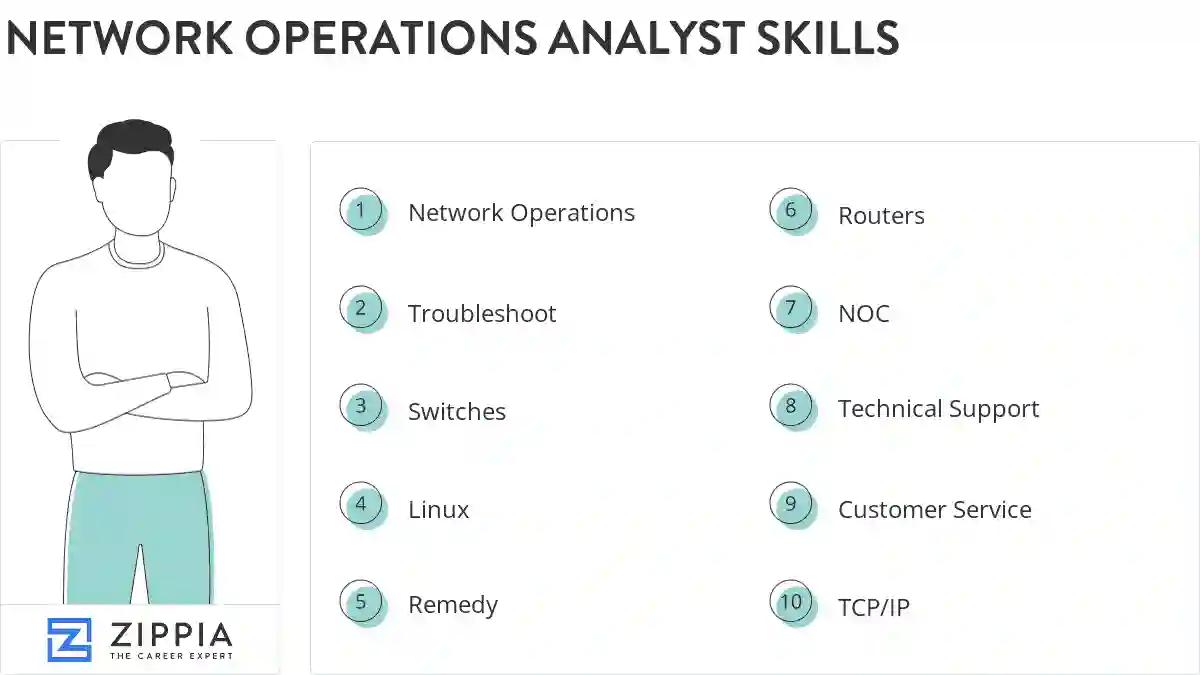
The most important skills for a network operations analyst resume and required skills for a network operations analyst to have include:
- Network Operations
- Troubleshoot
- Switches
- Linux
- Remedy
- Routers
- NOC
- Technical Support
- Customer Service
- TCP/IP
- ITIL
- Network Infrastructure
- VPN
- DOD
- SolarWinds
- Juniper
- Incident Management
- Unix
- Network Equipment
- Network Devices
- SharePoint
- Lan
- Telecommunication
- VoIP
- Windows Server
- OSPF
- SQL
- Network Performance
- Citrix
- BGP
- Trouble Tickets
- EIGRP
- Network Systems
- Network Troubleshooting
- Problem Resolution
- NetCool
- Provisioning
- Encryption
- VMware
- DNS
- Remote Troubleshooting
- DHCP
- SNMP
- Fault Isolation
- Network Problems
Updated January 8, 2025
