What does a nursing service administrator do?
Nursing service administrator responsibilities
Here are examples of responsibilities from real nursing service administrator resumes:
- Lead agency's new EMR implementation of software and clinician education.
- Assist physician with intubation, cardiac pulmonary resuscitation (CPR), cardioversion, defibrillation, and external pacemaker monitoring.
- Assist in starting emergency response training (CPR) for the staff.
- Organize, review, and ensure all patient consent forms are sign before surgery begins.
- Combine pieces of information to form general rules or conclusions which include reading EKG machines.
- Verify that consents are sign and the correct site is marked for the procedure and surgery.
- Orchestrate and present classroom instruction and engage in cardiac rehabilitation exercise sessions.
- Consult with nutritionist to maintain adequate caloric intake of patients in compromise state.
- Monitor patients during exercise and recognize and quickly respond to the changing patient condition.
- Provide patient education one-on-one teaching relate to cardiac rehabilitation, nutrition, exercise, lifestyle and social-emotional needs.
- Initiate cardiopulmonary resuscitation in emergency situations.
- Clean and change colostomy bags and undergarments; assist nurses with catheterizations.
Nursing service administrator skills and personality traits
We calculated that 47% of Nursing Service Administrators are proficient in Patients, CPR, and Blood Products. They’re also known for soft skills such as Communication skills, Compassion, and Physical stamina.
We break down the percentage of Nursing Service Administrators that have these skills listed on their resume here:
- Patients, 47%
Monitored patients during exercise and recognized and quickly responded to the changing patient condition.
- CPR, 15%
Assist with all emergency operational procedures including Initiate basic CPR in event of emergency situations related to dialysis treatment.
- Blood Products, 10%
Establish intravenous access, administration of blood and blood products; thrombolytics, sympathomimetics, anesthetics, and anti-arrhythmic drugs.
- Home Health, 4%
Provided home health visits to patient in home.
- Surgery, 3%
Verify that consents are signed and the correct site is marked for the procedure and surgery.
- Infection Control, 3%
Participated in quality improvement initiative, staff development, safety, and infection control activities.
Most nursing service administrators use their skills in "patients," "cpr," and "blood products" to do their jobs. You can find more detail on essential nursing service administrator responsibilities here:
Communication skills. The most essential soft skill for a nursing service administrator to carry out their responsibilities is communication skills. This skill is important for the role because "nursing assistants and orderlies must communicate effectively to address patients’ or residents’ concerns." Additionally, a nursing service administrator resume shows how their duties depend on communication skills: "contributed to efficient communication.skills used:knowledge of taking vital signs, temperature, blood pressure, pulses and respiration. "
Compassion. Another essential skill to perform nursing service administrator duties is compassion. Nursing service administrators responsibilities require that "nursing assistants and orderlies assist and care for the sick, injured, and elderly." Nursing service administrators also use compassion in their role according to a real resume snippet: "maintain as much dignity as i can for all the patients and offer an extreme amount of customer service and compassion. "
Physical stamina. Another skill that relates to the job responsibilities of nursing service administrators is physical stamina. This skill is critical to many everyday nursing service administrator duties, as "nursing assistants and orderlies spend much of their time on their feet." This example from a resume shows how this skill is used: "assessed patients in active withdrawal and provided interventions to manage physical and psychological withdrawal symptoms. "
The three companies that hire the most nursing service administrators are:
- Dialysis Clinic14 nursing service administrators jobs
- WakeMed9 nursing service administrators jobs
- University of Illinois Chicago7 nursing service administrators jobs
Choose from 10+ customizable nursing service administrator resume templates
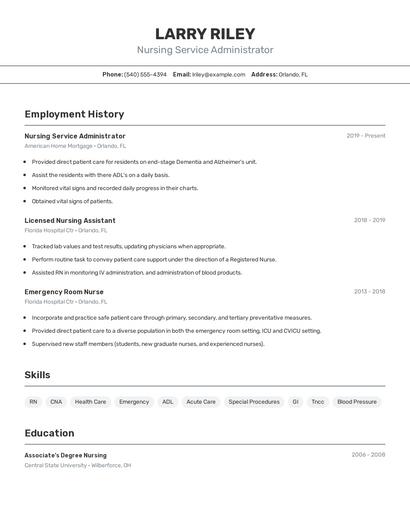
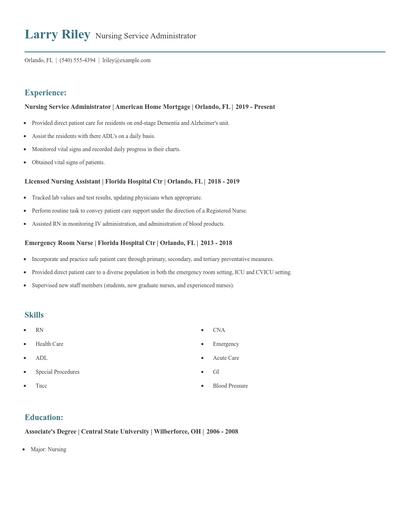
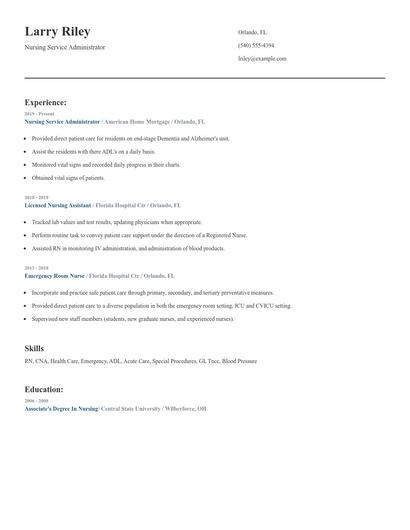
Build a professional nursing service administrator resume in minutes. Our AI resume writing assistant will guide you through every step of the process, and you can choose from 10+ resume templates to create your nursing service administrator resume.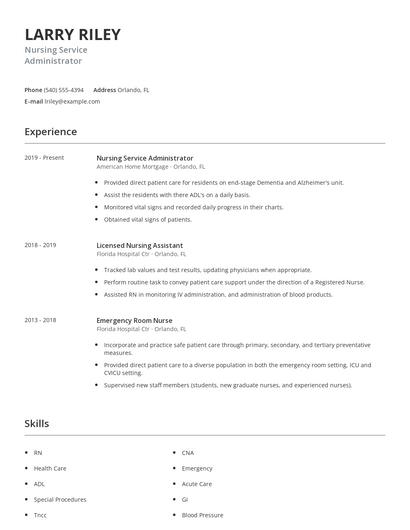


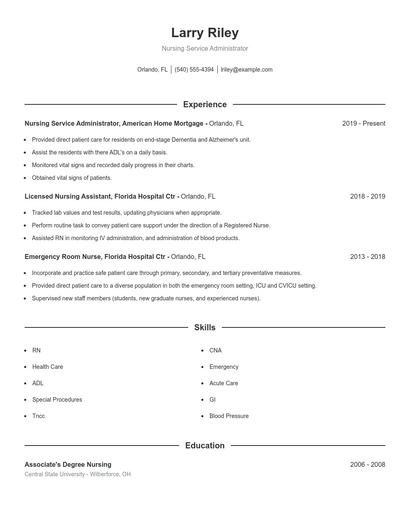
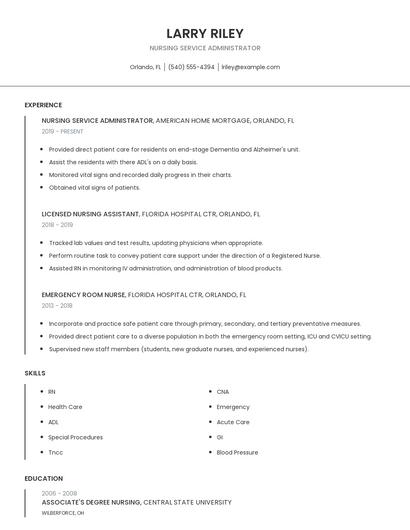
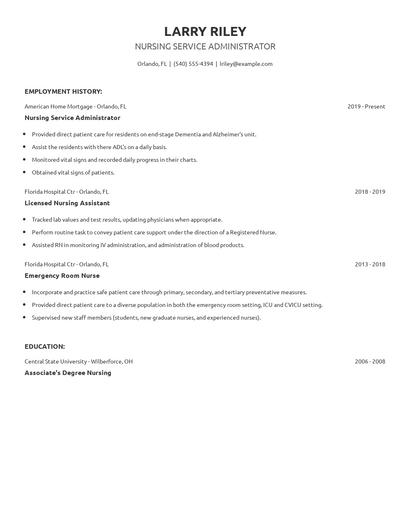
Compare different nursing service administrators
Nursing service administrator vs. Prn
A PRN or a "pro re nata" employee is responsible for covering a shift or a specific situation, especially during short-staffing or the need to complete a particular task. The PRNs often work for a medical industry without a regular or full-time commitment, having the freedom to manage their time and take multiple assignments from different organizations. A PRN must have excellent communication and organization skills, providing quality healthcare services to the patients and the organization.
These skill sets are where the common ground ends though. The responsibilities of a nursing service administrator are more likely to require skills like "blood products," "infection control," "hemodialysis," and "patient safety." On the other hand, a job as an prn requires skills like "healthcare," "occupational therapy," "customer service," and "physical therapy." As you can see, what employees do in each career varies considerably.
Prns earn the highest salaries when working in the professional industry, with an average yearly salary of $49,871. On the other hand, nursing service administrators are paid more in the health care industry with an average salary of $52,768.prns tend to reach similar levels of education than nursing service administrators. In fact, prns are 0.2% more likely to graduate with a Master's Degree and 1.1% more likely to have a Doctoral Degree.Nursing service administrator vs. Patients transporter
A patients transporter is responsible for transporting patients from one place to assigned healthcare facilities to receive medical care and treatment. Patients transporters assist with moving the patients, such as on wheelchairs and beds, depending on their conditions. They also deliver laboratory tests, medical equipment, specimens, and other medical-related records to different institutions advised by healthcare management. A patients transporter must always adhere to the regulatory procedures to maintain safe and secure operations, especially on ensuring patients' comfort during transportation.
Each career also uses different skills, according to real nursing service administrator resumes. While nursing service administrator responsibilities can utilize skills like "blood products," "surgery," "infection control," and "hemodialysis," patients transporters use skills like "customer service," "hippa," "medical equipment," and "stretchers."
Average education levels between the two professions vary. Patients transporters tend to reach lower levels of education than nursing service administrators. In fact, they're 9.2% less likely to graduate with a Master's Degree and 1.1% less likely to earn a Doctoral Degree.Nursing service administrator vs. Hospital volunteer
Hospital corpsmen are U.S. Navy enlisted medical specialists who perform the initial treatment during combat. The medical specialists serve as assistants in injury and disease prevention and treatment. They assist the health care professionals in the medical care of the Marine Corps and Navy personnel. Among their duties and responsibilities include preventive care, maintenance of patient treatment records, and administration of injections and medications. Also, it is their job to carry out emergency dental or medical treatment to marines and sailors.
The required skills of the two careers differ considerably. For example, nursing service administrators are more likely to have skills like "blood products," "home health," "infection control," and "hemodialysis." But a hospital volunteer is more likely to have skills like "emergency room," "front desk," "physical therapy," and "patient rooms."
Hospital volunteers typically earn similar educational levels compared to nursing service administrators. Specifically, they're 4.5% less likely to graduate with a Master's Degree, and 0.7% less likely to earn a Doctoral Degree.Nursing service administrator vs. Hospital corpsman
Types of nursing service administrator
Updated January 8, 2025
