
Automatically apply for jobs with Zippia
Upload your resume to get started.
Onsite coordinator skills for your resume and career
15 onsite coordinator skills for your resume and career
1. Payroll
Payroll is the sum of all the compensation that an organization has to pay to employees at a specified time. Payroll is managed by the finance or HR department while small business owners may handle it themselves. Payroll isn't fixed as it varies every month due to sick leaves, overtime, etc.
- Handled payroll for temporary associates.
- Have exposure to the HR payroll process and developing custom code via interacting with HR clusters and HR info type operations.
2. Data Warehouse
Data warehouse, often abbreviated as either DW or DWH is a system used in computing for data analysis as well reporting. The DW is also considered to be an integral component of business intelligence as they also provide storage facilities for both real-time and historical data. ETL and ELT are the two driving forces behind a data warehouse system.
- Provided inputs on end-to-end design, acquisition, development and implementation of the corporate data warehouse.
- Perform root cause analysis in case of any issues with the application or Data Warehouse (DWH).
3. Java
Java is a widely-known programming language that was invented in 1995 and is owned by Oracle. It is a server-side language that was created to let app developers "write once, run anywhere". It is easy and simple to learn and use and is powerful, fast, and secure. This object-oriented programming language lets the code be reused that automatically lowers the development cost. Java is specially used for android apps, web and application servers, games, database connections, etc. This programming language is closely related to C++ making it easier for the users to switch between the two.
- Developed the front-end with full end-to-end functionality using Java - J2EE, implemented in Front Controller Design pattern using RAD IDE.
- Involved in the various GUI (Views) development using JSP and multiple client side front-end validations through Java Script functions.
4. Test Cases
- Understand Testing requirements prepare Test estimations/ Test strategy/Test Plans/Review Test cases and validate execution results.
- Prepared and executed test cases manually for different streams/modules.
5. PL/SQL
- Worked on Custom program of PL/SQL to fix the existing data related to earlier conversion done by the Teams.
- Designed and developed PL/SQL programs, shell scripts and test (Unit, Integration, Performance etc.)
6. UAT
UAT stands for user acceptance testing, and it is the last phase in the software testing process that determines whether the software is fit for the purpose it was built or not. UAT checks two main things; whether the software fulfills the business requirements and can it be used by the end-users. It is the final and most critical step in the testing stages and it determines whether the software should be introduced in the market or not.
- Interacted directly with planners at Fabrication sites for requirements clarification and for coordinating UAT.
- Experienced in identifying business critical UAT test scenarios.
Choose from 10+ customizable onsite coordinator resume templates
Build a professional onsite coordinator resume in minutes. Our AI resume writing assistant will guide you through every step of the process, and you can choose from 10+ resume templates to create your onsite coordinator resume.7. DB2
The DB2, known as the Relational Database Management System, is a type of procedure developed by IBM to run and operate software applications such as Windows, Unix, and the Linux System. This type of system is designed mainly for IBM but was innovated to run in various operating systems. The main feature of the DB2 is to handle and manage a big chunk of data while allowing the users to enter the database engine without any problem.
- Developed MapReduce jobs to analyze Mainframe & DB2 data imported into HDFS and Store data back to HDFS.
- Extract data from TERADATA and load format into Db2 table.
8. QA
QA, or Quality Assurance is a procedure that entails all of the steps taken to avoid any errors in the manufacturing process or in the production of the goods that a company produces. It can also include ensuring the consistency of the services rendered. Quality assurance ensures that the quality of the service delivered to consumers meets or exceeds the promised expectations. This greatly aids in the prevention of any complications that might arise after the goods or services have been distributed. It makes sure that customers are satisfied.
- Performed QA Validation check and post Production implementation verification.
- Reviewed and executed unit and integration test plans to ensure thorough testing prior to QA turnover for all the applications.
9. SQL Server
- Involved in creating the Reports using Report viewer Web part & by using SQL Server Reporting Services (SSRS).
- Created, fine tuned and modified complex stored procedures in SQL Server 2008 R2 for better performance.
10. Unix
UNIX is a computer operating system that was first created in the 1960s and has been constantly updated since then. The operating system refers to the set of programs that enable a machine to function. It is a multi-user, multi-tasking device that works on computers, laptops, and servers. UNIX systems also have a graphical user interface (GUI), similar to Microsoft Windows, that makes it simple to use.
- Worked in UNIX platform developing C & C++ programs, shell scripting, CRON batch schedule in UNIX platform.
- Involved in writing Stored Procedures and UNIX shell scripts to execute Stored Procedures and data transfer using BCP utility.
11. Background Checks
- Performed interviews on potential candidates to analyze behavioral pattern and carry out relevant background checks to understand suitability for employment.
- Facilitated all prescreening procedures, such as drug test, background checks, etc.
12. COBOL
- Team Size 05 Programming Language Cobol , JCL, VSAM, Cyberlife Services.
- Collaborated with business users to define requirements for customer education database and developed system using COBOL with embedded PL/SQL.
13. User Interface
The user interface (UI) is the area or point where a person communicates with or transfers information to an electric computer or application. The user interface enables applications to offer precise product details to their intended customer without causing any misunderstanding. Customers want modern technology to behave in a certain manner for their convenience, so it is advised to create a user interface that is simple to use, precise, and predictable so that customers are fully pleased with its services. It can make a significant difference in converting visitors into customers.
- Used MVVM pattern to separate the business and presentation logic of your application from its user interface (UI).
- Developed the User interface using JSP, JavaScript, CSS, and HTML.
14. XML
XML is a medium for storing and transporting data that is independent of software and hardware. XML stands for eXtensible Markup Language. XML, like HTML, is a markup language that was created to store and transport data. It was created with the intention of being self-descriptive. There are no predefined tags in the XML language. Another feature is that XML is extensible.
- Used WSDL, XSD and XML to validate messages and testing with sample request messages and validated response messages.
- Used String Builder object to build XML IDOC dynamically which posted to SAP via IBM message queue.
15. Windows XP
- Supported software testing and validation for translating English web based training applications into various foreign localized training versions using Windows XP.
- Tested web-based application on different operating systems such as Windows XP, Vista and UNIX.
5 Onsite Coordinator resume examples
Build a professional onsite coordinator resume in minutes. Browse through our resume examples to identify the best way to word your resume. Then choose from 5+ resume templates to create your onsite coordinator resume.

What skills help Onsite Coordinators find jobs?
Tell us what job you are looking for, we’ll show you what skills employers want.
List of onsite coordinator skills to add to your resume
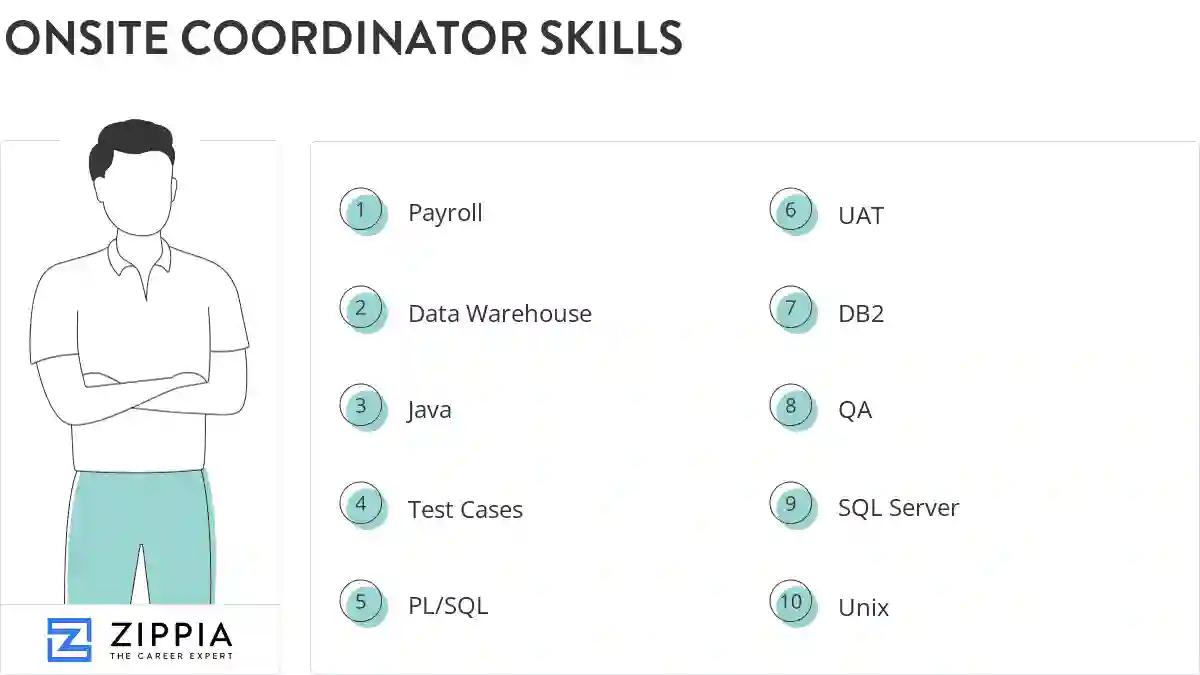
The most important skills for an onsite coordinator resume and required skills for an onsite coordinator to have include:
- Payroll
- Data Warehouse
- Java
- Test Cases
- PL/SQL
- UAT
- DB2
- QA
- SQL Server
- Unix
- Background Checks
- COBOL
- User Interface
- XML
- Windows XP
- ETL
- Management System
- HR
- Mainframe
- JCL
- SDLC
- HTML
- SLA
- Test Results
- Technical Specifications
- User Acceptance
- Test Scripts
- JAN
- Scrum
- QC
- Informatica
- Test Data
- J2EE
- SharePoint
- CICS
- FEB
- Production Issues
- Test Strategy
- Toad
- SME
- JSP
- MQ
- Jira
- Oracle 10G
- Ssis
- C Net
- Functional Specifications
- VSAM
Updated January 8, 2025
