
Automatically apply for jobs with Zippia
Upload your resume to get started.
Phlebotomy supervisor skills for your resume and career

15 phlebotomy supervisor skills for your resume and career
1. Patients
- Contacted insurance carriers to obtain any additional information needed to collect payment, including contacting patients, employers and guarantors.
- Maintained meticulous records and carefully monitored patients before, during, and after donation.
2. Customer Service
Customer service is the process of offering assistance to all the current and potential customers -- answering questions, fixing problems, and providing excellent service. The main goal of customer service is to build a strong relationship with the customers so that they keep coming back for more business.
- Participate in lab based and hospital committees for performance improvement process of quality and customer service.
- Conduct provider in-services, employee orientations and evaluations, serve as customer service representative.
3. Patient Care
Patient care entails the diagnosis, recovery, and control of sickness as well as the maintenance of physical and emotional well-being through the use of healthcare providers' services. Patient care is described as services provided to patients by health practitioners or non-professionals under guidance.
- Implemented changes in testing menu to more efficiently manage the work flow of the department without harmful effect on patient care.
- Collected and processed specimens and patient care in client offices and at our draw stations.
4. Laboratory Procedures
- Completed competency evaluations of all employees, ensuring that all staff complies with current protocol for laboratory procedures.
- Supervised 10 staff phlebotomists in daily laboratory procedures.
5. Specimen Collection
Specimen collection refers to process of collecting any tissue or fluid like substance in order to be analyzed and tested in a laboratory. Specimen collection is the initial necessary step for the diagnosis of a problem, providing a pathway to the eventual treatment.
- Provide required compliance for all local, state and federal regulations, delegation and processing of all in-house specimen collections.
- Supervised 5 employees in all aspects of data entry, insurance authorization, specimen collection, and shipment.
6. Payroll
Payroll is the sum of all the compensation that an organization has to pay to employees at a specified time. Payroll is managed by the finance or HR department while small business owners may handle it themselves. Payroll isn't fixed as it varies every month due to sick leaves, overtime, etc.
- Organized and monitored staffing schedules and rotations and completed weekly payroll.
- Monitor and manage laboratory budget and payroll.
Choose from 10+ customizable phlebotomy supervisor resume templates
Build a professional phlebotomy supervisor resume in minutes. Our AI resume writing assistant will guide you through every step of the process, and you can choose from 10+ resume templates to create your phlebotomy supervisor resume.7. Data Entry
Data entry means entering data into a company's system with the help of a keyboard. A person responsible for entering data may also be asked to verify the authenticity of the data being entered. A person doing data entry must pay great attention to tiny details.
- Manage handling and receipt, sampling, data entry, dispensing, control substance, distribution and destruction of materials.
- Perform basic clerical duties: filing, faxing, preparing mail, answering telephones, and electronic data entry.
8. Patient Service Centers
- Played a key role in ensuring the successful day to day operations of five patient service centers and five IOP centers.
- Draw, process, and transport specimens if needed to various offices and patient service centers in surrounding areas.
9. Customer Complaints
- Managed daily meetings, staffing PSC and customer complaints.
- Resolved customer complaints professionally while improving overall departmental performance.
10. Infection Control
Infection control describes the principles and practices used in hospitals and other healthcare facilities to control and minimize the spread of infections with the aim of lowering rates of infection. Infection control refers to the process of detecting and controlling pathogens in order to reduce their spread.
- Provide in-service education to nursing home staff: Disease management, infection control, lab testing etc.
- Close working relations with Clinicians, Nurses, and infection Control.
11. Blood Collection
- Directed high-volume blood collection operations, providing individualized care to large groups of donors.
- Perform capillary blood collection when required.
12. OSHA
- Educated staff on state and federal statutes, rules and regulations of CLIA, HIPPA, and OSHA.
- Administer health care services and procedures and enforce polices as outlined by HIPAA, CAP, OSHA.
13. Drug Screens
A drug screen is a drug test that consists of a collection of blood, urine, saliva, or even a hair sample. The samples are used to determine the presence of any chemical remnants which are present in the body after the intake of any drug.
- Implemented and trained staff on DOT and NDOT collection of drug screens and BAT (breath alcohol testing).
- Perform all drug screens, and DNA testing, Draw lab specimens on walk in clients.
14. Performance Reviews
Performance reviews refer to the official evaluation of a worker's performance done by the manager. The evaluation then helps the superior identify the worker's strengths and weaknesses and offers valuable feedback to help him overcome his shortcomings. This assessment also helps a worker set a future goal for himself and identify ways to better his future performance. Performance Reviews may be done on a monthly or yearly basis, depending on the company.
- Supervised 14 employees and conducted performance reviews.
15. Open Positions
Open positions may refer to a potential investment trade, where the trade has been established and recognized but has not yet closed. This is common for many investors holding a great deal of stock but have not yet sold those shares; however, there is considerable risk in holding multiple open positions given the market fluctuation.
- Interview applicable candidates for open positions, provide initial and ongoing training to staff members.
- Work with Human Resources in filling open positions.
5 Phlebotomy Supervisor resume examples
Build a professional phlebotomy supervisor resume in minutes. Browse through our resume examples to identify the best way to word your resume. Then choose from 5+ resume templates to create your phlebotomy supervisor resume.

What skills help Phlebotomy Supervisors find jobs?
Tell us what job you are looking for, we’ll show you what skills employers want.
List of phlebotomy supervisor skills to add to your resume
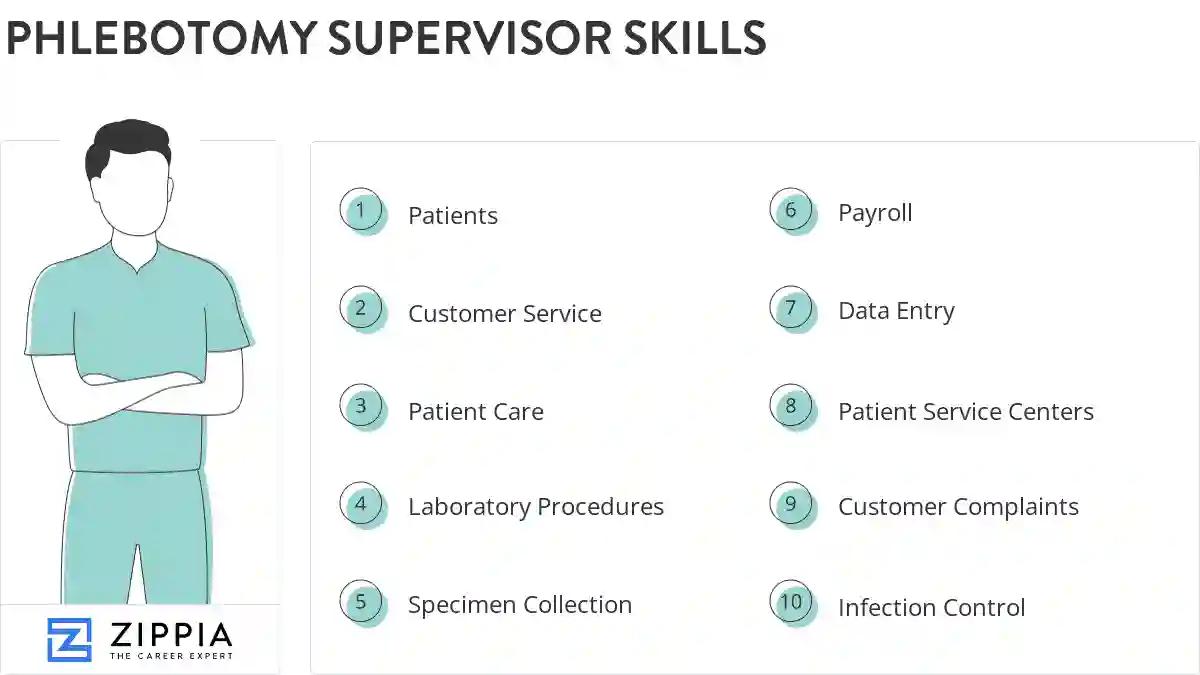
The most important skills for a phlebotomy supervisor resume and required skills for a phlebotomy supervisor to have include:
- Patients
- Customer Service
- Patient Care
- Laboratory Procedures
- Specimen Collection
- Payroll
- Data Entry
- Patient Service Centers
- Customer Complaints
- Infection Control
- Blood Collection
- OSHA
- Drug Screens
- Performance Reviews
- Open Positions
- Nursing Home
- Performance Evaluations
- Staff Performance
- CLIA
- HIPAA
- Phlebotomy Training
- LIS
- Chemistry
- Patient Identification
- Blood Samples
- EMR
- Disciplinary Actions
- Employee Training
- Timekeeping
- IOP
- QC
- Computer System
- Client Service
- FDA
- Compliance Standards
- DOT
- Stat
- Performance Appraisals
- Blood Cultures
- Proficiency Testing
- Drawing Blood
- Specimen Handling
- Client Satisfaction
- Epic
- Hippa
Updated January 8, 2025
