
Automatically apply for jobs with Zippia
Upload your resume to get started.
Practitioner skills for your resume and career

15 practitioner skills for your resume and career
1. Patients
- Treated patients on a referral basis and established active collaboration with veterinary specialists and general practitioners involved with patient care.
- Provide one-to-one meetings with patients conducted as needed according to behavioral observations or treatment plans.
2. Patient Care
Patient care entails the diagnosis, recovery, and control of sickness as well as the maintenance of physical and emotional well-being through the use of healthcare providers' services. Patient care is described as services provided to patients by health practitioners or non-professionals under guidance.
- Provide empathetic patient care, carefully assessing each case at every stage of the patient's history.
- Provided both out-patient and in-patient care across all age spans with acute and chronic cases.
4. Resuscitation
- Required skills including skilled adult and pediatric assessment, specialized medication dosing, IV initiation and adult and pediatric resuscitation.
- Assisted with procedures such as laceration repairs, lumbar punctures, pelvic examinations, and cardiopulmonary resuscitation.
5. Individual Therapy
- See clients in their homes for individual therapy.
- Provision of couples and adult individual therapy.
6. Continuous Improvement
Continuous improvement is an ongoing process of improvement of products, services, and processes with the help of innovative ideas. It is an organized approach that helps an organization to find its weaknesses and improve them.
- Ensured process improvements and artifacts were available to support repeatable results and continuous improvement for subsequent QA initiatives.
- Assisted various organizations in analyzing business practices and then designing and implementing continuous improvement plans.
Choose from 10+ customizable practitioner resume templates
Build a professional practitioner resume in minutes. Our AI resume writing assistant will guide you through every step of the process, and you can choose from 10+ resume templates to create your practitioner resume.7. Mental Illness
- Provided psycho-education about mental illness and its treatment.
- Key Contributions* Managed caseload 50+ diverse clientele diagnosed with chronic mental illness, dual diagnosis, and mood and anxiety disorder.
8. Crisis Intervention
- Provide emergency response and crisis intervention from allegations of abuse.
- Monitor case progress and provide crisis intervention in emergency situations.
9. DEA
Drug enforcement agents are specialized law enforcement officers, deployed to fight crime, especially drug-related offenses like the purchase and sale of illegal drugs. DE agents are physically fit and trained with the proper understanding of the law, training, and education.
- Assured timeliness of process completion Verified physician credentials with the following: o DEA o National Practitioner Data Bank o Board Certification
10. Java
Java is a widely-known programming language that was invented in 1995 and is owned by Oracle. It is a server-side language that was created to let app developers "write once, run anywhere". It is easy and simple to learn and use and is powerful, fast, and secure. This object-oriented programming language lets the code be reused that automatically lowers the development cost. Java is specially used for android apps, web and application servers, games, database connections, etc. This programming language is closely related to C++ making it easier for the users to switch between the two.
- Used caching mechanisms such as Java based local, distributed caches etc.
- Create, compile and run Spark applications using Scala and Java.
11. Food Safety
- Initiated and implemented weekly maintenance review meetings to improve executive management and QA Team participation in food safety program.
- Resolved customer complaints and addressed consumer satisfaction, food safety and quality concerns with root cause analysis investigations.
12. Substance Abuse
- Monitored outpatient and inpatient substance abuse services for adults and adolescents and conducted substance abuse assessments.
- Provided ongoing substance abuse counseling in collaboration with community group supports.
13. HR
HR stands for human resources and is used to describe the set of people who work for a company or an organization. HR responsibilities revolve around updating employee records and carrying out management processes like planning, recruitment, evaluation, and selection processes. HR is a key contributor to any company or organization's growth as they are in charge of hiring the right employees, processing payrolls, conducting disciplinary actions, etc.
- Developed and implemented management rotational program and mentoring program for HR function.
- Supported HR team members at Job and Benefit fairs by setting up for vendors and meet and greet w/ potential applicants.
14. Child Abuse
When a child who is under 18 is mistreated by an adult, it is considered child abuse. There are many forms of intentional harm and mistreatment for example physical abuse, sexual abuse, emotional abuse, medical abuse, and neglect in providing adequate basic life necessities.
- Conduct referral investigations of suspected child abuse and conduct risk and safety assessments utilizing safety organized practice.
- Conducted child abuse investigations and provided case management services to children and their families
15. Payroll
Payroll is the sum of all the compensation that an organization has to pay to employees at a specified time. Payroll is managed by the finance or HR department while small business owners may handle it themselves. Payroll isn't fixed as it varies every month due to sick leaves, overtime, etc.
- Processed national payroll for population of 100,000 union and non-union employees with specific attention to development of automated reporting functions.
- Prepare all electronic file submissions including weekly payroll, voluntary deductions and court ordered garnishments.
5 Practitioner resume examples
Build a professional practitioner resume in minutes. Browse through our resume examples to identify the best way to word your resume. Then choose from 5+ resume templates to create your practitioner resume.

What skills help Practitioners find jobs?
Tell us what job you are looking for, we’ll show you what skills employers want.
What skills stand out on practitioner resumes?
Katherina Nikzad-Terhune Ph.D.
Associate Professor, MSW Program Director, School of Social Work, Northern Kentucky University
What soft skills should all practitioners possess?
Katherina Nikzad-Terhune Ph.D.
Associate Professor, MSW Program Director, School of Social Work, Northern Kentucky University
What hard/technical skills are most important for practitioners?
Youngjin Kang Ph.D.
Assistant Professor, University of Illinois-Springfield
What practitioner skills would you recommend for someone trying to advance their career?
Andrew Schoolnik
Assistant Professor, Bachelor of Social Work Program Director, Website
On a macro level, the more the social worker dialogues with all stakeholders (those in favor and those opposed) the more that person gains knowledge and goodwill. This is at the heart of compromise - winning being defined as doing the most good for the most people.
On a clinical level, social workers work mutually with their clients. Learning about a client's values begins with dialogue (even when our values are different) and creating treatment plans is often-based on compromise (agency policy/goals, and client goals).
List of practitioner skills to add to your resume
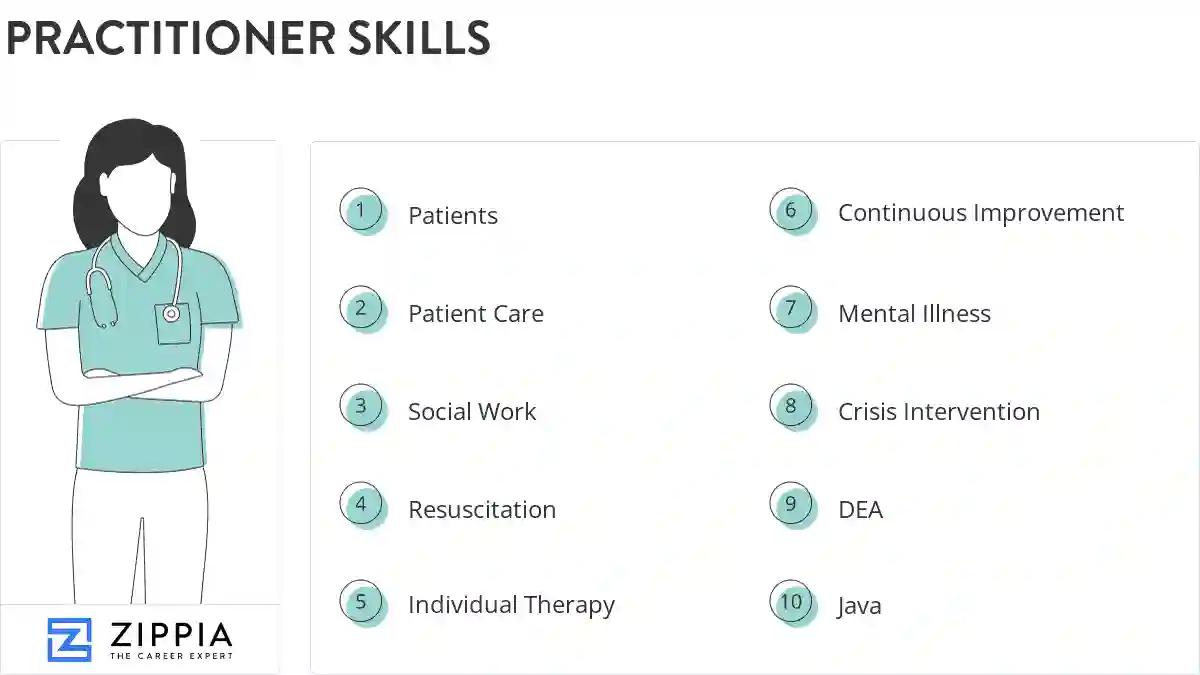
The most important skills for a practitioner resume and required skills for a practitioner to have include:
- Patients
- Patient Care
- Social Work
- Resuscitation
- Individual Therapy
- Continuous Improvement
- Mental Illness
- Crisis Intervention
- DEA
- Java
- Food Safety
- Substance Abuse
- HR
- Child Abuse
- Payroll
- Community Resources
- Mental Health
- Private Practice
- Applied Behavior Analysis
- Mental Health Issues
- SQF
- Family Therapy
- Value Stream
- Direct Clinical Services
- Sigma
- Kaizen
- Discharge Planning
- Developmental Disabilities
- Diagnostic Assessments
- Medicaid
- Group Therapy
- Clinical Documentation
- Community Agencies
- Eating Disorders
- Medication Management
- Physical Therapy
- Law Enforcement
- HACCP
- Chemotherapy
- Risk Assessments
- QA
- FDA
- Thai
- Court Reports
- Vital Signs
- Intubation
- Cognitive Behavioral Therapy
- Domestic Violence
Updated January 8, 2025

3. Social Work