
Automatically apply for jobs with Zippia
Upload your resume to get started.
Process development technician skills for your resume and career
15 process development technician skills for your resume and career
1. R
R is a free software environment and a language used by programmers for statistical computing. The R programming language is famously used for data analysis by data scientists.
- Develop statistical analysis solutions using Bayes Statistics and R for quality control and marketing
- Supported engineers and R &D group for experiment runs.
2. GMP
GMP stands for Good Manufacturing Practice. It is a system that ensures that all products like food, beverages, and medicinal drugs that are produced comply with the quality standards. It helps in minimizing the risks and hazards that cannot be eliminated after the testing of final products.
- Assisted other department with PD & GMP manufacturing and wrote and revised SOP.
- Developed a solid understanding of GMP requirements and developed and revised SOPs and manufacturing documents.
3. Data Entry
Data entry means entering data into a company's system with the help of a keyboard. A person responsible for entering data may also be asked to verify the authenticity of the data being entered. A person doing data entry must pay great attention to tiny details.
- Maintained logs/records of specimen received while using data entry and organizational skills, proficiency with numbers, researching of information.
- Processed specimen through data entry computer application-Properly labeled and sorted specimen after processing-Used Microsoft Outlook for communication with team members
4. Process Equipment
Process equipment refers to the machinery used in processing and refining industries. This equipment is responsible for a single job in the refinement process, which can vary from maintaining the flow of a chemical, controlling chemical reactions, or even storing chemicals. Process equipment can also be broken down into two categories, which are fixed and rotating equipment, depending on the movement required from the equipment.
- Operated, cleaned, decontaminated, sanitized and documented all work performed on process equipment and utilities.
- Involved in identifying process equipment for company's future needs as the micro-battery technologies evolve.
5. Product Development
Product development is the complete procedure of creating a product from concept until release of the final product. Product development has many stages after which a product is released into the market. Identifying the need, creating the opportunity, conceptualizing a product, and providing a solution, all are different stages of product development.
- Coordinated and managed prototype development, submissions, design reviews and tooling modifications for 9 new product development programs.
- Prepared environmental catalysts for product development and quality specification determination.
6. Lean Manufacturing
- Supervised and maintained Surface Mount Technology (SMT) assembly and inspection systems within required parameters in a Lean manufacturing environment.
- Performed preventative and corrective maintenance actions on manufacturing equipment in a clean manufacturing environment.
Choose from 10+ customizable process development technician resume templates
Build a professional process development technician resume in minutes. Our AI resume writing assistant will guide you through every step of the process, and you can choose from 10+ resume templates to create your process development technician resume.7. Clean Rooms
As the name suggests, clean rooms are scientifically cleansed from microbes, dirt particles, and many other pollutants. It has a shallow level of external particles and is useful in the manufacturing and engineering of products. Since chemical reactions and scientific procedures can be affected by outside factors, they provide dirt and an interaction-free environment where scientific manufacturing can occur. Clean rooms are beneficial in various industries, including the aerospace, optics, and nanotechnology industries.
- Implement clean room protocols to minimize particles contamination and maintain clean room integrity.
- Design and manage multiple class 10,000 clean room laboratories.
8. Pilot Plant
A pilot plant is a small, pre-commercial production system that is operated to determine whether a process is feasible and sustainable before using it on a large industrial scale. It is an important test for new processes or equipment in hazard identification before production takes place on a larger scale.
- Scaled process development pilot plant applications to full scale manufacturing facilities.
- Operated safely and efficiently a variety of chemical pilot plants of advanced complexity in response to requests from the engineering staff.
9. Etch
- Developed proprietary spacer and recess etch processes for Freon elimination project to protect environment/ozone layer.
- Developed MEMS processes using special protective coating to etch holes through Silicon wafers.
10. Laboratory Equipment
- Developed and posted a Microsoft PowerPoint-based Work Aid Document system for correctly starting, operating, & shutting down laboratory equipment.
- Perform maintenance of laboratory equipment including the reporting of malfunction of equipment, troubleshooting and performing repairs as necessary.
11. Statistical Analysis
- Measured tablet parameters for statistical analysis in conjunction with pharmaceutical formulations.
- Provided on site supplier development support using statistical analysis to identify equipment placement issue root causes and technical improvements.
12. Process Control
Process control is a method pertaining to continuous production processes that uses the aid of ICS (Industrial Control Systems) for production. This method enables production to be done with a level of consistency and safety in an economically friendly manner that is impossible to achieve solely through manual control.
- Designed and implement process control techniques and procedures into manufacturing environments.
- Monitored and operated computer integrated reactors and process controlled equipment.
13. Autoclaves
- Load autoclaves with the kits and supplies needed for processing, making sure to maximize capacity.
- Utilized filtration equipment, autoclaves depyrogenation ovens and glass wash systems.
14. Technical Reports
Technical reports are a type of document that is used to indicate either the progress, result, or process of scientific research or the state of problems occurring within such research. A technical report may also showcase the report's overall conclusion and may also include recommendations. This kind of report does not require a peer review and isn't published officially but distributed within the organizations where it was formed.
- Received Employee of the Month Recognition Award for significantly reducing process confusion and improving production capabilities Executed technical reports.
- Collected, analyzed and verified data to monitor and optimize processes and prepared technical reports.
15. CIP
A Capital Improvement Plan (CIP) is a planning tool used to coordinate the timing and financing of capital improvements over a period of several years. It helps organizations make good budget decisions for large projects and purchases based on objectives and resources. The purpose of a CIP is to identify capital improvement projects, identify and forecast funding sources, prioritize improvements based on available funds, and estimate a timeline for completing the improvements.
- Perform CIP's and SIP's, filters buffers, calibrate pH probes, calibrate conductivity meters, and pull samples.
- Performed CIP and SIP of tanks as needed during the process.
5 Process Development Technician resume examples
Build a professional process development technician resume in minutes. Browse through our resume examples to identify the best way to word your resume. Then choose from 5+ resume templates to create your process development technician resume.

What skills help Process Development Technicians find jobs?
Tell us what job you are looking for, we’ll show you what skills employers want.
List of process development technician skills to add to your resume
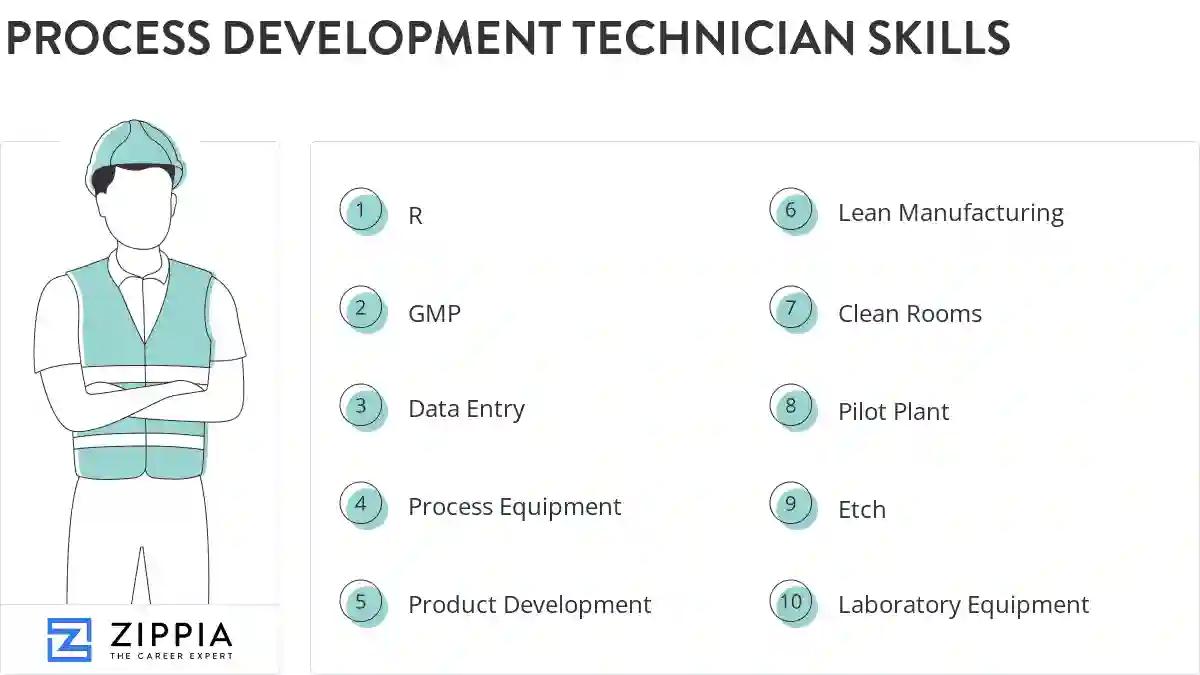
The most important skills for a process development technician resume and required skills for a process development technician to have include:
- R
- GMP
- Data Entry
- Process Equipment
- Product Development
- Lean Manufacturing
- Clean Rooms
- Pilot Plant
- Etch
- Laboratory Equipment
- Statistical Analysis
- Process Control
- Autoclaves
- Technical Reports
- CIP
- QC
- Process Validation
- Catheter
- ISO
- FDA
- Equipment Maintenance
- Pilot Scale
- Dryers
- Medical Devices
- Troubleshoot
- Liquid Chromatography
- Production Processes
- Process Improvement
- Analytical Methods
- Data Analysis
- Process Optimization
- Failure Analysis
- Clinical Trials
- Test Methods
- Centrifugation
- Sigma
- Data Collection
- OQ
- DOE
- RAN
- SPC
- Thin Films
- Continuous Improvement
- HPLC
- Production Equipment
- CMP
Updated January 8, 2025
