
Automatically apply for jobs with Zippia
Upload your resume to get started.
Process scientist skills for your resume and career
15 process scientist skills for your resume and career
1. Chemistry
Chemistry is the branch of science that tells us about the composition, properties, and structure of elements and compounds. The processes these elements undergo and how they undergo change all come under the branch of chemistry.
- Serve as lead trainer for Process Chemistry for moisture assays, near-line sodium and Hunter Color analysis.
- Performed various tests including: gravimetric, spectrometric, and wet chemistry.
2. GMP
GMP stands for Good Manufacturing Practice. It is a system that ensures that all products like food, beverages, and medicinal drugs that are produced comply with the quality standards. It helps in minimizing the risks and hazards that cannot be eliminated after the testing of final products.
- Harmonized the tech transfer process between the development SDF group and GMP manufacturing SDF group.
- Installed, qualified, and validated instruments for GMP use.
3. Cell Culture
- Function as a member of a team to develop and scale-up mammalian cell culture process and tech-transfer.
- Authored the Cell Culture and DPC manufacturing business unit sections of the 2007 Annual Product Report.
4. Technical Reports
Technical reports are a type of document that is used to indicate either the progress, result, or process of scientific research or the state of problems occurring within such research. A technical report may also showcase the report's overall conclusion and may also include recommendations. This kind of report does not require a peer review and isn't published officially but distributed within the organizations where it was formed.
- Write and present technical reports documenting the technology transfer, scale-up, troubleshooting and equipment/raw material evaluation activities.
- Authored 120+ in-house technical reports.
5. HPLC
- Coordinated installation and qualification of customized HPLC system to be used for successful development of topical cream product.
- Developed and performed methods for analysis of radio labeled organic pesticides through extensive HPLC and Liquid Scintillation techniques usage.
6. Harvest
- Performed statistical analyses of on/off-line manufacturing data to investigate failures of release parameters (harvest OD).
- Perform product harvest using depth filters and TFF systems.
7. Technical Support
Technical support or tech support are the services provided by any hardware or software company to users. They help in solving the technical difficulties the customers face with their products or services. Moreover, the tech support employees maintain, manage, and repair the IT faults. They are also responsible for resolving the network problems, installing and configuring hardware and software.
- Provide technical support for process optimization strategies and/or troubleshooting of operational issues in the manufacturing activities.
- Provided technical leadership for the qualification of a new, pilot-scale fill/finish facility in the Global Technical Support group.
8. CMC
CMC stands for "chemistry, manufacturing, and controls," which represents a standard procedure when producing new pharmaceutical drugs. First the drug is developed through chemical tests and analysis, then the drug is manufactured. Before the pharmaceutical can be offered to the public, it must be tested on individuals, often animal test subjects first and then human beings. This allows pharmacists to determine whether the drug must be reconsidered, reproduced, or whether any side effects accompany the drug.
- Participated in CMC meetings to define process development goals for purification department.
- Complied data and wrote the CMC section of the NDA, stability test protocols, and final reports.
9. FDA
The Food and Drug Administration (FDA) is a division of the US Department of Health and Human Services that regulates the production and sale of food, pharmaceutical products, medical equipment, and other consumer goods, as well as veterinary medicine. The FDA is now in charge of overseeing the manufacture of products like vaccines, allergy treatments, and beauty products.
- Author of technical documentation in response to FDA, European, Clients, and internal compliance audits.
- Championed site compliance activities while under FDA consent decree.
10. DOE
DOE, DOX, or design of experiments is a term used to refer to a part of applied statistics whose main focus is to conduct and observe controlled tests with the ultimate goal of understanding and explaining how information and results might vary under different hypotheses and circumstances and how such variables affect the results and tests. Design of experiments is used in marketing, politics, various sciences, and, of course, experiments.
- Led the development and execution of DOE experiments to generate a base case starting point for work on new chemical entities.
- Worked with the formulation team to design DOE experiments, execute the experiments, and analyze/interpret the results.
11. Troubleshoot
Troubleshooting is the process of analyzing and fixing any kind of problem in a system or a machine. Troubleshooting is the detailed yet quick search in the system for the main source of an issue and solving it.
- Designed and carried out laboratory experiments to troubleshoot product related issues.
- Analyze data and recommend procedures to troubleshoot manufacturing operations.
12. Manufacturing Support
- Managed product transfers and provided manufacturing support.
- Provided quality and manufacturing support.
13. Electrophoresis
- Conduct Quality Control of RNA and DNA using on chip electrophoresis via the Agilent Bioanalyzer 2100.
- Developed assays to detect residual complement activity Performed SDS-PAGE and acid urea gel electrophoresis.
14. QC
Quality control is a set of instructions or procedures to ensure a manufactured product or a service is up to the highest quality standards. This set of quality control criteria are either defined by the clients or the company itself.
- Monitored internal QC supply inventory, outsourced materials for QC panel generation
- Analyzed testing results of technical manufacturing, QC, or product performance to determine acceptability of the product.
15. Process Improvement
- Managed process improvement, validation, and cost optimization projects.
- Lead technical projects, process improvement projects and factory operations.

What skills help Process Scientists find jobs?
Tell us what job you are looking for, we’ll show you what skills employers want.
What process scientist skills would you recommend for someone trying to advance their career?
Scott Johnson
Professor and Director, University of Maine
What type of skills will young process scientists need?
Joe Harrison
Animal Scientist and Extension Specialist, Washington State University
List of process scientist skills to add to your resume
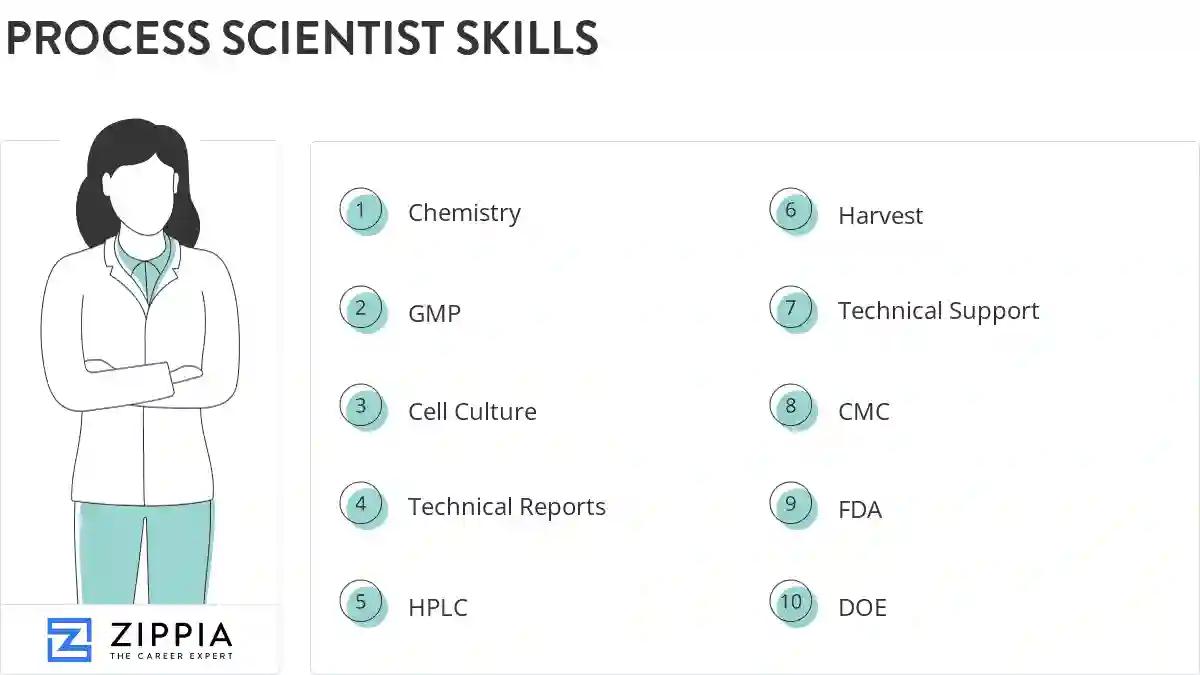
The most important skills for a process scientist resume and required skills for a process scientist to have include:
- Chemistry
- GMP
- Cell Culture
- Technical Reports
- HPLC
- Harvest
- Technical Support
- CMC
- FDA
- DOE
- Troubleshoot
- Manufacturing Support
- Electrophoresis
- QC
- Process Improvement
- Extraction
- Product Development
- R
- Dosage Forms
- Regulatory Affairs
- Environmental Monitoring
- API
- Process Optimization
- GLP
- QA
- Pilot Plant
- Data Management
- Process Design
- Process Changes
- Technical Operations
- Development Reports
- FMEA
- ISO
- CMO
- IR
- Centrifugation
- Immunoassay
- CAPA
- RNA
- SCADA
- Customer Complaints
- Sigma
- Cell Lines
Updated January 8, 2025
