
Automatically apply for jobs with Zippia
Upload your resume to get started.
Production scheduler/planner skills for your resume and career
15 production scheduler/planner skills for your resume and career
1. Master Production Schedule
- Confer with department supervisors and review master production schedule, work orders, and related information to determine material requirements.
- Managed a team including warehouse operators, Inventory Control Specialist, Master Production Scheduler & Label Printing Operator.
2. MRP
MRP is an abbreviation of Material Requirements Planning and refers to the control system which is implemented in the planning and management of the activities related to manufacturing. Through MRP, manufacturers can easily schedule the production and it can also be used for inventory. MRP systems are mostly software-based but the process can also be carried out manually.
- Create and maintain inventory levels for manufactured items utilizing MRP principles.
- Utilized MRP data for collaborative follow-up with procurement on component shortages.
3. Material Availability
The quantity of material required to begin and finish a task is called material availability. The percentage of the total inventory integral to accomplishing the assigned task given the quality is up to standard. Before any project starts, the planner will ensure that the required material is available and permit its execution. The type of material availability check depends upon the available time for the task.
- Analyzed and determined the optimal production schedule of customer orders including client's requirements, production sequencing and material availability.
- Requisition material and establish sequential delivery dates to departments according to job order priorities and material availability.
4. Production Planning
Production planning is the planning of manufacturing in an industry or company. It uses resources like materials, employees, and production capacity, to serve customers. Production planning can be used in combination with production control into production and control planning.
- Developed and implemented production planning scenarios for largest Spandex production facility in the world.
- Execute and monitor the production planning process including production order review and inventory status.
5. Inventory Control
- Fostered open communication with Engineering, Purchasing, Manufacturing, Inventory Control, Quality and Configuration Management.
- Provided planning, expediting, receiving and inventory control for a major aerospace seating manufacturer.
6. Delivery Dates
A delivery date is a day on which a stock, bond, or option trade must be finalized. In other words, it is a final date on which the underlying commodities for a forward contract must be delivered for the fulfillment of the terms of the contract.
- Maximize and create capacity utilization per resources while meeting the required delivery dates.
- Approved/disapproved orders that did not get the requested delivery date after going through the mainframe order quoting system.
Choose from 10+ customizable production scheduler/planner resume templates
Build a professional production scheduler/planner resume in minutes. Our AI resume writing assistant will guide you through every step of the process, and you can choose from 10+ resume templates to create your production scheduler/planner resume.7. Customer Orders
- Work daily with the Purchasing Department to ensure adequate material flow for all customer orders including unanticipated customer orders.
- Work closely with customer service representatives and act as their information link regarding customer orders and delivery schedules.
8. ERP
Enterprise Resource Planning (ERP) is computer software used by major corporations and organizations for conducting their management and accounting tasks efficiently. ERP systems bind different business processes with each other allowing smoother flow of data between them resulting in swift project assessment and completion.
- Planned and leveled weekly and daily production schedules for over 10 departments and 600 employees utilizing ERP systems and practices.
- Volunteered to serve as lead on successful implementation of PeopleSoft ERP software, representing the MRO Directorate at the NSLD.
9. Lean Manufacturing
- Implemented quality initiatives and Lean Manufacturing and safety departmental regulations to optimize setup reduction times and minimize recurring daily issues.
- Participate in multiple Continuous Improvement teams to apply Lean Manufacturing principles across multiple plants.
10. Logistics
Logistics is a complete organization and implementation of a problem. Logistics are often considered in a complex business operation, as some works need detailed plannings. Logistics are also used in military action.
- Developed inventory and distribution logistics plans to meet deployment/shipping schedules to multiple Northeastern Regional service facilities.
- Provided daily reports to manage and track customer requirements and provide updates to managers, operations, warehouse and logistics.
11. On-Time Delivery
On-Time Delivery, or OTD, is a metric that measures the rate at which finished goods and deliveries are completed on time. This rate is measured by the overall number of units shipped within a specified time frame agreed upon by the consumer and supplier. On-Time Delivery allows suppliers' compliance with delivery deadlines, and hence their consistency, to be assessed using a continuous and collaborative development approach.
- Collaborated closely with production and sales to ensure all customer expectations for on-time delivery were met while optimizing machine utilization.
- Coordinate activities with the Supply Chain organization and review material positions to ensure on-time delivery and consistent flow in production.
12. Customer Service
Customer service is the process of offering assistance to all the current and potential customers -- answering questions, fixing problems, and providing excellent service. The main goal of customer service is to build a strong relationship with the customers so that they keep coming back for more business.
- Initiated changes in buying strategies by researching the effectiveness of manufacturing versus purchasing materials resulting in profitability and customer service improvements.
- Optimized finished-goods and raw material inventory levels to meet inventory carrying cost targets and to increase customer service levels.
13. Purchase Orders
- Supported maintenance division purchase order activity from initiation to execution: Worked closely with vendors on parts needs and deliveries.
- Entered purchase orders and communicated upcoming jobs to Fabrication, purchasing and Production.
14. Shop Floor
- Assisted in implementing Shop Floor Control procedures and responsible for maintaining accuracy.
- Master Scheduler responsible for creating and maintaining a valid master schedule for Planners and capacity planning for the shop floor.
15. Production Orders
- Prepared weekly schedule and communicated exceptions to sales and manufacturing team; provided weekly reporting on production orders status and completion.
- Plan production orders in sufficient detail to communicate all information required to generate tickets produce materials and pack finished goods.
5 Production Scheduler/Planner resume examples
Build a professional production scheduler/planner resume in minutes. Browse through our resume examples to identify the best way to word your resume. Then choose from 5+ resume templates to create your production scheduler/planner resume.

What skills help Production Scheduler/Planners find jobs?
Tell us what job you are looking for, we’ll show you what skills employers want.
List of production scheduler/planner skills to add to your resume
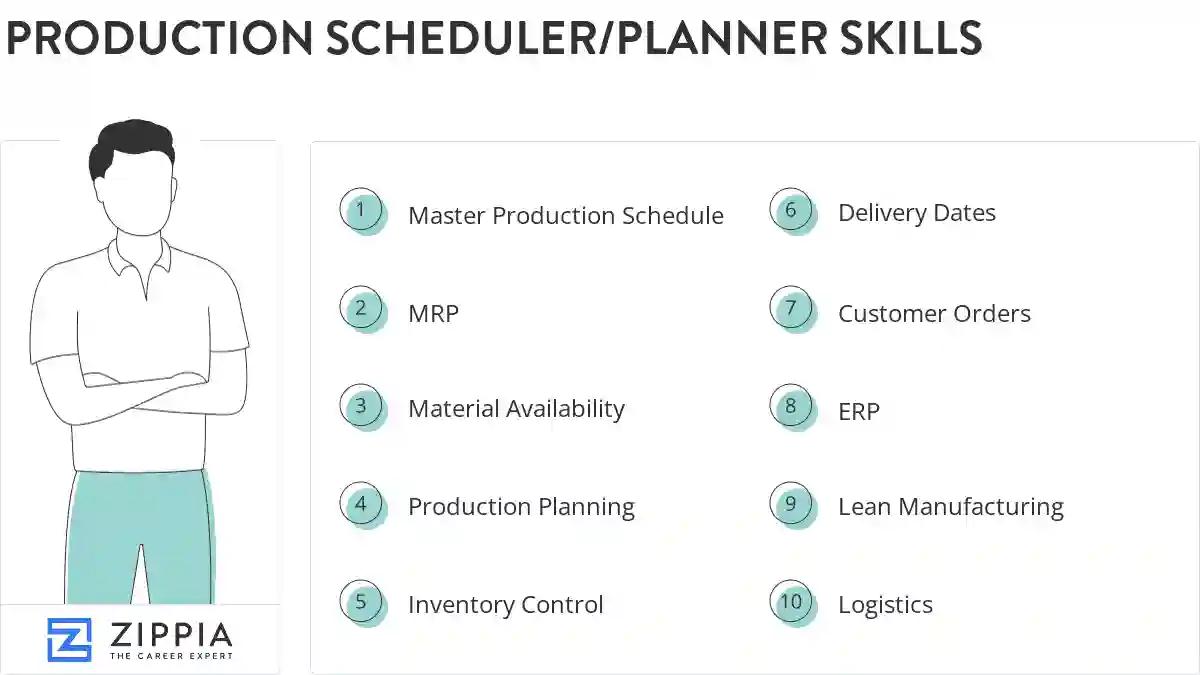
The most important skills for a production scheduler/planner resume and required skills for a production scheduler/planner to have include:
- Master Production Schedule
- MRP
- Material Availability
- Production Planning
- Inventory Control
- Delivery Dates
- Customer Orders
- ERP
- Lean Manufacturing
- Logistics
- On-Time Delivery
- Customer Service
- Purchase Orders
- Shop Floor
- Production Orders
- Production Control
- Production Capacity
- Customer Demand
- Shop Load
- Production Process
- Production Floor
- Production Lines
- Material Shortages
- BOM
- Stock Transfers
- Inventory Management
- Kanban
- WIP
- Production Problems
- Design Changes
- Sigma
- Sales Orders
- R
- Supply Chain Planning
- Plant Capacity Data
- Sales Forecasts
- Goods Inventory
- Enterprise Resource Planning
- Production Reports
- Due Dates
- Cycle Counts
- Production Issues
- Inventory Accuracy
- AS400
- Production Specifications
- ECO
- CNC
- Delay Schedules
- Production Runs
Updated January 8, 2025
