Explore jobs
Find specific jobs
Explore careers
Explore professions
Best companies
Explore companies
Job outlook for program evaluators in the United States
Are program evaluator jobs in demand?
Program evaluator job and salary trends over time
Program evaluator jobs over time
Program evaluator job growth rate over time
| Year | # of jobs | % of population |
|---|---|---|
| 2021 | 400 | 0.00% |
| 2020 | 401 | 0.00% |
| 2019 | 406 | 0.00% |
| 2018 | 394 | 0.00% |
| 2017 | 385 | 0.00% |
Average program evaluator salary over time
Program evaluator salary by year
| Year | Avg. salary | Hourly rate | % Change |
|---|---|---|---|
| 2026 | $55,579 | $26.72 | +2.6% |
| 2025 | $54,188 | $26.05 | +3.9% |
| 2024 | $52,163 | $25.08 | +1.9% |
| 2023 | $51,190 | $24.61 | +4.1% |
| 2022 | $49,165 | $23.64 | +3.2% |
Program evaluator jobs by state
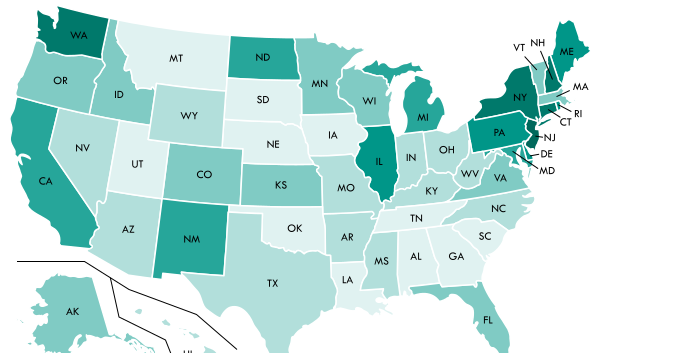
Most common states for program evaluators
| Rank | State | Population | # of jobs | Employment/ 1000ppl |
|---|---|---|---|---|
| 1 | North Dakota | 755,393 | 158 | 21% |
| 2 | New Hampshire | 1,342,795 | 211 | 16% |
| 3 | Delaware | 961,939 | 152 | 16% |
| 4 | Rhode Island | 1,059,639 | 157 | 15% |
| 5 | Montana | 1,050,493 | 150 | 14% |
| 6 | Utah | 3,101,833 | 390 | 13% |
| 7 | Minnesota | 5,576,606 | 674 | 12% |
| 8 | Colorado | 5,607,154 | 671 | 12% |
| 9 | Oregon | 4,142,776 | 504 | 12% |
| 10 | Nebraska | 1,920,076 | 225 | 12% |
| 11 | South Dakota | 869,666 | 107 | 12% |
| 12 | District of Columbia | 693,972 | 85 | 12% |
| 13 | Connecticut | 3,588,184 | 411 | 11% |
| 14 | New Mexico | 2,088,070 | 203 | 10% |
| 15 | Idaho | 1,716,943 | 177 | 10% |
| 16 | Maine | 1,335,907 | 136 | 10% |
| 17 | New Jersey | 9,005,644 | 777 | 9% |
| 18 | Arizona | 7,016,270 | 636 | 9% |
| 19 | Wisconsin | 5,795,483 | 501 | 9% |
| 20 | Alabama | 4,874,747 | 416 | 9% |
Most common cities for program evaluators
| Rank | City | # of jobs | Employment/ 1000ppl | Avg. salary |
|---|---|---|---|---|
| 1 | Annapolis | 1 | 3% | $53,821 |
| 2 | Bangor | 1 | 3% | $54,890 |
| 3 | Belleville | 1 | 2% | $55,499 |
| 4 | Bethesda | 1 | 2% | $53,060 |
| 5 | Tampa | 2 | 1% | $51,018 |
| 6 | Albany | 1 | 1% | $39,982 |
| 7 | Bossier City | 1 | 1% | $40,812 |
| 8 | Boulder | 1 | 1% | $49,125 |
| 9 | Washington | 2 | 0% | $75,584 |
| 10 | Anchorage | 1 | 0% | $49,456 |
| 11 | Atlanta | 1 | 0% | $40,262 |
| 12 | Baltimore | 1 | 0% | $54,020 |
| 13 | Birmingham | 1 | 0% | $39,762 |
Program Evaluator job outlook: Expert opinions
Our panel of program evaluator experts
SUNY Polytechnic Institute
Texas A&M University San Antonio
University of North Florida
University of South Florida
University of South Florida
Idaho State University
SUNY College at Oswego
Texas Tech University Health Sciences Center
Baylor University
Tennessee State University
Northeast Ohio Medical University
Seattle University

East Tennessee State University

Boston University
American University

Frostburg State University
What general advice would you give to a Program Evaluator?
Catherine Annis Ph.D.: The jobs that pay top dollar in the public sector are leadership positions or highly specialized roles, so it is important to focus on building your credentials. Utilize resources like the Bureau of Labor Statistics Occupational Outlook Handbook to easily explore careers by salary, field of degree, education requirements, predicted job growth, and more. Identify and target the jobs you might want early on. Build experience in the content, skills, and experience that will make you a strong candidate for the job. Keep track of instances where you made a positive impact and demonstrated performance success for future job applications and interviews!
What Program Evaluator skills would you recommend for someone trying to advance their career?
Catherine Annis Ph.D.: The world continues to become more interconnected, digitized, and globalized. Strong public sector candidates will be able to demonstrate skills related to collaboration, technology, and foreign language proficiency.
What will help Program Evaluators increase their earning potential?
Catherine Annis Ph.D.: Seek out those in the career paths that you are interested in and ask to meet. Ask them questions about how they got there and details about their work. In this way, you can assess whether that career trajectory fits you while also building your professional network.
What Program Evaluator skills would you recommend for someone trying to advance their career?
Natalie Stepanian Ph.D., RN: Having a degree in Public Health can provide you many opportunities in the job market. There are a wide variety and levels of jobs that are available depending on the degree or degrees you hold. When you are first starting to look at possible venues you would like to work for start with a good internet search. There are many opportunities within the U.S. Public Health Service which most people are unaware of. You can also look at the Department of Health and Human Services with the federal government where Public Health is under their umbrella. This is a federal agency, there are also state and local Public Health Departments that have a variety of jobs. Some of the categories for jobs are: Epidemiology, Disaster and Emergency Specialists, Natural Science Managers, Public Health Nurses, Water Quality Planner, Healthcare Manager, Public Health Educator, Environmental Health Scientist, Biostatistician, Infection Preventionist, Public Health Consultant, Public Health Nutritionist, Health Policy Analyst, Biomedical Researcher, Occupational Health and Safety Specialist, Clinical Research Coordinator, Research Assistant, Nonprofit Coordinator, Nonprofit Executive Director, Social and Community Service Manager, just to name a few. Before you jump in see if you can arrange to shadow someone that is in a Public Health job so you can really see what the job will entail before you pursue it.
What will help Program Evaluators increase their earning potential?
Natalie Stepanian Ph.D., RN: Since the Covid Pandemic of 2020 happened it has been very apparent that our Public Health infrastructure needs to be strengthened at the local, state, and federal levels. Currently there is a great need for individuals with Public Health degrees and training. I only see this need to continue to rise. The U.S. government is making efforts to fortify and strengthen our Public Health services. Between climate change, manmade and natural disasters, viral, bacterial, prion, and vector born illnesses new or emerging outbreaks are continuing.
What general advice would you give to a Program Evaluator?
Shawn Gibbs PhD, MBA, CIH: There are plenty of jobs available in the field of public health. However, the exact position you want may not be in the exact location you want at the exact time that you want. So, it is important to be flexible in your job search. Setting yourself apart from the rest of the applicant pool is also important, you can demonstrate this through your skillsets or through additional certifications that others may not have. Of course, I am biased, but I would also recommend a Texas A&M; University School of Public Health degree; we are a land-grant, space-grant, sea-grant, member of the Association of American Universities so we have everything you could need to set you up for success in your career.
What Program Evaluator skills would you recommend for someone trying to advance their career?
Shawn Gibbs PhD, MBA, CIH: The field of public health offers so many opportunities. I would recommend that you come into the field with a plan but be willing to adapt that plan when new opportunities or interests present themselves to you. This will allow you to accomplish your goals and set new goals as you learn more about public health and how it relates to your own interests and life goals.
What will help Program Evaluators increase their earning potential?
Shawn Gibbs PhD, MBA, CIH: Public Health has a rich history. I think the ability to manage change in the field, including the applicability of new and evolving technologies. Communication is a skillset that always has value, you need to know your audience and be able to meet your audience where they are with your communications.
What general advice would you give to a Program Evaluator?
Stephanie Hooper MPH, HTL: Attaining degrees and additional credentials like certifications and licensures will certainly help with job options as well as salary increases. If there is an area of public health that is of particular interest (i.e., nutrition, physical activity, etc.), researching credible certifications or licenses and attaining them shows a mastery in that area, and dedication to continual education in order to maintain that credential. If there are many applicants competing for the same job, but you are able to show that you have advanced degrees or additional credentials, it could be the difference in landing the position over someone else. Additionally, it is important to recognize that even if you have advanced degrees and credentials, often times in life we have to be willing to start at a lower salary than we had hoped for and work our way up. Many times, public health students are offered positions following an internship role, but the pay may be less than anticipated. It is important to remember that hard work and experience are also essential for getting our salaries to where we want them to be.
What Program Evaluator skills would you recommend for someone trying to advance their career?
Stephanie Hooper MPH, HTL: One of the most important things to do is volunteer or shadow at places that align with your future professional goals. Not only does doing these types of activities show potential employers that you are ambitious and willing to put in the time needed to be successful, sometimes we think that a career might be the one for us but once we get out there and try it, our opinion changes. Public health is an extremely broad field so getting hands-on experience can be extremely beneficial for helping to narrow down the choices and save time and money in the long run by eliminating what you are not interested in.
What will help Program Evaluators increase their earning potential?
Stephanie Hooper MPH, HTL: In the next 5 years I think it will be extremely important to have basic computer skills in many areas including Microsoft Office and even data analysis software. No matter what area of public health we work in, data is collected and used to determine population health issues, resources available/lacking, and effectiveness of health or education programs. Therefore, if young professionals are able to utilize the basic data collection and analysis tools, they will be best prepared to enter the workforce. Additionally, public speaking skills are essential in this field. Even if you land a job that does not require speaking at a conference, we are always tasked with presenting our public health findings to a wide variety of players including community members and various stakeholders; so, having presentation skills and being comfortable speaking in front of others is very useful. Aside from the aforementioned skills, I also believe that communication skills are necessary in public health. As I mentioned previously, we are interfacing with all sorts of groups, and with large populations of people. Therefore, aside from having the ability to speak publicly, understanding how to create written materials (i.e., fact sheets), and using social media to create health content is invaluable. Being that technology is continually expanding, and along with that means of communication are shifting, it is important to stay on top of trends and familiarize ourselves with new communication platforms as they allow us to reach large audiences in real-time.
Ms. Michelle Edelstein MPH
Director of Marketing and CommunicationWhat general advice would you give to a Program Evaluator?
Ms. Michelle Edelstein MPH: Attached are responses from Claire Brown, MPH, Director for Student Experiences & Alumni Affairs, Rutgers School of Public Health.
What Program Evaluator skills would you recommend for someone trying to advance their career?
Ms. Michelle Edelstein MPH: Attached are responses from Claire Brown, MPH, Director for Student Experiences & Alumni Affairs, Rutgers School of Public Health.
What will help Program Evaluators increase their earning potential?
Ms. Michelle Edelstein MPH: Attached are responses from Claire Brown, MPH, Director for Student Experiences & Alumni Affairs, Rutgers School of Public Health.
What general advice would you give to a Program Evaluator?
Maureen Chiodini-Rinaldo: God gave you two ears and one mouth. Listen twice as much as you talk. Remain open-minded and stay in touch with your mentors. We should always be learning. Find your path and your niche by doing what makes you happy. Don't chase the money. If you are happy and doing what you love and are passionate about, the money will come.
What general advice would you give to a Program Evaluator?
Laura Rusnak MPH, CPH, CHES: People need to know their specific area within public health and understand the salary potential for that specific field. They also need to realize that for-profit organizations are going to pay folks very differently than non-profits or governmental organizations. While salary is important, so are benefits like healthcare, educational assistance, work-life balance, and many others. Graduates need to consider the whole compensation package and do their research on the industry, as well as employer, within their field of interest.
What Program Evaluator skills would you recommend for someone trying to advance their career?
Laura Rusnak MPH, CPH, CHES: Find your passion and jump in to gain experience. Many students don't know "what I want to do with my life" and feel stuck. They don't know how to figure that out. It doesn't come from thinking about it. It comes from DOING it and gaining some hands-on experience. Part-time jobs, volunteering, and internships all provide invaluable experience that students need to figure out the best fit for them in the beginning of their careers. I advise students to get out there and gain experience early on, even before they graduate if they can. Getting into the field will help you decide if you're doing what you should be doing, and the steps you need to take to cultivate your career in public health.
What will help Program Evaluators increase their earning potential?
Laura Rusnak MPH, CPH, CHES: Technology skills are essential, as are people skills. Being able to leverage technology is essential to improving health outcomes. But public health professionals also need to be able to deal with people. Technology is going to be able to do many of the tasks that people used to do. But it is people who will have to effectively leverage that technology and make sure that it is being used correctly/ethically. And people want to get health services from humans, not computers. Computers can't do what we do in public health. So we need to be able to leverage technology and keep doing what computers can't, personalizing public health activities.
What general advice would you give to a Program Evaluator?
Kristin Van De Griend PhD, MPH: Try to gather as much information as you can about current trends in salaries in the field. Ask your colleagues, professors, and career counselors, and then negotiate for yourself before you accept a job offer. Often, you can negotiate salary, paid time off, parental leave, and startup costs for research.
What Program Evaluator skills would you recommend for someone trying to advance their career?
Kristin Van De Griend PhD, MPH: According to the Council on Education for Public Health, graduates of public health programs should be skilled in explaining and addressing the 'cultural, social, political, and economic determinants of health and how the determinants relate to population health and health inequities.' They should also understand how globalization impacts population health, with special attention to disparities among different populations. The focus in public health has moved from individual behaviors and behavior change to communities and partnerships.
What will help Program Evaluators increase their earning potential?
Kristin Van De Griend PhD, MPH: To maximize your salary potential, try to gather as much information as you can about current trends in salaries in the field. Ask your colleagues, professors, and career counselors, and then negotiate for yourself before you accept a job offer. Often, you can negotiate salary, paid time off, parental leave, and startup costs for research.
Dr. Jessica Harris CHES
Assistant Professor of Health Promotion and Wellness Management at SUNY Oswego, Assistant Associate Director of the Honors Program at SUNY Oswego, Part-time Instructor at Syracuse University Exercise Science Falk College, and Certified Health Education SpecialistSUNY College at Oswego
Gerontology
What general advice would you give to a Program Evaluator?
Dr. Jessica Harris CHES: Adapting to evolving trends, technologies, and population needs will be critical for success in the health promotion field in the coming years. Alongside this trend, digital health literacy is set to become increasingly important, with virtual care delivery and integration of digital health technologies into everyday practice. Furthermore, cultural awareness and diversity awareness will remain essential as the field continues to serve diverse populations, requiring professionals to tailor interventions that resonate with different cultural backgrounds.
What Program Evaluator skills would you recommend for someone trying to advance their career?
Dr. Jessica Harris CHES: Acquiring additional certifications or specialized training in high-demand areas can significantly enhance your qualifications and marketability, thereby potentially increasing your earning potential. Secondly, actively seek out opportunities for career advancement and professional growth within your organization or through networking with industry peers and mentors.
What will help Program Evaluators increase their earning potential?
Dr. Jessica Harris CHES: For graduates stepping into their career field, I suggest fostering a curious and adaptable mindset. This is crucial as many fields are constantly evolving, with new research, technology, and approaches emerging regularly. Staying updated on current trends, best practices, and advancements can be achieved through seizing learning opportunities like workshops and conferences. Furthermore, strong communication and interpersonal skills are essential for effective collaboration and engagement with diverse populations.
What general advice would you give to a Program Evaluator?
Gerard Carrino PhD, MPH: Many public health jobs are in the public and nonprofit sectors, which offer a lot of autonomy, authority, and visibility, while providing a good paycheck, great benefits, and solid job security. You can maximize your earning potential in these sectors by learning a few skills that most graduates and many in the workforce don’t have, such as project management, budgeting, and managing disaster scenarios. You can also double down on some highly sought-after skills like mathematical modeling of disease or working with Big Data, if that’s your skillset. More and more, private industry is recognizing the extraordinary value of the public health degree - which helps make it the second fastest-growing undergraduate degree in the nation - because our graduates hit the ground running and are able to apply real-world skills like critical thinking, evaluating evidence, and project management immediately after graduation.
What Program Evaluator skills would you recommend for someone trying to advance their career?
Gerard Carrino PhD, MPH: Public health professionals must be curious, open-minded, systematic, and adaptable to rapidly changing situations. Now and in the near future, being creative and cool-headed and having an entrepreneurial spirit will certainly help too. At the Julia Jones Matthews School of Population and Public Health, we teach all our students to think critically; to evaluate facts and evidence fairly, systematically, and dispassionately; and to make tough decisions when situations are uncertain. By the time you graduate from a public health program, you should have a command of common tools like Microsoft Excel, you should understand the great promise and potential peril of artificial intelligence, you should be able to interpret Big Data to make important decisions, and you should be able to spot misinformation and disinformation from a mile away.
What will help Program Evaluators increase their earning potential?
Gerard Carrino PhD, MPH: Be curious, and be open to a very different way of thinking about health, healthcare, illness, and wellness. Rather than working to cure disease or to fix people up after they get sick or hurt, public health professionals work to make sure they don't get sick or injured in the first place. At the Julia Jones Matthews School of Population and Public Health, our goal is to ensure the well-being of entire communities and populations, analyzing trends, identifying root causes, and implementing interventions to promote health and wellness on a large scale.
Gabriel Benavidez MPH, PhD
Assistant Professor - EpidemiologyBaylor University
Public Health
What general advice would you give to a Program Evaluator?
Gabriel Benavidez MPH, PhD: I think students can maximize their salary potential by having a strong technical skill set. The more a graduate knows how to do, the more valuable they make themselves to future employers. Another important aspect is networking. Graduates should also attempt build a large network of individuals from a variety of different career fields. Building a strong professional network can open doors to opportunities that may not be advertised publicly. Attend industry conferences, join professional organizations, and connect with alumni to expand your network
What Program Evaluator skills would you recommend for someone trying to advance their career?
Gabriel Benavidez MPH, PhD: Many skills in the field of public health are likely to become more crucial due to technological advancements and evolving health priorities. Proficiency in data analytics and digital health tools will be extremely important as public health increasingly relies on big data and telehealth technologies for decision-making and health management. Skills in health equity and cultural competency will be essential, with a growing focus on designing inclusive health programs that address disparities and reach diverse communities effectively. Additionally, the COVID-19 pandemic highlighted the importance of interdisciplinary collaboration and crisis management. Public health professionals will need to adeptly manage cross-sector partnerships and navigate complex crisis scenarios, including emergency preparedness and response. Effective communication and policy advocacy skills will also be critical for conveying public health messages and influencing health policies in response to emerging global health challenges and misinformation.
What will help Program Evaluators increase their earning potential?
Gabriel Benavidez MPH, PhD: I would tell recent public health graduates, both grad and undergrad, not to underestimate their skills. Public health training equips students with a robust and diverse range of skills that are highly applicable across various roles and fields, even outside traditional public health paths. So, when you're out there job hunting, think outside the box. Your public health skills are not just applicable to traditional public health roles; they’re applicable and needed across a spectrum of careers.
Charles Brown Ph.D., M.Ed.
Associate ProfessorTennessee State University
Health Professions And Related Clinical Sciences
What general advice would you give to a Program Evaluator?
Charles Brown Ph.D., M.Ed.: Recent graduates should strive to acquire skills that are transferrable throughout various sectors of the health field. For instance, project management, business, and collaboration skills are imperative and tends to offer individuals numerous opportunities when seeking to maximize their overall salary potential.
What Program Evaluator skills would you recommend for someone trying to advance their career?
Charles Brown Ph.D., M.Ed.: In the next 3-5 years, it will be important for graduates to become proficient in collecting, analyzing, and reporting data to better understand the barriers, facilitators, and effective strategies that may be used to help people improve their overall health.
What will help Program Evaluators increase their earning potential?
Charles Brown Ph.D., M.Ed.: My advice to recent graduates is to become more self-aware of your professional strengths and areas for improvement in the field. With this in mind, pursuing opportunities that offers the ability to work on areas for improvement and utilizing key strengths may be the best approach for recent graduates. This realization may lead graduates to their next set of experiences in the field.
Amy Lee MD, MPH, MBA
Professor and Program DirectorNortheast Ohio Medical University
Public Health
What general advice would you give to a Program Evaluator?
Amy Lee MD, MPH, MBA: For any field, including public health, I would advise a graduate to network—speak to everyone and find mentors. If you aspire to be promoted in your organization, talk to people who are in a job that you want and find out what they would advise that you do to grow and develop your career.
What Program Evaluator skills would you recommend for someone trying to advance their career?
Amy Lee MD, MPH, MBA: To maximize your salary potential, young professionals should keep on top of their field. This includes finding mentors, expanding your network, asking questions, finding out what others are doing.
What will help Program Evaluators increase their earning potential?
Amy Lee MD, MPH, MBA: Public health is diverse! However, general skills that will be more important in the next few years are communication and the ability to collaborate. Being able to address misinformation and being able to use multiple channels of communication, including social media is important to deliver evidence-based information to the public. Collaboration is important to mobilize resources and to change systems to improve the community’s health.
Theresa Earenfight Ph.D.
Professor of History, Director, Women, Gender, and Sexuality Studies ProgramSeattle University
History Department
Will there be an enduring impact of the coronavirus pandemic on Program Evaluators?
Theresa Earenfight Ph.D.: As a historian of the European Middle Ages, I'm struck by how students this past year have acquired something scarce: historical empathy. The past can seem so remote, so very different from our lived experiences today, and this can make history seem irrelevant. But this fall, I was teaching a section on the bubonic plague, which historians of medicine now know was a global pandemic, not just an epidemic in Europe. Usually, students are fascinated by the gruesome medical details, but not this group.
They did not need or want to look death in the eyes. They wanted to know how did people react? How did they get back to normal? When we ticked off the list of reactions--fear, distrust of science (such as it was in 1348), xenophobia, scapegoating, economic collapse, hoarding supplies, turn to religion, gallows humor about worms crawling about corpses--they got it. When we talked about the aftermath--eat, drink, be merry, and protest the inequality--they got it. That is historical empathy, and I'm sad that this was how it had to be learned, but it will give them broader compassion that can encompass people alive today.
Will there be an enduring impact of the coronavirus pandemic on Program Evaluators?
Dr. Frederick Gordon Ph.D.: Graduate students will need to refocus on the changing institutional role, being both remote and in-person, and impacting agency goals and performance.
How do you envision technology impacting Program Evaluators in the next 5 years?
John Marston: More opportunities for remote work as organizations become more comfortable with small platforms.
How do you envision technology impacting Program Evaluators in the next 5 years?
Dr. Adelaide Kelly-Massoud: Well, every teacher and teacher candidate was thrust into distance learning. Misguided attempts to foster understanding often leaned our adult distant learning pedagogy. Teachers, and those who prepare teachers, found their job to research, define, design, and implement meaningful teaching and learning using a virtual platform. Words such as synchronous and asynchronous are now a part of our everyday vernacular. But there is a much more optimistic change on the horizon that we can thank coronavirus for.
Communication and collaboration have been forced to change. Parents and Teachers are more connected and have been put in a position to leverage technology to build networks of support and consistent dialog. I urge teachers to leverage this in their future as we work to reopening schools; we should learn from this experience to leverage technology to keep us connected.
Jamelyn Tobery-Nystrom
Coordinator of M.Ed. Special EducationFrostburg State University
Educational Professions
What type of skills will young Program Evaluators need?
Jamelyn Tobery-Nystrom: Special education needs are wide and varying, depending on position and state/jurisdiction needs. In general, knowledge and experience in the Autism Spectrum is a high need area. Knowledge and skills in behavioral/mental health are also in demand. Indeed, due to the COVID-19 pandemic, the ability to adapt instruction online is a new skill area for special education teachers.