What does a program planner do?

A program planner is responsible for facilitating and developing program agendas according to business requirements and specifications. Program planners manage program activities by following budget limitations, identifying resources, and finalizing the total count of participants. They also coordinate with professional event planners for recovery solutions should any issues arise. A program planner must have excellent communication and organizational skills, especially in updating the program manager of updates and plan adjustments as needed to achieve program goals and objectives.
Program planner responsibilities
Here are examples of responsibilities from real program planner resumes:
- Create and manage integrated master project plans with detail WBS structures.
- Manage part parameters in order to run MRP effectively to maintain a continuous supply chain at the targeted inventory levels.
- Display excellent leadership skills in directing the performance of the IPT leads and integrate program level performance for program monthly reviews.
- Conduct intensive interfacing with engineering and IPT leads to analyze complex schedules and develop viable action plans for scheduling risk mitigation.
- Develop and manage the SharePoint database.
- Resolve issues regarding logistics, repair cycles, materials returns and cross-contamination; manage all supply-chain relate escalated issues.
- Direct customer and DCMA interface.
- Facilitate all team planning sessions and WBS development sessions.
- Identify schedule risks using EVMS and critical path methodologies.
- Establish and define program plan requirements for DOD contracts.
- Conduct review of DOD projects within guidelines of FAR/DFAR.
- Establish mitigation plans and ensure approve mitigation steps are integrate in the IMS.
- Issue work orders in timely MRP manner while assisting in creation of material requirement.
- Furnish copies of schedules to NASA for their use in briefing MSFC upper management.
- Provide detail analysis of the IMS and supporting documents to ensure quality, completeness and compliance.
Program planner skills and personality traits
We calculated that 12% of Program Planners are proficient in Program Planning, Program Management, and Master Schedule. They’re also known for soft skills such as Leadership skills, Analytical skills, and Communication skills.
We break down the percentage of Program Planners that have these skills listed on their resume here:
- Program Planning, 12%
Provided program planning support and monitoring of all financial activities for procurement, maintenance and facility organizations.
- Program Management, 10%
Prepared documentation detailing baseline changes to labor budget or schedule for approval by program management.
- Master Schedule, 9%
Created and maintained numerous Integrated Master Schedules with complex integrated logic networks.
- Microsoft Project, 9%
Prepare actual spending reports, and project control of government projects, using SAP, Microsoft Project and Excel.
- Earned Value Management, 8%
Developed and refined knowledge of Earned Value Management and Critical Path Methodology.
- Management System, 6%
Initiate and maintain all material requirements for assigned projects within the company Material Management System, based on engineering design.
Most program planners use their skills in "program planning," "program management," and "master schedule" to do their jobs. You can find more detail on essential program planner responsibilities here:
Leadership skills. The most essential soft skill for a program planner to carry out their responsibilities is leadership skills. This skill is important for the role because "urban and regional planners must be able to manage projects, which may include overseeing tasks and planning assignments." Additionally, a program planner resume shows how their duties depend on leadership skills: "interact with client project controls leadership for contractor compliance in maintenance and reporting. "
Analytical skills. Many program planner duties rely on analytical skills. "urban and regional planners analyze information and data from a variety of sources, such as market research studies, censuses, and environmental impact studies," so a program planner will need this skill often in their role. This resume example is just one of many ways program planner responsibilities rely on analytical skills: "worked within the program management office to manage, interpret, and communicate program related data thereby optimizing evidence-based decision making. "
Communication skills. Another skill that relates to the job responsibilities of program planners is communication skills. This skill is critical to many everyday program planner duties, as "urban and regional planners must be able to communicate clearly and effectively because they interact with colleagues and stakeholders, prepare research reports, give presentations, and meet with a wide variety of audiences, including public officials, interest groups, and community members." This example from a resume shows how this skill is used: "managed all materials planning communications between manufacturing and program management. "
The three companies that hire the most program planners are:
- Lockheed Martin52 program planners jobs
- Raytheon Technologies18 program planners jobs
- ClearPlan
16 program planners jobs
Choose from 10+ customizable program planner resume templates
Build a professional program planner resume in minutes. Our AI resume writing assistant will guide you through every step of the process, and you can choose from 10+ resume templates to create your program planner resume.


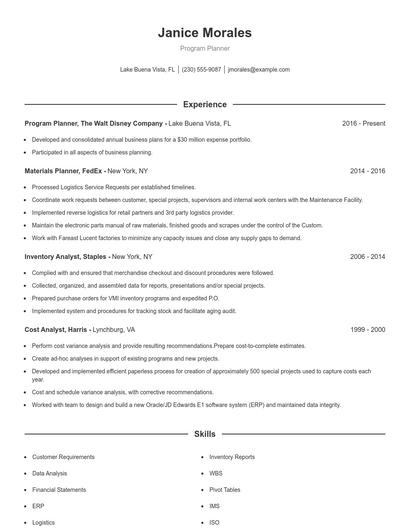


Compare different program planners
Program planner vs. Urban design consultant
An urban design consultant is in charge of many projects, and so they have to oversee tasks and plan assignments. They are skilled in creating interior design solutions, space planning, sketching, and product selection. They have to analyze information and data gotten from market research studies and censuses. They also have to do presentations and prepare reports.
These skill sets are where the common ground ends though. The responsibilities of a program planner are more likely to require skills like "program planning," "program management," "master schedule," and "microsoft project." On the other hand, a job as an urban design consultant requires skills like "gis," "urban design," "sketch," and "landscape architecture." As you can see, what employees do in each career varies considerably.
Urban design consultants really shine in the telecommunication industry with an average salary of $63,199. Comparatively, program planners tend to make the most money in the technology industry with an average salary of $68,661.On average, urban design consultants reach higher levels of education than program planners. Urban design consultants are 22.1% more likely to earn a Master's Degree and 0.1% less likely to graduate with a Doctoral Degree.Program planner vs. Housing grant analyst
When it comes to planning an internship, an intern's duties will depend on the directives of supervising staff or a manager. Typically, an intern's responsibilities will revolve around performing clerical tasks such as processing documents, producing reports and presentations, responding to calls and correspondence, and managing schedules. There are also instances where an intern must share ideas and insights, attend meetings, maintain records, update databases, and assist staff in various tasks while under more experienced colleagues' supervision.
Each career also uses different skills, according to real program planner resumes. While program planner responsibilities can utilize skills like "program planning," "program management," "master schedule," and "microsoft project," housing grant analysts use skills like "grants management," "affordable housing," "appeals," and "financial data."
On average, housing grant analysts earn a lower salary than program planners. Some industries support higher salaries in each profession. Interestingly enough, housing grant analysts earn the most pay in the education industry with an average salary of $55,298. Whereas program planners have higher pay in the technology industry, with an average salary of $68,661.Average education levels between the two professions vary. Housing grant analysts tend to reach similar levels of education than program planners. In fact, they're 3.7% less likely to graduate with a Master's Degree and 0.1% more likely to earn a Doctoral Degree.Program planner vs. Planning internship
The required skills of the two careers differ considerably. For example, program planners are more likely to have skills like "program planning," "program management," "master schedule," and "microsoft project." But a planning internship is more likely to have skills like "gis," "arcgis," "photoshop," and "transportation planning."
Planning interns make a very good living in the professional industry with an average annual salary of $41,003. On the other hand, program planners are paid the highest salary in the technology industry, with average annual pay of $68,661.Most planning interns achieve a lower degree level compared to program planners. For example, they're 6.0% less likely to graduate with a Master's Degree, and 0.0% less likely to earn a Doctoral Degree.Program planner vs. Community development planner
Types of program planner
Updated January 8, 2025
