
Automatically apply for jobs with Zippia
Upload your resume to get started.
Program trainer skills for your resume and career
15 program trainer skills for your resume and career
1. Work Ethic
- Developed occupational workshops on work ethics and performance.
- Identified and assessed the participants' skills, interests, work values, strengths, weaknesses, and work ethics.
2. PowerPoint
- Go over a PowerPoint presentation with New Hires and Trainer.
- Experience with Microsoft systems, including Excel and PowerPoint.
3. On-The-Job Training
- Received on-the-job training in customer service excellence and cash handling while working at the Pac Tower Caf .
- Trained and managed 12 individuals with limitations with on-the-job training skills and achieved significant improvements in their productivity.
4. Professional Development
Professional development means to have the essential training certification or education with the purpose of earning and having a successful career. Every job requires a different set of skills. However, new skills may be needed in the future. Professional development, in this regard, helps people to develop and polish the skills and become efficient workers.
- Facilitated professional development training for second year teachers.
- Present professional development in 1-1 and small group settings.
5. Training Classes
A training class is a series of classes/lessons designed to impart skills and knowledge for a specific job or activity or to develop skills and knowledge or fitness to specific useful skills in oneself or others. There are a variety of benefits for the trainee, including improved self-esteem, motivation, and confidence, acquiring a new skill or qualification, updating skills, and keeping in touch with new developments in the field.
- Conducted job training classes for new employees teaching principles, techniques, procedures and methods of At&T U- Verse.
- Facilitated training classes for new hires, and conducted refresher classes.
6. Customer Service
Customer service is the process of offering assistance to all the current and potential customers -- answering questions, fixing problems, and providing excellent service. The main goal of customer service is to build a strong relationship with the customers so that they keep coming back for more business.
- Conducted quality assurance testing for proprietary file management and customer service management systems which improved the user experience across departments.
- Provided excellent customer service in a fast-paced, detail-oriented, high demand environment.
Choose from 10+ customizable program trainer resume templates
Build a professional program trainer resume in minutes. Our AI resume writing assistant will guide you through every step of the process, and you can choose from 10+ resume templates to create your program trainer resume.7. Training Sessions
- Design and deliver training sessions on website functionality and implementation.
- Coordinate conferences and training sessions related training application events.
8. Management Training
- Selected for the Leadership Development Program - management training program -taking ongoing training seminars to develop my coaching and administrative skills.
- Participated in Account Management Training Program.
9. Training Curriculum
- Developed integrated treatment plans & delivered the training curriculum.
- Tailored training curriculum to unique learning styles and personality types to fit multiple adult learners.
10. Learning Techniques
- Utilized effective presentation skills including creative training techniques and adult/accelerated learning techniques.
- Utilize adult/accelerated learning techniques; teach classes for the DirecTV Project.
11. Facilitation
- Led project management, curriculum writing and pilot facilitation in collaboration with advisory team.
- Participated in AECOM training - Presentation skills, Presentation facilitation and other subjects.
12. Training Materials
- Prepared training materials for various delivery methods, including facilitator led lectures and class discussions.
- Experienced in presentation of training materials and facilitating course.
13. Medicare
Medicare is a federal government insurance program that offers health care coverage to people who are 65 and above. In some cases, younger people with disabilities whose status is identified by the SSA can also avail the insurance program. Medicare covers the health expenses of people who are not able to afford it plus it protects the payee from rising health care costs.
- Served insurance members with complete and accurate information regarding Medicare, Medicaid and insurance coverage benefits.
- Assisted Medicare beneficiaries with eligibility questions, coverage and claim issues.
14. Blended Learning
- Collaborated with external subject matter experts to develop blended learning solutions.
- Design, develop, and conduct blended learning solutions for on-demand learning with valid and reliable assessments and streamlined record keeping.
15. Commercial Banking
- Acquired a thorough knowledge of the commercial banking industry.
5 Program Trainer resume examples
Build a professional program trainer resume in minutes. Browse through our resume examples to identify the best way to word your resume. Then choose from 5+ resume templates to create your program trainer resume.

What skills help Program Trainers find jobs?
Tell us what job you are looking for, we’ll show you what skills employers want.
What program trainer skills would you recommend for someone trying to advance their career?
Jaunelle Celaire
Chair, Professor of Voice, University of Alaska Fairbanks
What type of skills will young program trainers need?
Edwin Garro
ASQ Board of Directors, ASQ Fellow & CEO, PXS, Performance Excellence Solution, ASQ
Additionally, respect for all people and humility. New graduates should enter the job market willing to know, understand and accept their peers, bosses, and employees (if they start their careers as new managers or supervisors), and that requires a lot of real listening, an open mind, and "not knowing."
For hard skills, technology is a big part of any profession these times. The required skills are way more than simply a passive use of technology, so being good in apps, specialized software, and hardware is just not enough. New professionals do need to know how to speak with algorithms and to write software code; sooner or later, the ability to write even a small piece of code will come in very handy.
What technical skills for a program trainer stand out to employers?
Maria Salazar Ph.D.
Professor, University of Denver
It is important to foster a growth-mindset in oneself, and also in one's school community. Employers are also looking for a commitment to educational equity. With emerging consciousness of racial inequality and the need for systems that promote racial justice, employers want to hire people who are culturally competent and can move beyond statements of the value of diversity, to the enactment of educational environments that promote equity for those who are marginalized. This skill set includes: cross-cultural communication, culturally responsive teaching, and strength-based practices.
List of program trainer skills to add to your resume
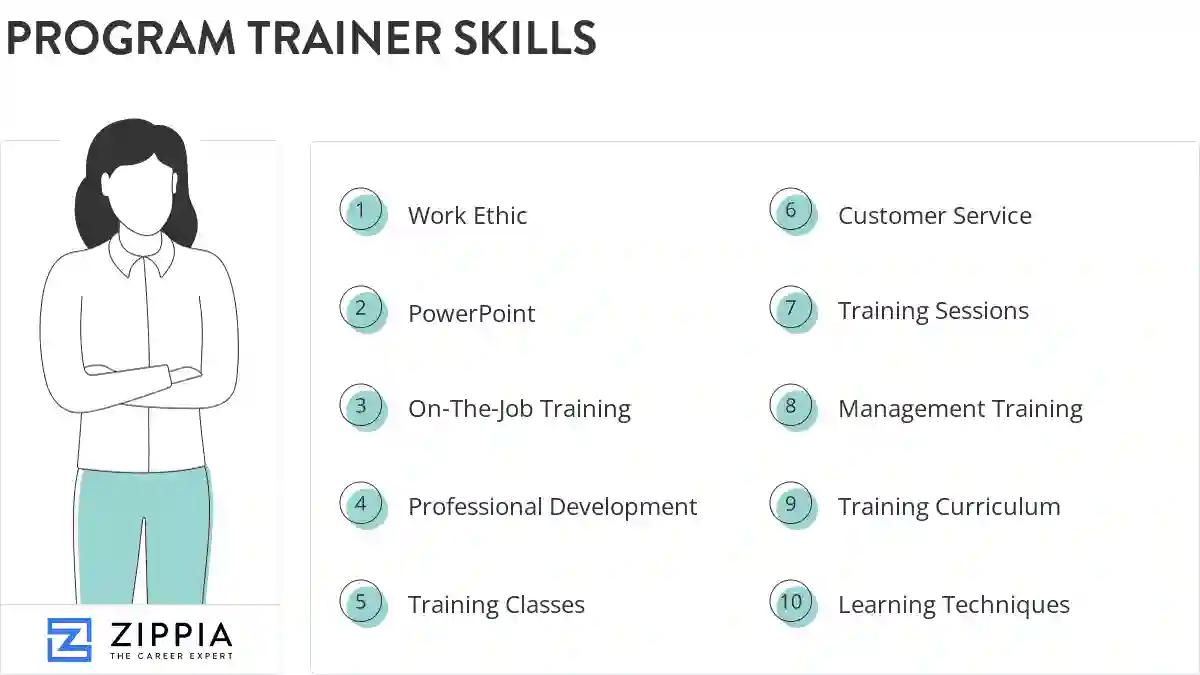
The most important skills for a program trainer resume and required skills for a program trainer to have include:
- Work Ethic
- PowerPoint
- On-The-Job Training
- Professional Development
- Training Classes
- Customer Service
- Training Sessions
- Management Training
- Training Curriculum
- Learning Techniques
- Facilitation
- Training Materials
- Medicare
- Blended Learning
- Commercial Banking
- CPR
- Direct Care
- Developmental Disabilities
- Front Desk
- Administrative Tasks
- Applied Behavior Analysis
- Financial Analysis
- Medicaid
- Direct Supervision
- Training Courses
- Education Programs
- Intellectual Disabilities
- Various Training
- Windows
- HR
- Continuous Improvement
- Client Programs
- Depth Training
- Product Knowledge
- Led Training
- PST
Updated January 8, 2025
