
Automatically apply for jobs with Zippia
Upload your resume to get started.
Protective services officer skills for your resume and career
15 protective services officer skills for your resume and career
1. Patrol
- Coordinated with outside agencies regarding effective patrol responses.
- Perform patrol duties throughout the DHS facility looking to render any employees/visitors with assistance and to report any dangerous harmful condition.
2. Patients
- Monitored psychiatric patients to prevent self-inflicted injuries and protect medical staff from physical harm.
- Perform security duties and provides a safe atmosphere for patients, visitors and staff by surveillance and identifying security issues.
3. CPR
Cardiopulmonary resuscitation or CPR is a medical procedure that involves chest compression to help a patient breathe. This artificial ventilation helps in keeping the brain function in place and regulates blood throughout the body. CPR is a lifesaving procedure that is used in emergencies.
- Operate emergency equipment, perform first aid including CPR, take accurate notes of the scene, and write detailed reports.
- Red Cross CPR and First Aid Teaching Certificate.
4. Protective Services
Protective services are services offered to vulnerable individuals or legal representatives to protect them against potential abuse, violence, or negligence. Protective services are offered to ensure that an individual's safety stays intact and they don't fall victim to crime or exploitation. Such services include, social casework, stated appointed witness protection, home care, legal assistance, day-care etc.
- Provided protective service responsibilities to employees and visitors to office buildings that housed federal government offices.
- Specialized training provided by Federal Protective Services under direction of the US Department of Homeland Security.
5. Emergency Situations
- Qualified to carry an automatic weapon and underwent extensive training in order to deal with dangerous emergency situations.
- Responded to emergency situations in accordance with established protective security policies, standards, and procedures.
6. Safety Hazards
Safety hazards are defined as any potential source of danger or harm to a person's health and safety. The term commonly refers to the risks associated with the kind of occupation or work. The five common types of occupational safety hazards are; biological (health risks from viruses, bacteria, insect,s, etc.), chemical (dangerous substances used in manufacturing plants), physical (risk of injury associated with labor), Ergonomic (worker's efficiency during work), and Psychosocial (mental health risks involved with certain occupations).
- Diffuse irregular or unusual conditions that may create security concerns or safety hazards for customers, employees and visitors.
- Conducted safety searches and seizures and inspected fire and safety hazards.
Choose from 10+ customizable protective services officer resume templates
Build a professional protective services officer resume in minutes. Our AI resume writing assistant will guide you through every step of the process, and you can choose from 10+ resume templates to create your protective services officer resume.7. Control Systems
- Program access control systems for Maricopa County employees.
- Monitored environmental control systems to ensure proper oxygen levels and potential toxic levels were at acceptable levels.
8. Criminal Justice
- Certified by Virginia Department of Criminal Justice Services.
- Certified by the Virginia Department of Criminal Justice Services as a Armed Protection Officer.
9. Incident Reports
An Incident Report, in a medical facility such as hospitals and nursing homes, is a type of paperwork filled out immediately after and in the case of an incident of some sort, with the goal of describing the incident and its consequences, as well as the measurements taken after or during the incident, as well as any other information relevant to said incident. Such an incident might be a patient acting out or a patient being injured.
- Evaluated, investigated and reported all security and law enforcement incidents and completed incident reports.
- Complete daily activity reports and incident reports as required.
10. CCTV
- Monitored Closed Circuit Television (CCTV) for any unauthorized activity.
- Conducted aggressive CCTV monitoring to deter terrorist surveillance and attacks.
11. Emergency Response
- Provide first response capabilities in the event of medical or criminal emergencies in accordance with federal emergency response procedures.
- Selected as an original member of the Laboratory's Security Emergency Response Team (SERT) for its 1981 pilot program.
12. Security Services
Security services provide security to a customer who can pay for the service. They offer different services and packages that start with the basic security to more thorough security. This could include a security guard, with a weapon and a guard dog.
- Perform residence surveys, recommend security services and assist in coordinating physical security installation, maintenance, and report activities.
- Provide medical response, rescue, and security services to an industrial site of up to 1200employees.
13. Federal Facilities
- Uphold all rules and regulations of District of Columbia (DC) federal facilities congruent to federal law.
- X-Ray technician for all the federal facilities in the downtown area.
14. Circuit Television
- Operate X-Ray, Magnetometers, Closed Circuit Television.
- Supervised a comprehensive physical security program involving closed circuit television, intrusion detection systems, and secure entry control points.
15. OC
- Armed weapons for PSO, baton, OC.. and PSO skills if needed..
- Received Unarmed license, and certifications for baton, OC spray and handcuffing.
5 Protective Services Officer resume examples
Build a professional protective services officer resume in minutes. Browse through our resume examples to identify the best way to word your resume. Then choose from 5+ resume templates to create your protective services officer resume.

What skills help Protective Services Officers find jobs?
Tell us what job you are looking for, we’ll show you what skills employers want.
List of protective services officer skills to add to your resume
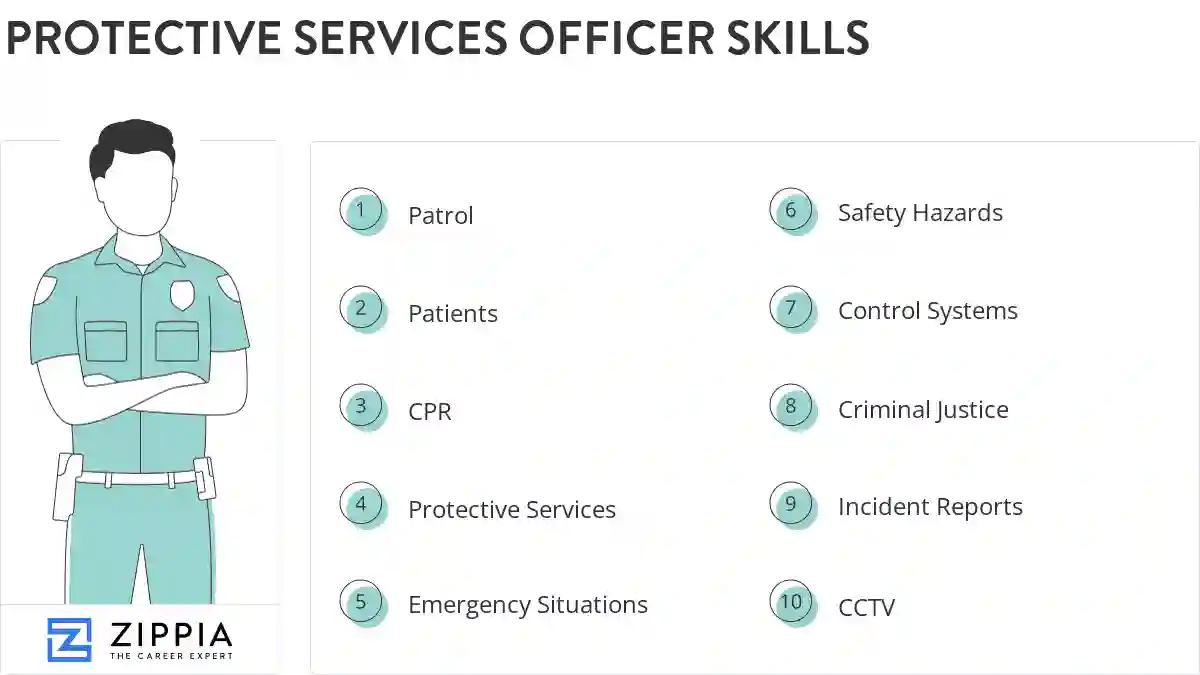
The most important skills for a protective services officer resume and required skills for a protective services officer to have include:
- Patrol
- Patients
- CPR
- Protective Services
- Emergency Situations
- Safety Hazards
- Control Systems
- Criminal Justice
- Incident Reports
- CCTV
- Emergency Response
- Security Services
- Federal Facilities
- Circuit Television
- OC
- Law Enforcement Agencies
- Vehicle Patrols
- Security Systems
- DHS
- Public Safety
- Fire Alarms
- Security Procedures
- X Ray Machines
- Physical Security
- Foot Patrol
- Traffic Control
- X-Ray Machines
- Criminal Acts
- EMT
- Security Measures
- DOJ
- Medical Emergencies
- Property Damage
- PSO
- Crowd Control
- Magnetometers
- Federal Laws
- Metal Detectors
- Alarm Systems
- Security Checks
- GSA
- Emergency Calls
- Federal Property
- Security Patrols
- Property Rules
- Security Breaches
- Security Incidents
Updated January 8, 2025
