
Automatically apply for jobs with Zippia
Upload your resume to get started.
Provider relations specialist skills for your resume and career
15 provider relations specialist skills for your resume and career
1. Provider Relations
- Trained other areas of the organization to improve interdepartmental collaboration and understanding of the Provider Relations team's processes.
- Assisted provider relations staff in promoting provider satisfaction via timely and thorough resolution of provider issues.
2. Medicaid
- Established and maintained positive and productive relations with network providers for Medicaid and Medicare.
- Educate providers about Medicaid Managed Care policy and procedures.
3. Health Plan
- Represented CalOptima at community and health plan-sponsored events.
- Handle customer service inquiries from providers, physicians and internal and external clients related to health plans and medical chart retrieval.
4. Orientation Materials
- Conducted provider orientations for all participating providers in King County WA while authoring/updating orientation materials.
- Perform provider orientations, including updating orientation materials to include most current/ relevant content.
5. Issue Resolution
Issue resolution refers to a set of processes that can be used to resolve an issue, conflict, dispute, or claim, and the ability to deal with the problems that need to be resolved, the decisions that need to be made, and the risks that need to be mitigated. Essentially, an issue resolution process intends to make it easier for people to come to a resolution following an issue.
- Coordinated issue resolution and delivery of accurate information.
- Conducted provider education/issue resolution office site visits.
6. Claims Submission
- Educate providers regarding policies and procedures related to referrals and claims submission.
- Educate providers on new policies and procedures related to referrals and claims submission, website education, solicitation and problem solving.
Choose from 10+ customizable provider relations specialist resume templates
Build a professional provider relations specialist resume in minutes. Our AI resume writing assistant will guide you through every step of the process, and you can choose from 10+ resume templates to create your provider relations specialist resume.7. EDI
- Project lead in various initiatives related to implementation of e-commerce solutions such as EDI interfaces and on-line claims and eligibility look-up.
- Complete, submit, and track Clearinghouse applications for Claim submission (EDI) and Electronic Remittance Advice (ERA).
8. Claims Processing
Claims Processing is the entire workflow involved within the insurance company to evaluate a claim before it gets approved. It has many administrative layers such as assessing insurance eligibility, investigating the medical treatments taken, and reviewing medical codes before it settles or denies a claim with the insured healthcare provider.
- Prevented and/or recovered inappropriate health benefit payments due to claims processing errors and/or abusive and inappropriate billing practices.
- Encouraged Providers to use Web applications for electronic claims processing.
9. Customer Service
Customer service is the process of offering assistance to all the current and potential customers -- answering questions, fixing problems, and providing excellent service. The main goal of customer service is to build a strong relationship with the customers so that they keep coming back for more business.
- Adhered to department operating routines, including policy and procedures, communication and customer service to quickly respond to customer inquiries.
- Provide responsive and professional customer service to providers regarding status of medical authorizations also provide any modifications when applicable.
10. Phone Calls
Phone calls are a wireless or wired connection made over a telephone or a mobile phone between two people. Two parties are involved in a phone call, the caller and the receiver. A caller dials the number of the one he wants to call, and the recipient hears a bell or a tune to which he picks up the call. The call establishes a connection between them through which they can communicate. The voice is converted into signals and is transmitted through wired or wireless technology.
- Assist answering telephone calls if Average Handle Time and Average Speed of Answer metrics were in jeopardy.
- Manage work queues, phone calls, and emails.
11. Network Development
Network development is the process of scaling, developing and automating digital networks so that companies can process data more efficiently. Network development is generally carried out by a network engineer.
- Assisted staff with difficult issues including researching provider project spreadsheets and claims responding to providers and Network Development.
- Maintain and submit all required reports for network development and generate reports as per client and state requirements.
12. Medicare Advantage
- Conduct strategic and tactical plans for membership growth in Medicare Advantage plans through broker relationships, age-in conversion and provider/clinic education.
- Performed as a liaison between the Medicare Advantage plan, and the participating Physician and Hospital Network Organizations.
13. Provider Contracts
The definition of a provider contract is 'an agreement between a contracting entity and a provider according to which the provider agrees to deliver medical services to a claimant under this title in exchange for payment or reimbursement of an agreed-upon amount.' A provider contract relates to exactly one business partner. It consists of a contract header and contract items and details like contract start date, contract end date, authorization group, company code for authorization checks and the number of the business partner who entered the provider contract.
- Managed and increased profit margins for Florida and Georgia transportation providers by negotiating provider contracts for new and existing providers.
- Reviewed current provider contracts and communicated to operations manager its benefits and disadvantages.
14. Medical Terminology
- Maintain a working knowledge of Medicare and medical terminology.
- Assisted with billing operations, with extensive knowledge of ICD-9 coding, HCPCS, CPT medical terminology, and billing procedures.
15. Appeals
- Assisted with provider appeals, physician credentialing process and facility site-reviews when applicable.
- Assisted with the eligibility appeals process for denied attestations.
5 Provider Relations Specialist resume examples
Build a professional provider relations specialist resume in minutes. Browse through our resume examples to identify the best way to word your resume. Then choose from 5+ resume templates to create your provider relations specialist resume.

What skills help Provider Relations Specialists find jobs?
Tell us what job you are looking for, we’ll show you what skills employers want.
What type of skills will young provider relations specialists need?
Elisha Blankson
Program Director NCCU, Assistant Professor, North Carolina Central University
List of provider relations specialist skills to add to your resume
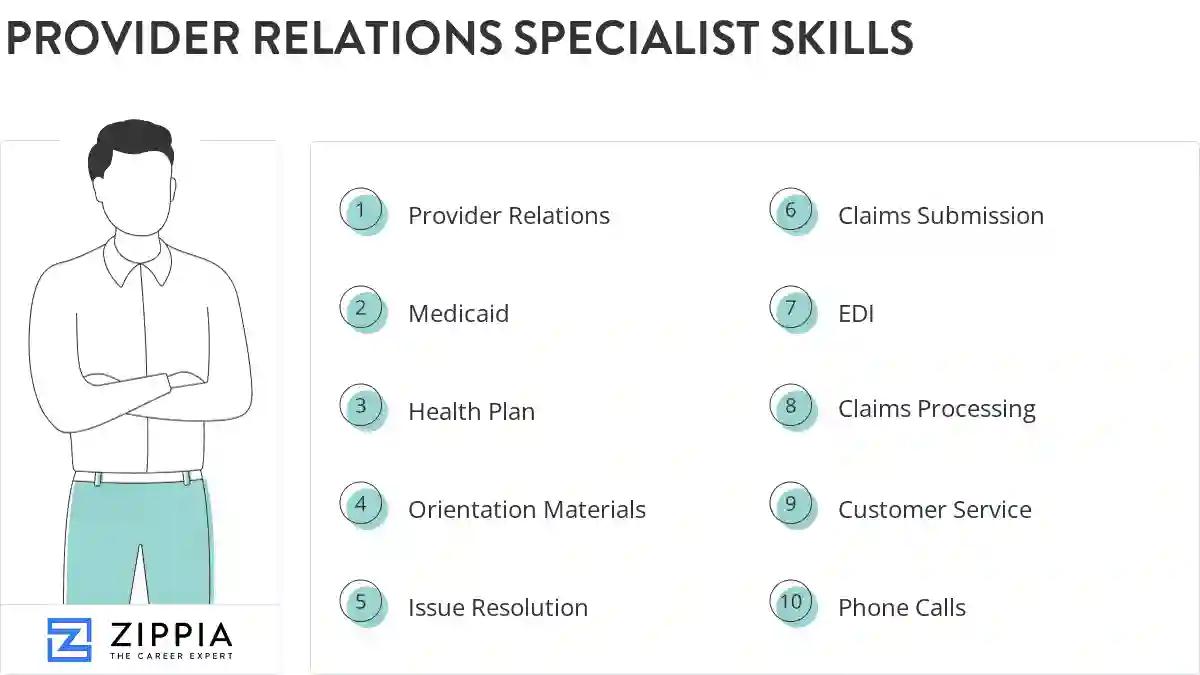
The most important skills for a provider relations specialist resume and required skills for a provider relations specialist to have include:
- Provider Relations
- Medicaid
- Health Plan
- Orientation Materials
- Issue Resolution
- Claims Submission
- EDI
- Claims Processing
- Customer Service
- Phone Calls
- Network Development
- Medicare Advantage
- Provider Contracts
- Medical Terminology
- Appeals
- Physician Practice
- CPT
- Provider Directories
- Fee Schedules
- Provider Data
- Provider Inquiries
- CMS
- IPA
- Provider Education
- HCPCS
- Provider Orientations
- Primary Care
- Billing Issues
- Inbound Calls
- Outbound Calls
- HMO
- Hippa
- Provider Applications
- ICD-9
- Provider Complaints
- CAQH
- NCQA
- Medical Claims
- PowerPoint
- Medical Professionals
- DEA
- Technical Assistance
- Health Fairs
- NPI
- Cactus
Updated January 8, 2025
