
Automatically apply for jobs with Zippia
Upload your resume to get started.
Quality assurance manager/project manager skills for your resume and career
15 quality assurance manager/project manager skills for your resume and career
1. Status Reports
- Managed daily activities, issue resolution and test execution/Defect status reports across project execution teams in order to deliver multiple projects.
- Delivered detailed status reports to project stakeholders on a weekly basis.
2. Project Management
- Maintained strict adherence to standard project management methodology for organization while continuing development of delivery processes for Professional Services Team.
- Created a Project Management Forecasting system to help project managers allocate resources and manage projects.
3. Quality Standards
Quality standards are a specific level of standards of products that are set by the companies for the customers that have to be met and maintained throughout the process until the time of delivery. Quality standards are information that includes the customer's requirements, guidelines, and characteristics for the needed final product or service.
- Develop QA project plan and coordinate with developers, product management, and QA staff to ensure product passes Quality Standards.
- Inspected and Evaluated site installation for quality standards, reporting back to General Manager with field issues and job status.
4. ISO
- Developed corporate operational procedures and Management System Manual for company operations and ISO accreditation.
- Maintained ISO accreditation and performed management reviews.
5. Regression
- Performed manual regression testing utilizing Black Box methodology for web and client-server applications.
- Conducted various tests such as functional, regression, integration, back end testing, system testing and User Acceptance testing.
6. Scrum
Scrum is a lean structure for communicating, designing, and promoting complex products, with a focus on programming development. It has been applied to a variety of areas, including manufacturing, testing, new technology, and marketing techniques. Scrum is a simple framework that helps people, organizations, and teams generate value by providing many solutions to complicated problems.
- Incorporated Agile methodology and SCRUM techniques to manage requirements and enhance the evolving applications.
- Engage in Scrum & Iteration Planning, Retrospective, Show N Tell, and Gate check review etc.
Choose from 10+ customizable quality assurance manager/project manager resume templates
Build a professional quality assurance manager/project manager resume in minutes. Our AI resume writing assistant will guide you through every step of the process, and you can choose from 10+ resume templates to create your quality assurance manager/project manager resume.7. Corrective Action
- Conduct internal audits and monthly surveillance to measure performance, make appropriate recommendation for corrective actions and improvements as necessary.
- Utilized TapRoot software to investigate safety and quality problems, determine root cause and identify corrective action.
8. Test Cases
- Develop test plan/test cases/documents/checklists and report issues.
- Led all aspects of the Quality Assurance processes including development of test plans, test cases and execution of test cases.
9. Quality Audits
- Establish Quality Audit Schedule, reviewed Contractor and METRO specification and Procedures for Quality requirements.
- Ensured safety and compliance accordingly with new government testing standards and implemented quality audit programs.
10. SQL Server
- Provided management skills in migrating from SQL Server environment to ORACLE environment.
- Used skills for migration from SQL Server to Oracle environment.
11. Management Process
- Created the Change Order Management process to complement budgeting and resources within the organization.
- Provided strategy for an effective change management process for the off shore model.
12. PMO
Project management office or, as is often abbreviated, PMO is a part often found in larger companies, agencies, and other organizations of varying sizes. This department's main focus is to create, alter, and help implement project management policies and regulations within their enterprise, through a number of methods and means, such as documents, guides, and personal assistance. A PMO is truly helpful in standardising and improving the way projects are handled, and thus should be good at minimising costs, errors, and incidents.
- Established PMO guidelines, templates, and publications.
- Provided PMO with all required documentation.
13. FDA
The Food and Drug Administration (FDA) is a division of the US Department of Health and Human Services that regulates the production and sale of food, pharmaceutical products, medical equipment, and other consumer goods, as well as veterinary medicine. The FDA is now in charge of overseeing the manufacture of products like vaccines, allergy treatments, and beauty products.
- Recognized by client for establishing one of the most transparent and successful QA processes in the FDA.
- Manage industrial services in accordance with FDA, Governmental and other regulatory standards.
14. UAT
UAT stands for user acceptance testing, and it is the last phase in the software testing process that determines whether the software is fit for the purpose it was built or not. UAT checks two main things; whether the software fulfills the business requirements and can it be used by the end-users. It is the final and most critical step in the testing stages and it determines whether the software should be introduced in the market or not.
- Manage data validation, UI, Automation, Mobile app, UAT support, Production Validation.
- Communicate the environment refresh schedule to the development, SIT, UAT and business teams.
15. Process Improvement
- Developed performance metrics for tracking and trending cost analysis, process improvement and non-conformance.
- Performed process evaluation, troubleshooting, and continuous process improvements to enhance thermal treatment system compliance with RCRA and TSCA regulations.
5 Quality Assurance Manager/Project Manager resume examples
Build a professional quality assurance manager/project manager resume in minutes. Browse through our resume examples to identify the best way to word your resume. Then choose from 5+ resume templates to create your quality assurance manager/project manager resume.

What skills help Quality Assurance Manager/Project Managers find jobs?
Tell us what job you are looking for, we’ll show you what skills employers want.
What skills stand out on quality assurance manager/project manager resumes?
Elisa Chan
Assistant Professor of Marketing, New York Institute of Technology
What quality assurance manager/project manager skills would you recommend for someone trying to advance their career?
Nicole Jones Young Ph.D.
Assistant Professor of Organizational Behavior, Franklin and Marshall College
For students who opt not enter the workforce immediately upon graduation, I would recommend that they utilize this time in a strategic fashion, primarily expanding their network, increasing their skills related to data analytics/analysis, and reading or researching within the broader business field as well as their particular field of interest. Expanding your network is always beneficial because of the value employers place on referrals. If students do not know where to start, I would recommend they join their applicable professional organization and begin attending events (virtual events can still help build relationships).
While specific job duties may differ, the ability to understand and utilize data is in high demand in virtually every job role. Having comfort with data-both quantitative and qualitative--can be a highly beneficial skill that many in the job market may not have to offer.
I also recommend continued reading and researching, as whenever you do enter the workforce you want to know what is going on. I am never surprised, but always disappointed when I ask my students if they heard the latest job numbers or if they saw a recent news article. It is hard to articulate your value to an organization's problems if you are unaware of what they are. Stay current.
Interestingly, I would not recommend that someone enroll in a graduate program simply to take up time. If you just love school, have a clear focus, or had already planned to enroll in graduate school prior to COVID, then proceed. However, if you are unsure about your interests or future career goals, enrolling in a graduate program may be a large investment of time and money that may not result in securing a job of interest upon completion.
What type of skills will young quality assurance manager/project managers need?
Robert Mcnab Ph.D.
Professor of Economics, Old Dominion University
What soft skills should all quality assurance manager/project managers possess?
Milena Stanislavova Ph.D.
Professor of Mathematics and Chair of Economics Department, University of Kansas
List of quality assurance manager/project manager skills to add to your resume
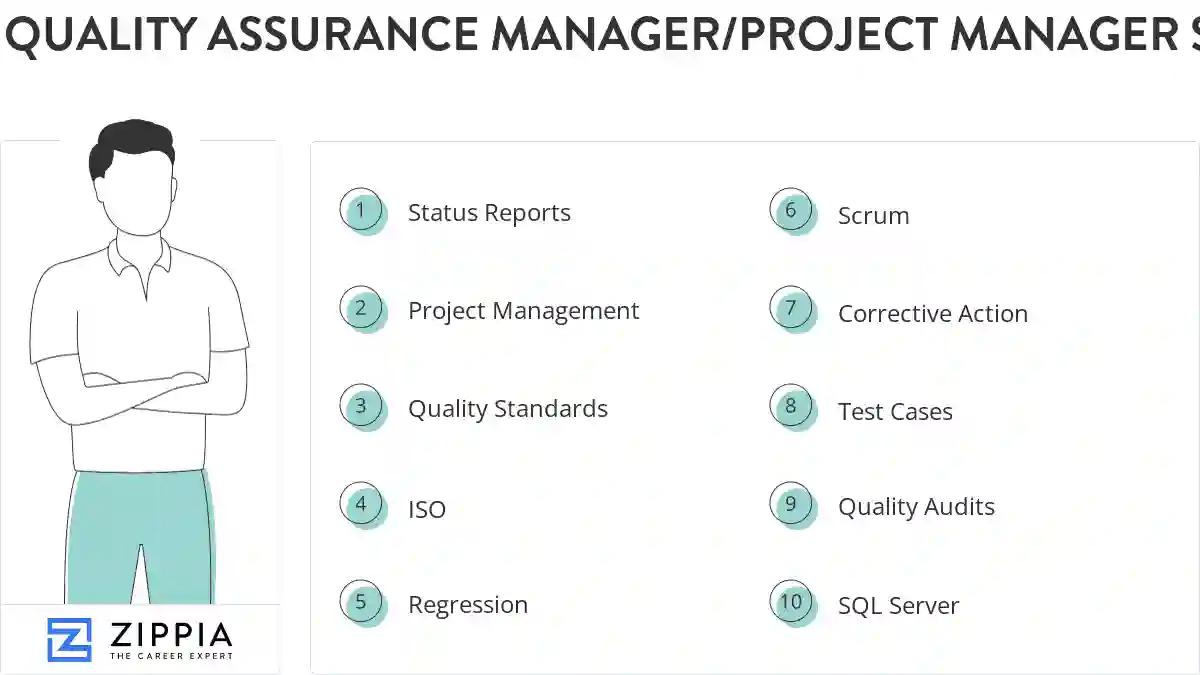
The most important skills for a quality assurance manager/project manager resume and required skills for a quality assurance manager/project manager to have include:
- Status Reports
- Project Management
- Quality Standards
- ISO
- Regression
- Scrum
- Corrective Action
- Test Cases
- Quality Audits
- SQL Server
- Management Process
- PMO
- FDA
- UAT
- Process Improvement
- Jira
- Test Strategy
- User Interface
- Sops
- Management System
- Windows
- Test Scripts
- Quality Assurance Program
- SDLC
- Sigma
- Test Execution
- API
- NDE
- SharePoint
- Project Scope
- User Acceptance
- Internal Audit
- SIT
- ERP
- Quality Issues
- Risk Management
- Test Results
- Resource Allocation
- Unix
- Data Analysis
- HR
- Qa Testing
- Business Process
- QTP
- Qa Support
- Microsoft Project
- ITP
- Test Scenarios
- SME
Updated January 8, 2025
