
Automatically apply for jobs with Zippia
Upload your resume to get started.
Remote broadcast engineer skills for your resume and career
15 remote broadcast engineer skills for your resume and career
1. JavaScript
- Enabled asynchronous messaging between habit building users in JavaScript client by integrating Ruby gem.
- Provided in-depth code reviews of Ruby and JavaScript features following agile development methodologies.
2. Infrastructure
Infrastructure includes the organizational and physical structures needed to run an area or a society smoothly. It is a group of basic facilities required for any society or firm to run sustainably and efficiently. The infrastructural system is a high investing area and helps majorly in flourishing the economy and prosperity of a country. It is an underlying system needed for ensuring the safety and comfort of the public and to run a country smoothly. All the tasks needed to be performed for a flourishing economy and a happy and healthy public are included in infrastructure.
- Level 3 Support Remote Access Infrastructure architecture/engineering/administration.
- Leveraged Citrix Receiver infrastructure to bring Windows applications to mobile devices (iOS, Android, BlackBerry).
3. Linux
Linux is a Unix-like operating system. Just like Windows, Mac OS, and IOS, Linux is an operating system used by millions across the globe. Android itself is powered by the Linux operating system. Linux manages all the hardware resources that are associated with your computer. The software is famous because of the protection it grants from viruses, malware, and crashes. The Linux operating system is entirely free and is an open-source software meaning it can be altered by those equipped with the knowledge to code.
- Installed and configured WebLogic and Apache Tomcat application servers running on Red Hat Enterprise Linux in a clustered/non-clustered environment.
- Developed procedures to unify streamline and automate applications development and deployment procedures with Linux container technology using Docker.
4. CSS
- Focused on resolving numerous cross browser compatibility related to CSS and JavaScript.
- Designed and developed intranet web applications using JavaScript and CSS.
5. Technical Support
Technical support or tech support are the services provided by any hardware or software company to users. They help in solving the technical difficulties the customers face with their products or services. Moreover, the tech support employees maintain, manage, and repair the IT faults. They are also responsible for resolving the network problems, installing and configuring hardware and software.
- Manage Onsite technicians and provide direction and technical support.
- Helped increase equipment availability factor by responding to emergent issues and providing technical support to safely meet outages schedules.
6. Provisioning
- Administer cloud computing platform, including user provisioning, backup operations and Exchange Administration.
- Developed an automation to address all provisioning failures based on pattern and create auto-generated cases in Remedy.
7. IP
An IP - Internet Protocol is a unique number assigned to all devices connected to information technology, such as printers, routers, modems, etc. Each device or domain that connects to the Internet is assigned an IP address, and as packets are directed to the IP address attached to them, the data goes where it is needed. IP addresses are the identifier used to send information between devices on a network. They contain location information and make devices accessible for communication.
- Operate and configuring IP & microwave decoders/encoders.
- Deployed, installed, and configured NewPOS POS systems, security IP cameras, and audio/visual equipment for major franchises.
8. Switches
- Operated heavy equipment, climbing on and off railroad cars, lining switches, communicating by radio and or hand signals.
- Designed and made modifications to manufactured equipment to improve quality and reliability of switches routers and hubs.
9. VPN
A Virtual Private Network, VPN encrypts a device's internet access, activity, and identity through a secure server, making data theft and third-party traceability more difficult, and increasing the privacy and security of public and private networks, the internet, and Wi-Fi hotspots. The VPN is designed to protect one's system and network from being compromised.
- Supported users on Remote Access via Cisco VPN and iPass connect, Cisco VPN client's software.
- Designed two distinct executive communication packages utilizing Virtual Private Network (VPN) technology for use by mobile combatant commander.
10. Connectivity
- Configured and managed device connectivity to firewall in Active Directory & TCP/IP environment.
- Provided internet connectivity at remote locations, and maintained the website on a daily basis.
11. VoIP
- Job ended due to resession.Skills UsedKnowledge of pbx/key, acd and voip systems.
- Patched cable drops to provide network functionality of VOIP and video services to users desk from network LAN room.
12. ISDN
- Utilized leading-industry equipment for audio compression & transmission over ISDN and phone lines.
13. Group Policies
- Administered client's User accounts, file and folder permissions, and group policies in Active Directory
- Designed and implemented an active directory structure and associated group policies, insuring an efficient and secure infrastructure.
14. Audio Equipment
Audio equipment is related to recording, reproducing, or processing sound. The equipment can include anything from loudspeakers to microphones. Some of the common audio equipment are CD players, microphones, iPod, stereo, MP3 player, loudspeakers, AC receivers, tape recorders, mixing consoles, amplifiers, and effects units.
- Set up audio equipment and transmitters for live remote broadcasts.
- Maintained remote truck and all video audio equipment.
15. Mac
A media access control or simply MAC is a network policy that identifies or determines how the data is being transferred in two particular servers through a network cable. The purpose of a MAC protocol is to prevent network or technical issues and simplify transferring the information or data.
- Worked on multiple client sites - Mac based and PC based.
- Performed hardware installations for Mac computers with limited software configuration.

What skills help Remote Broadcast Engineers find jobs?
Tell us what job you are looking for, we’ll show you what skills employers want.
What skills stand out on remote broadcast engineer resumes?
Dr. Heidrun Schmitzer
Professor and Chair, Xavier University
What soft skills should all remote broadcast engineers possess?
Dr. Heidrun Schmitzer
Professor and Chair, Xavier University
What remote broadcast engineer skills would you recommend for someone trying to advance their career?
Todd Allen
Professor and Chair, University of Michigan - Ann Arbor
What type of skills will young remote broadcast engineers need?
John Ring
Director Engineering Outreach, Elon University
List of remote broadcast engineer skills to add to your resume
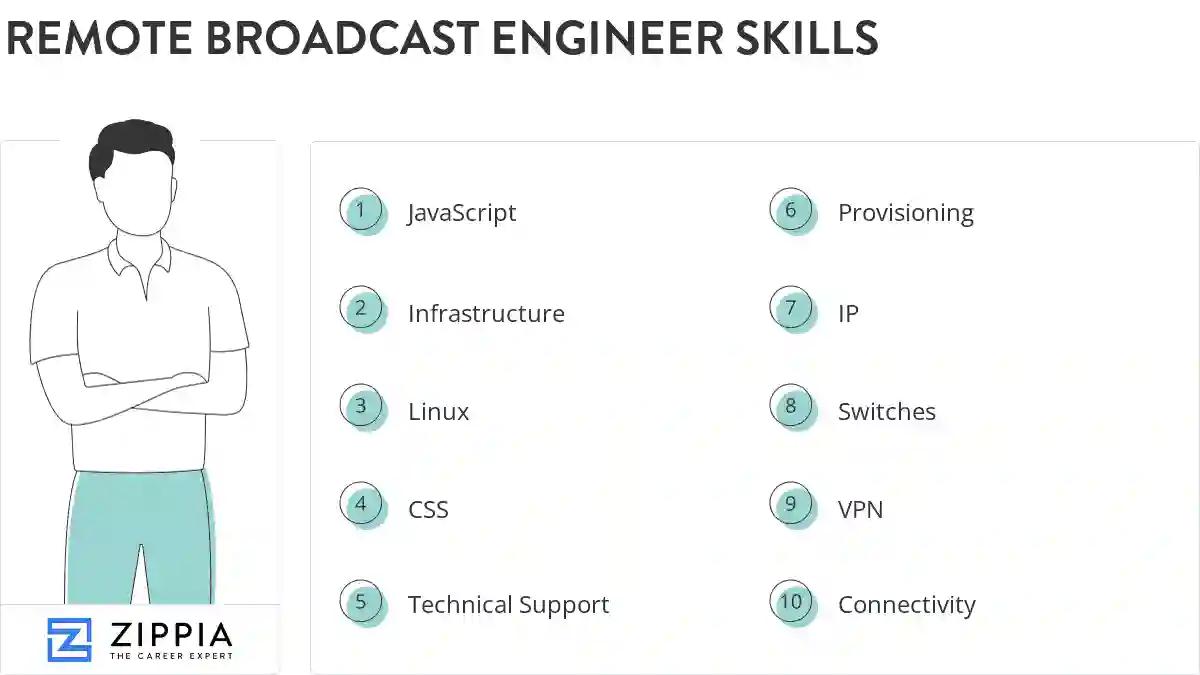
The most important skills for a remote broadcast engineer resume and required skills for a remote broadcast engineer to have include:
- JavaScript
- Infrastructure
- Linux
- CSS
- Technical Support
- Provisioning
- IP
- Switches
- VPN
- Connectivity
- VoIP
- ISDN
- Group Policies
- Audio Equipment
- Mac
- IIS
- Customer Service
- Troubleshoot Issues
- PBX
- User Accounts
- Desktop Support
- Manage Windows Servers
- NFL
- PC
Updated January 8, 2025
