What does a replenishment analyst do?
Replenishment analysts are professionals who are responsible for managing inventories while ensuring necessary materials are replenished for a company or specific department. These analysts are required to collaborate with production and supply chain teams so that they can ensure the availability of the product and meet the changing demand needs of their customers. They must effectively and accurately obtain purchase orders from multiple vendors and customers. Replenishment analysts must also maximize profit levels by effectively managing inventory levels and utilizing the E3 replenishment system.
Replenishment analyst responsibilities
Here are examples of responsibilities from real replenishment analyst resumes:
- Analyze and forecast sales, manage inventory levels and determine distribution strategy to all Marshalls stores.
- Transform data into stories through effective use of data visualization, simplification and understanding of intend audiences.
- Coordinate DC replenishment for new modulars, enabling DCs to service store mod-fill orders.
- Improve forecast accuracy MABD (must arrive by date) and OTD (on-time delivery).
- Develop a customer focuse transportation strategy to lead Mizkan in efforts of becoming compliant with OTIF & MABD targets.
- Set up avocado category from manual process to automate ordering on GRS system.
- Analyze and forecast sales, manage inventory levels and determine distribution strategy to all Marshalls stores.
Replenishment analyst skills and personality traits
We calculated that 17% of Replenishment Analysts are proficient in Supply Chain, Purchase Orders, and Logistics. They’re also known for soft skills such as Analytical skills, Communication skills, and Detail oriented.
We break down the percentage of Replenishment Analysts that have these skills listed on their resume here:
- Supply Chain, 17%
Modified forecasts and plans by conducting monthly Forecast meetings and collaborating with customer's internal supply chain Replenishment Team.
- Purchase Orders, 8%
Expedited purchase orders ensuring deliveries on a timely basis, included communicating with vendors, transportation department and club receiving staff.
- Logistics, 7%
Supported Senior and Divisional Replenishment Manager by performing detailed logistics analysis and participate in cross-functional analysis or projects.
- Demand Planning, 6%
Work closely with manufacturing plants to provide customer insight and forecast data for integrated demand planning collaboration to improve customer service.
- POS, 6%
Analyzed historical POS to create seasonal profiles for all items, allowing the system to more efficiently predict seasonal trends.
- Vendor Performance, 4%
Reconcile inventory and vendor needs while ensuring vendor performance.
Most replenishment analysts use their skills in "supply chain," "purchase orders," and "logistics" to do their jobs. You can find more detail on essential replenishment analyst responsibilities here:
Analytical skills. One of the key soft skills for a replenishment analyst to have is analytical skills. You can see how this relates to what replenishment analysts do because "market research analysts must evaluate large amounts of data and information related to market conditions." Additionally, a replenishment analyst resume shows how replenishment analysts use analytical skills: "analyzed sales and inventory reports using dss and pc spreadsheets in order to follow trends and sales projections. "
Communication skills. Another essential skill to perform replenishment analyst duties is communication skills. Replenishment analysts responsibilities require that "market research analysts must be able to clearly convey information when gathering material, interpreting data, and presenting results to clients." Replenishment analysts also use communication skills in their role according to a real resume snippet: "facilitated communications and expectations between warehouse and corporate using the vantage point of working different aspects in the supply chain. "
Detail oriented. replenishment analysts are also known for detail oriented, which are critical to their duties. You can see how this skill relates to replenishment analyst responsibilities, because "market research analysts must pay attention to minutiae to evaluate data." A replenishment analyst resume example shows how detail oriented is used in the workplace: "provide detailed inventory and sales analysis to support decision making process across the entire supply chain. "
The three companies that hire the most replenishment analysts are:
- Kwik Trip9 replenishment analysts jobs
- DXL2 replenishment analysts jobs
- Dollar Tree2 replenishment analysts jobs
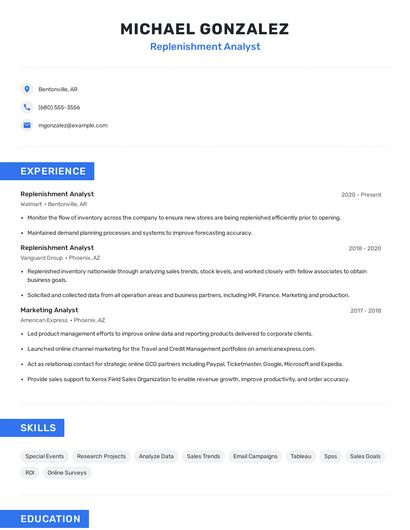
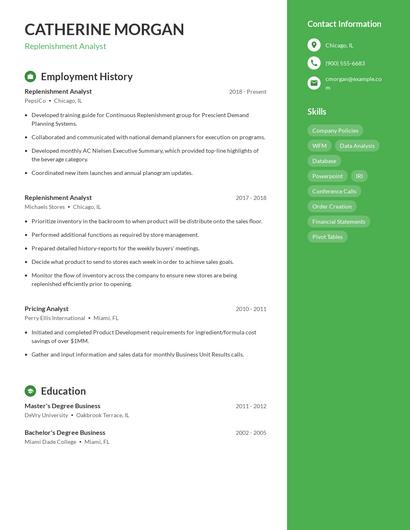
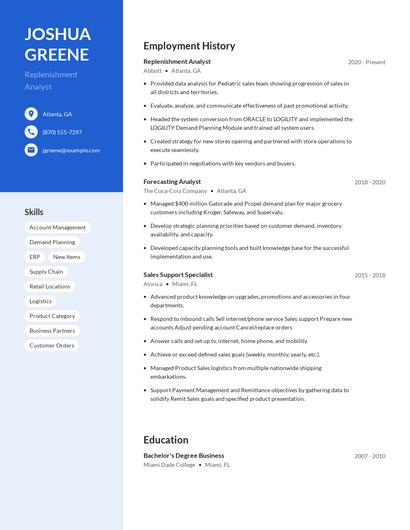
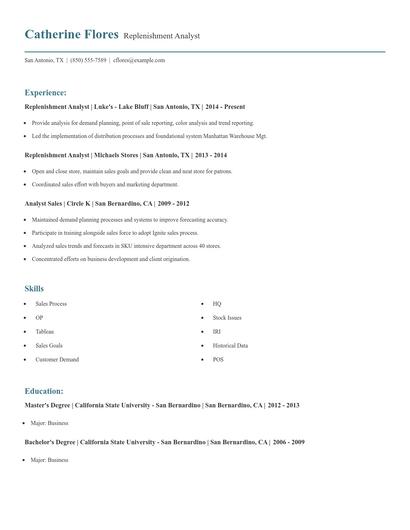
Choose from 10+ customizable replenishment analyst resume templates
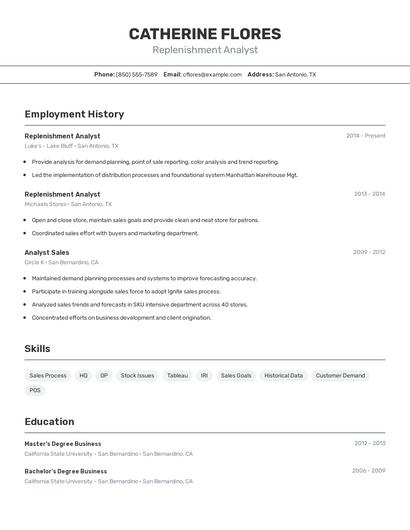
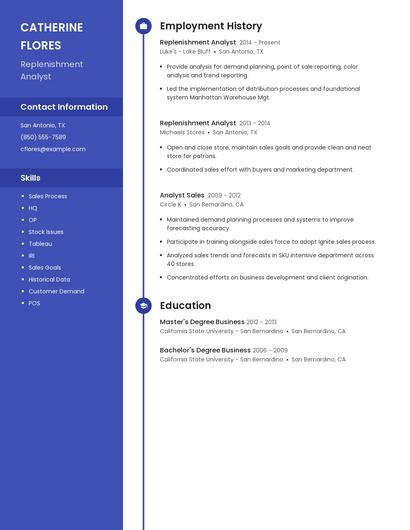
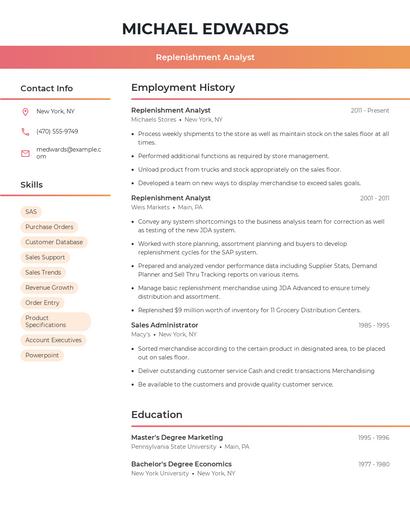
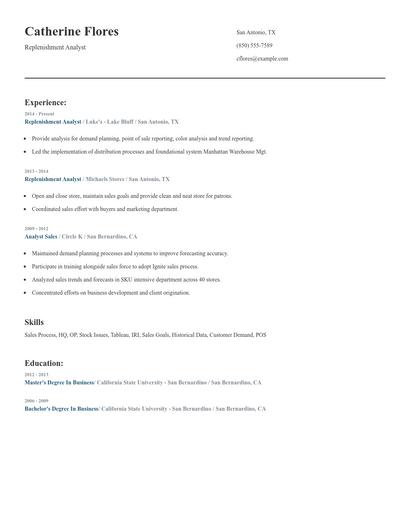
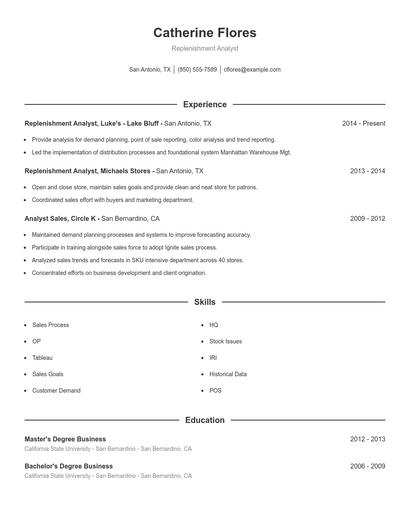
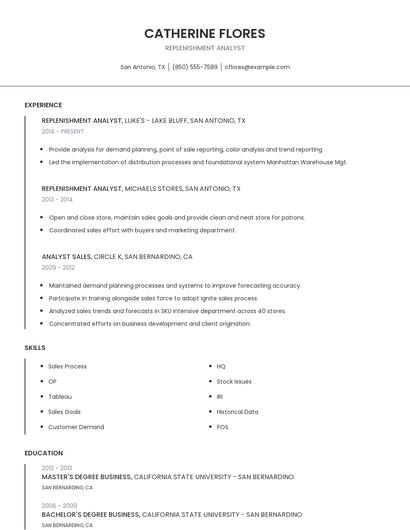
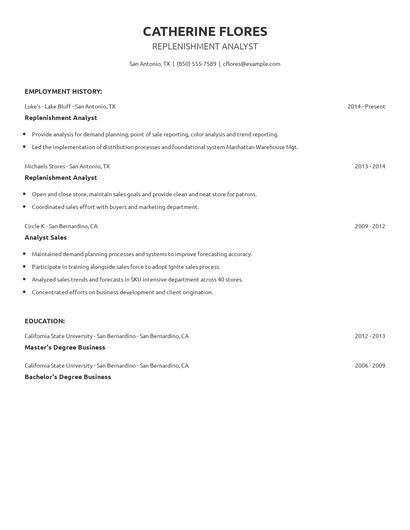
Build a professional replenishment analyst resume in minutes. Our AI resume writing assistant will guide you through every step of the process, and you can choose from 10+ resume templates to create your replenishment analyst resume.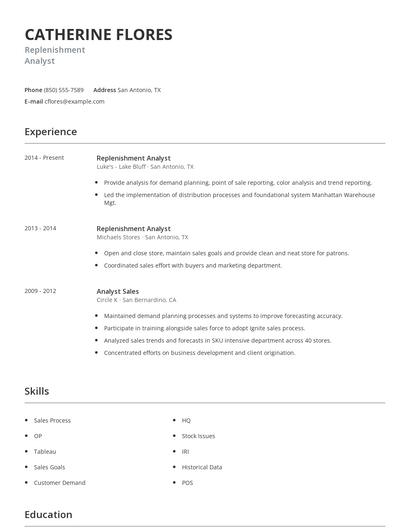
Compare different replenishment analysts
Replenishment analyst vs. Marketing internship
Marketing interns are usually marketing students or fresh graduates who are interested in getting actual work experiences before taking on a full-time job. They usually have an interest or academic background related to marketing. They assist marketing teams in most of their daily activities, sit in their meetings, record minutes of these meetings, take note of action plans, and attend other events related to marketing. They also assist in preparing collateral and other marketing materials, join brainstorming sessions, or any other activity that will help enrich their experience.
There are some key differences in the responsibilities of each position. For example, replenishment analyst responsibilities require skills like "supply chain," "purchase orders," "logistics," and "demand planning." Meanwhile a typical marketing internship has skills in areas such as "digital marketing," "powerpoint," "facebook," and "marketing campaigns." This difference in skills reveals the differences in what each career does.
Marketing interns tend to make the most money working in the technology industry, where they earn an average salary of $33,333. In contrast, replenishment analysts make the biggest average salary, $69,538, in the manufacturing industry.The education levels that marketing interns earn slightly differ from replenishment analysts. In particular, marketing interns are 0.3% more likely to graduate with a Master's Degree than a replenishment analyst. Additionally, they're 0.1% less likely to earn a Doctoral Degree.Replenishment analyst vs. Analyst sales
Analyst sales, or a sales analyst, is an individual who is responsible for increasing sales and revenue of a company by running competitive analysis and making recommendations on how the marketing and sales team should move forward. Sales analysts must assist in the review of monthly financial statements and prepare complex financial statements for retail and service businesses. They develop and provide market intelligence data solutions for the sales team to maximize territory sales efforts. Sales analysts must also maintain a business relationship with key account top management to deliver outstanding customer service and assistance.
Each career also uses different skills, according to real replenishment analyst resumes. While replenishment analyst responsibilities can utilize skills like "supply chain," "purchase orders," "logistics," and "demand planning," analyst sales use skills like "salesforce," "customer service," "data analysis," and "crm."
On average, analyst sales earn a higher salary than replenishment analysts. Some industries support higher salaries in each profession. Interestingly enough, analyst sales earn the most pay in the finance industry with an average salary of $80,458. Whereas replenishment analysts have higher pay in the manufacturing industry, with an average salary of $69,538.Average education levels between the two professions vary. Analyst sales tend to reach higher levels of education than replenishment analysts. In fact, they're 5.1% more likely to graduate with a Master's Degree and 0.1% less likely to earn a Doctoral Degree.Replenishment analyst vs. Market analyst internship
When it comes to a marketing analyst internship, an intern primarily follows a senior or a more experienced officer's directives. Most of their tasks will revolve around processing paperwork, maintaining records and databases, participating in research and analyses, and assisting senior analysts in various projects. There are also instances where they can attend meetings, participate in social media handling, and even share marketing insights. Furthermore, as an intern, it is essential to learn and adhere to the company's policies and regulations.
The required skills of the two careers differ considerably. For example, replenishment analysts are more likely to have skills like "supply chain," "purchase orders," "logistics," and "demand planning." But a market analyst internship is more likely to have skills like "powerpoint," "data analysis," "data entry," and "financial models."
When it comes to education, market analyst interns tend to earn higher degree levels compared to replenishment analysts. In fact, they're 9.6% more likely to earn a Master's Degree, and 0.4% more likely to graduate with a Doctoral Degree.Replenishment analyst vs. Business process analyst
The business process analysts are responsible for producing, managing, and enhancing business processes to improve business performance using data. They gather, analyze, and transcribe information about internal processes to obtain a comprehensive picture of the company's internal workings. Their responsibilities include developing strategies, identifying the needs of the user, and communicating compound data in a comprehensible way. Also, they identify, implement, and assess business metrics that are essential to the end-users. Additionally, they may act as consultants to project teams providing them with recommendations for product or service improvement.
Types of replenishment analyst
Updated January 8, 2025
