
Automatically apply for jobs with Zippia
Upload your resume to get started.
Research staff member skills for your resume and career
15 research staff member skills for your resume and career
1. Python
Python is a widely-known programming language. It is an object-oriented and all-purpose, coding language that can be used for software development as well as web development.
- Collected magnetic data and estimated the critical exponents of Ni2MnGa system from extensive data analysis utilizing a purpose-written Python code.
- Developed python code to categorize galaxies using geometrical convex hull contours defined by previous data sets.
2. Machine Learning
- Use of machine learning approaches, as well as dynamic modeling for project.
- Research related to clinical decision support algorithms Useful employment of multiple machine learning techniques to achieve common prediction goal
3. Research Projects
- Participated in research projects for the development of high energy linear proton accelerators (RFQ-injected LINACS).
- Worked as a member of technical staff working on various research projects funded by the institute.
4. DOE
DOE, DOX, or design of experiments is a term used to refer to a part of applied statistics whose main focus is to conduct and observe controlled tests with the ultimate goal of understanding and explaining how information and results might vary under different hypotheses and circumstances and how such variables affect the results and tests. Design of experiments is used in marketing, politics, various sciences, and, of course, experiments.
- Used DOE for a PECVD process that increased throughput by 100% and reduced film thickness non-uniformity by 50%.
- Managed all ISE efforts and activities between the DOE, ISE-PM, and other IC agencies.
5. Data Analysis
- Contributed to software toolkit for EEG data analysis, feature extraction and classification.
- Task Lead Lead developer for Big Data analysis software package.
6. Java
Java is a widely-known programming language that was invented in 1995 and is owned by Oracle. It is a server-side language that was created to let app developers "write once, run anywhere". It is easy and simple to learn and use and is powerful, fast, and secure. This object-oriented programming language lets the code be reused that automatically lowers the development cost. Java is specially used for android apps, web and application servers, games, database connections, etc. This programming language is closely related to C++ making it easier for the users to switch between the two.
- Translated use case models (in UML) into Java code utilizing Rational XDE (Eclipse) and Rational Rose Suite
- Created PDA's Java demo, attracting customers like Walt Disney and demonstrating context aware feasibility for CDMA systems.
Choose from 10+ customizable research staff member resume templates
Build a professional research staff member resume in minutes. Our AI resume writing assistant will guide you through every step of the process, and you can choose from 10+ resume templates to create your research staff member resume.7. C
- Lead software developer for real-time, safety-critical VxWorks 5.5 C based flight computer.
- Designed and developed software programs to convert proprietary hydrocarbon intensity data into SEG-Y formatted data using C under UNIX.
8. C++
C++ is a general-purpose programming language that is used to create high-performing applications. It was invented as an extension to the C language. C++ lets the programmer have a high level of domination over memory and system resources. C++ is an object-oriented language that helps you implement real-time issues based on different data functions
- Developed complex programming in C++ to calculate a function being optimized within a numerical optimization procedure and to deliver the results.
- Designed effective and efficient big data clustering algorithms using Python and C++ for classification and anomaly detection in real-world data sets.
9. Architecture
- Developed the architecture and implemented several modules including an embedded 8051.
- Developed a package of architecture evaluation tools for PowerPC.
10. System Design
System design refers to the electronic structural component of a system.
- Defined architectural guidelines and frameworks for team, including EJB design framework, testing framework, and subsystem design patterns.
- Supervised the development & installation of two major capital projects preparing performance specifications & approving system design.
11. Adaptive
- Provided dedicated support to the adaptive Intelligence Planning process.
- Designed Adaptive Equalizer and Timing Recovery sub-blocks.
12. Cloud Computing
- Assessed DoD computer security threats and opportunities offered by virtualization and cloud computing !
- Applied the developed prototype methodology to Mobile cloud computing devices for point-to-point communications of Internet of things.
13. Linux
Linux is a Unix-like operating system. Just like Windows, Mac OS, and IOS, Linux is an operating system used by millions across the globe. Android itself is powered by the Linux operating system. Linux manages all the hardware resources that are associated with your computer. The software is famous because of the protection it grants from viruses, malware, and crashes. The Linux operating system is entirely free and is an open-source software meaning it can be altered by those equipped with the knowledge to code.
- Constructed Linux support for just-emerging cellular data (GPRS, 1XRTT/CDMA2000) PCMCIA cards, then ported to Familiar Linux.
- Packaged and delivered code that ran on both Linux and Windows servers.
14. Distributed Computing
- Programmed in Matlab to analyze Big Datasets produced by a large-scale distributed computing environment.
- Co-authored a flexible asynchronous, message-oriented event bus used in multiple robotics, data visualization and distributed computing projects.
15. Parallel Programming
- Train and mentor high school teachers, undergraduate and graduate students to adopt parallel programming concepts and models on HPC resources.
5 Research Staff Member resume examples
Build a professional research staff member resume in minutes. Browse through our resume examples to identify the best way to word your resume. Then choose from 5+ resume templates to create your research staff member resume.

What skills help Research Staff Members find jobs?
Tell us what job you are looking for, we’ll show you what skills employers want.
What skills stand out on research staff member resumes?
Verónica Gutiérrez Ph.D.
Director of Undergraduate Research, Director of Bridge and Launch Programs, Associate Professor of Latin American History, Azusa Pacific University
What research staff member skills would you recommend for someone trying to advance their career?
Melinda Kreisberg Ph.D.
Professor, Biology, West Liberty University
What type of skills will young research staff members need?
Bart Elmore
Associate Professor of Environmental History, Ohio State University
What technical skills for a research staff member stand out to employers?
Sya Kedzior Ph.D.
Associate Professor, Towson University
What soft skills should all research staff members possess?
Shiri Noy Ph.D.
Assistant Professor, Denison University
List of research staff member skills to add to your resume
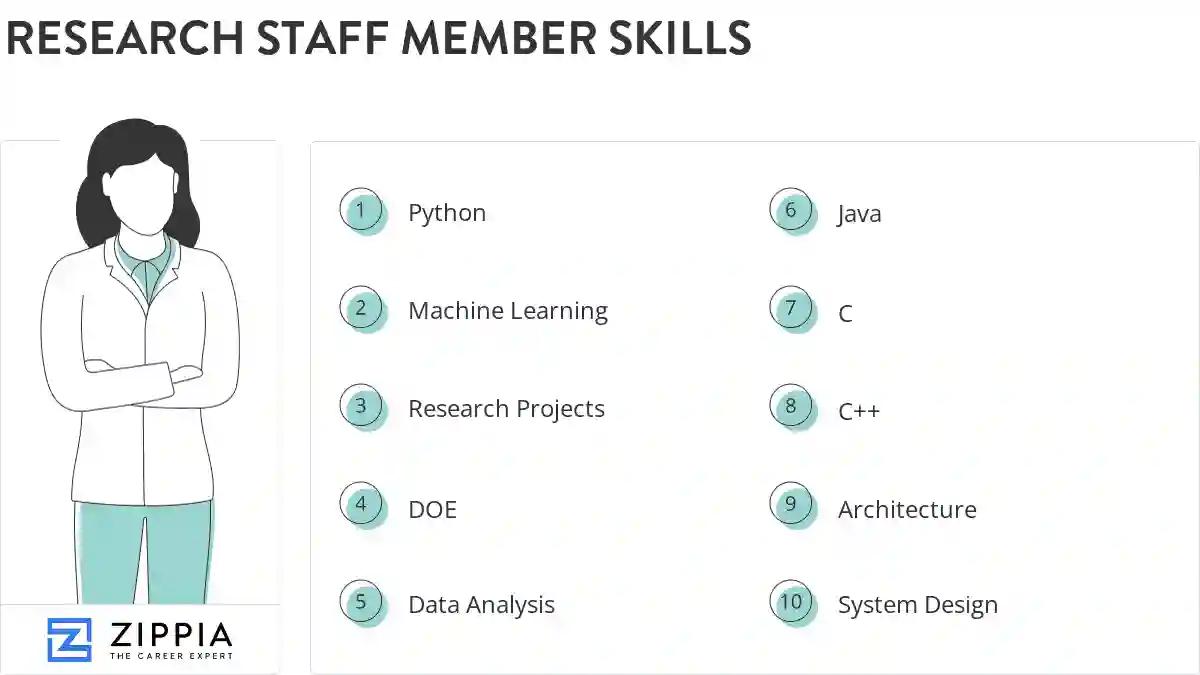
The most important skills for a research staff member resume and required skills for a research staff member to have include:
- Python
- Machine Learning
- Research Projects
- DOE
- Data Analysis
- Java
- C
- C++
- Architecture
- System Design
- Adaptive
- Cloud Computing
- Linux
- Distributed Computing
- Parallel Programming
- FPGA
- Software Development
- Prototyping
- Visualization
- Cache
- Fortran
- R
- Data Collection
- Algorithm Development
- VLSI
- Statistical Analysis
- Unix
- Signal Processing
- LabVIEW
- Data Acquisition
- CAD
- MIT
- RF
- Aerospace
- GUI
- SEM
- Journal Articles
- CMOS
- DOD
- Xerox
- Cell Culture
- Research Studies
- Development Projects
- IRB
Updated January 8, 2025
