What does a research technician lead do?
Research technician lead responsibilities
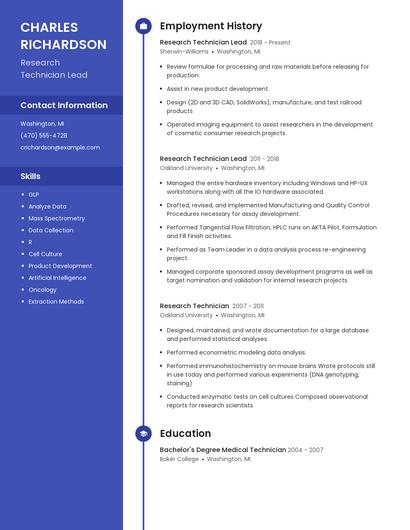
Here are examples of responsibilities from real research technician lead resumes:
- General laboratory duties; coordinate maintenance of equipment, maintain ingredient and prototype inventory, manage shipping and receiving.
- Train temporary staff and interns, create training materials, troubleshoot technical issues.
- Develop, in collaboration with others, efficient methods for the sequencing of DNA.
- Execute lab techniques, including protein complementation, PCR, ligations and high throughput robotics.
- Coordinate and present information regarding the progress of large scale DNA sequencing projects on a weekly basis.
- Perform in-store audits of package and display labeling for accuracy of EPA, FTC, and FDA consumer claims.
- Perform routine internal laboratory audit for FDA inspection.
- Perform verification, optimization and validation studies using biological samples to prepare automate extraction solution for transfer to clinical laboratory.
- Participate in an anti-drug media campaign research grant fund by NIH.
- Coordinate research focuse training workshops with researchers, university professors, CDC and NIH personnel.
- Deepen expertise in pharmacokinetics, biopharmaceutics, and pharmacodynamics including PK/PD modeling, simulations, through hands-on laboratory research.
Research technician lead skills and personality traits
We calculated that 14% of Research Technician Leads are proficient in Emerging Technologies, Laboratory Equipment, and R. They’re also known for soft skills such as Analytical skills, Observational skills, and Technical skills.
We break down the percentage of Research Technician Leads that have these skills listed on their resume here:
- Emerging Technologies, 14%
Develop emerging technologies including transparent solar window, color coded 2D/3D human machine interface.
- Laboratory Equipment, 12%
Executed and coordinated scheduled verification and calibration on laboratory equipment
- R, 8%
Aided in development of R code for use with acoustic Dopplers and high frequencysondes.
- Troubleshoot, 7%
Train temporary staff and interns, created training materials, troubleshoot technical issues.
- Independent Research, 6%
Identified new threats through closed/vetted security groups and independent research on new tools and techniques of hacker groups.
- Data Entry, 5%
Use of mobile devices empowered faster decision-making and eliminated the need for after-the-fact data entry.
Common skills that a research technician lead uses to do their job include "emerging technologies," "laboratory equipment," and "r." You can find details on the most important research technician lead responsibilities below.
Analytical skills. To carry out their duties, the most important skill for a research technician lead to have is analytical skills. Their role and responsibilities require that "biological technicians need to conduct scientific experiments and analyses with accuracy and precision." Research technician leads often use analytical skills in their day-to-day job, as shown by this real resume: "completed design, setup, monitoring, and data collection for plant physiology experiment. "
Observational skills. Another soft skill that's essential for fulfilling research technician lead duties is observational skills. The role rewards competence in this skill because "biological technicians must constantly monitor their experiments." According to a research technician lead resume, here's how research technician leads can utilize observational skills in their job responsibilities: "performed an evaluation of the cam simulations by the comparisons with observational data involving extensive data analysis. "
Technical skills. research technician leads are also known for technical skills, which are critical to their duties. You can see how this skill relates to research technician lead responsibilities, because "biological technicians need to set up and operate sophisticated equipment and instruments." A research technician lead resume example shows how technical skills is used in the workplace: "supervised and provided technical support to analysts for instrumentation, sops and testing methods. "
Communication skills. A big part of what research technician leads do relies on "communication skills." You can see how essential it is to research technician lead responsibilities because "biological technicians must understand and follow the instructions of their managing scientists." Here's an example of how this skill is used from a resume that represents typical research technician lead tasks: "managed opposition research projects and staff for national political communications firm. "
The three companies that hire the most research technician leads are:
- Highmark48 research technician leads jobs
- Danaher20 research technician leads jobs
- BAE Systems2 research technician leads jobs
Choose from 10+ customizable research technician lead resume templates
Build a professional research technician lead resume in minutes. Our AI resume writing assistant will guide you through every step of the process, and you can choose from 10+ resume templates to create your research technician lead resume.



Compare different research technician leads
Research technician lead vs. Biology laboratory assistant
A biology laboratory assistant is in charge of assisting scientists or researchers and performing laboratory support tasks on a daily basis. Their responsibilities include setting up and sanitizing equipment, preparing samples, maintaining documentation of all experiments and procedures, writing laboratory reports, and running errands as needed. There are also instances where they must update databases, answer calls and correspondence, and grade student papers. Furthermore, a biology laboratory assistant must maintain the cleanliness of laboratories, all while implementing its policies and regulations.
There are some key differences in the responsibilities of each position. For example, research technician lead responsibilities require skills like "emerging technologies," "laboratory equipment," "r," and "troubleshoot." Meanwhile a typical biology laboratory assistant has skills in areas such as "lab equipment," "biology laboratory," "chemistry," and "anatomy." This difference in skills reveals the differences in what each career does.
Biology laboratory assistants earn the highest salaries when working in the government industry, with an average yearly salary of $53,128. On the other hand, research technician leads are paid more in the professional industry with an average salary of $74,751.biology laboratory assistants tend to reach lower levels of education than research technician leads. In fact, biology laboratory assistants are 11.1% less likely to graduate with a Master's Degree and 5.2% less likely to have a Doctoral Degree.Research technician lead vs. Laboratory internship
A laboratory intern is responsible for assisting laboratory operations and perform examinations and experiments under the supervision of tenured laboratory staff. Laboratory interns shadow all the laboratory processes, document their observations, and conduct an in-depth analysis of the results. They must have excellent knowledge of scientific procedures, demonstrating their class learnings to practical applications. A laboratory intern must be detail-oriented, especially on conducting and verifying the accuracy of research materials. It is also required for a laboratory intern to be a fast-learner, understanding the scientific complexities to master various approaches.
In addition to the difference in salary, there are some other key differences worth noting. For example, research technician lead responsibilities are more likely to require skills like "emerging technologies," "troubleshoot," "independent research," and "data entry." Meanwhile, a laboratory internship has duties that require skills in areas such as "lab procedures," "chemistry," "python," and "data analysis." These differences highlight just how different the day-to-day in each role looks.
On average, laboratory interns earn a lower salary than research technician leads. Some industries support higher salaries in each profession. Interestingly enough, laboratory interns earn the most pay in the technology industry with an average salary of $48,851. Whereas research technician leads have higher pay in the professional industry, with an average salary of $74,751.Average education levels between the two professions vary. Laboratory interns tend to reach lower levels of education than research technician leads. In fact, they're 9.1% less likely to graduate with a Master's Degree and 5.2% less likely to earn a Doctoral Degree.Research technician lead vs. Microbiological laboratory technician
A microbiological laboratory technician specializes in handling and testing samples, ensuring accuracy and safety. Often working under the supervision of a more experienced scientist, a microbiological laboratory technician has the responsibility to operate various devices and machines, record all progress and data, review results, and produce reports and documentation. There are also instances when a technician must submit results within deadlines or follow a senior scientist's directives. Furthermore, it is essential to adhere to the safety policies and rules of the laboratory at all times.
Some important key differences between the two careers include a few of the skills necessary to fulfill the responsibilities of each. Some examples from research technician lead resumes include skills like "emerging technologies," "laboratory equipment," "troubleshoot," and "independent research," whereas a microbiological laboratory technician is more likely to list skills in "microbiology lab," "aseptic technique," "lab equipment," and "food safety. "
Microbiological laboratory technicians earn the best pay in the manufacturing industry, where they command an average salary of $39,707. Research technician leads earn the highest pay from the professional industry, with an average salary of $74,751.Most microbiological laboratory technicians achieve a lower degree level compared to research technician leads. For example, they're 10.6% less likely to graduate with a Master's Degree, and 6.0% less likely to earn a Doctoral Degree.Research technician lead vs. Senior research fellow
Senior Research Fellows are reputable researchers employed in an academic institution or a research facility. The nature of their employment in the institution is related to their research work or field of interest. Senior Research Fellows lead a team of researchers on big projects that require more team members. They manage the team's budget, set timelines, and guide the researchers. They spearhead the analysis of the data gathered. They also set the tone for the presentation materials. Senior Research Fellows should be passionate about their field, should have a thirst for knowledge, and should be able to lead teams.
Even though a few skill sets overlap between research technician leads and senior research fellows, there are some differences that are important to note. For one, a research technician lead might have more use for skills like "emerging technologies," "laboratory equipment," "troubleshoot," and "data entry." Meanwhile, some responsibilities of senior research fellows require skills like "python," "data analysis," "research findings," and "visualization. "
The average resume of senior research fellows showed that they earn higher levels of education compared to research technician leads. So much so that theyacirc;euro;trade;re 9.1% more likely to earn a Master's Degree and more likely to earn a Doctoral Degree by 10.7%.Types of research technician lead
Updated January 8, 2025
