Explore jobs
Find specific jobs
Explore careers
Explore professions
Best companies
Explore companies
What is a scheduling manager and how to become one

A scheduling manager oversees and coordinates the schedules of employees, resources, and tasks within an organization. They create and maintain a master schedule, ensuring that it aligns with business objectives and meets demands. Scheduling managers use software to streamline the scheduling process and track goals. They work with managers and department heads to optimize schedules for efficiency and productivity. Communication skills are critical for scheduling managers as they must effectively report changes while minimizing disruption.
Avg. Salary $77,213
Avg. Salary $59,228
Growth rate -8%
Growth rate 0.3%
American Indian and Alaska Native 0.37%
Asian 3.77%
Black or African American 9.57%
Hispanic or Latino 11.96%
Unknown 3.77%
White 70.56%
Genderfemale 54.86%
male 45.14%
Age - 51American Indian and Alaska Native 3.00%
Asian 7.00%
Black or African American 14.00%
Hispanic or Latino 19.00%
White 57.00%
Genderfemale 47.00%
male 53.00%
Age - 51Stress level is high
7.1 - high
Complexity level is intermediate
7 - challenging
Work life balance is excellent
6.4 - fair
What are the pros and cons of being a scheduling manager?
Pros
Offers potential for career growth and advancement
Can be financially rewarding with high earning potential
Offers a fast-paced work environment with constant challenges and problem-solving opportunities
Provides the ability to develop and implement innovative scheduling strategies
Offers the ability to gain valuable experience in project management
Cons
May require long hours during peak times or periods of high demand
May require working weekends or holidays in some industries
Can be challenging to manage employee expectations and preferences while meeting business needs
May require dealing with difficult or uncooperative employees or managers
Can be repetitive and monotonous at times, especially when dealing with routine scheduling tasks.
Scheduling manager career paths
Key steps to become a scheduling manager
Explore scheduling manager education requirements
Start to develop specific scheduling manager skills
Skills Percentages Patients 12.89% Customer Service 11.68% Schedule Changes 5.48% Excellent Interpersonal 4.52% Human Resources 4.27% Complete relevant scheduling manager training and internships
Accountants spend an average of Less than 1 month on post-employment, on-the-job training. New scheduling managers learn the skills and techniques required for their job and employer during this time. The chart below shows how long it takes to gain competency as a scheduling manager based on U.S. Bureau of Labor Statistics data and data from real scheduling manager resumes.Research scheduling manager duties and responsibilities
- Manage, schedule, and run quality assurance on customer appointments for field analysts.
- Lead ISO 9001 internal audits, as well as a lean team and 6S participant.
- Analyze contractor prepare CPM schedules and work with contractors and consultants to achieve an approve baseline schedule.
- Analyze the IMS and manage cross-program dependencies to inform managers of schedule concerns, issues, and risks.
Prepare your scheduling manager resume
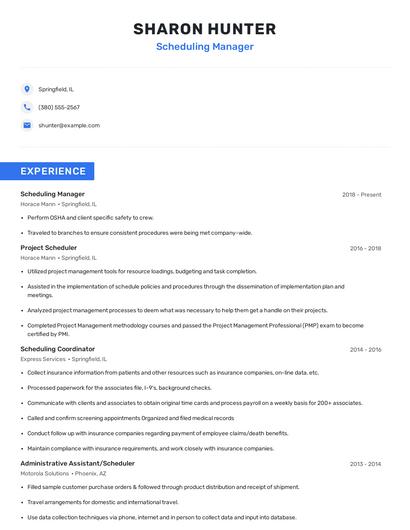
When your background is strong enough, you can start writing your scheduling manager resume.
You can use Zippia's AI resume builder to make the resume writing process easier while also making sure that you include key information that hiring managers expect to see on a scheduling manager resume. You'll find resume tips and examples of skills, responsibilities, and summaries, all provided by Zippi, your career sidekick.
Choose from 10+ customizable scheduling manager resume templates
Build a professional scheduling manager resume in minutes. Browse through our resume examples to identify the best way to word your resume. Then choose from 10+ resume templates to create your scheduling manager resume.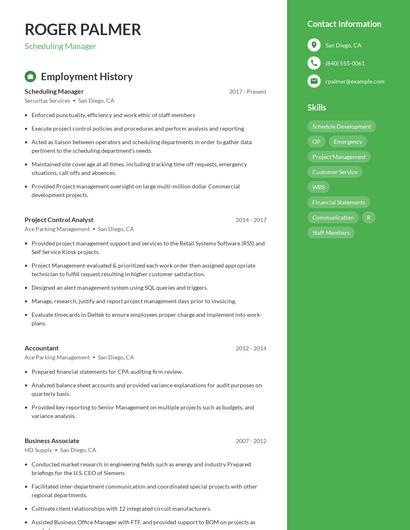
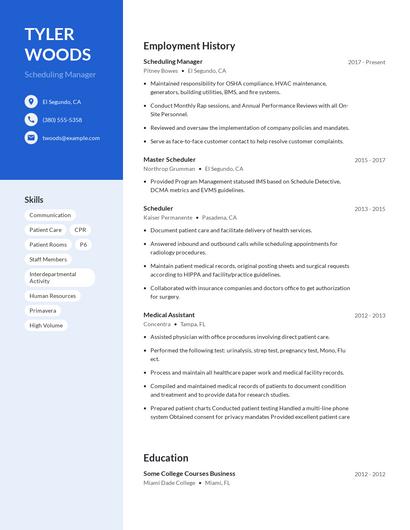
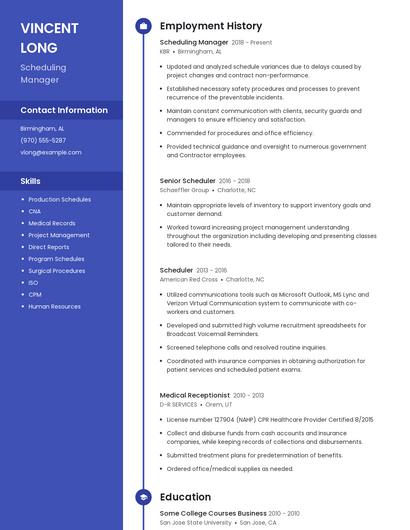
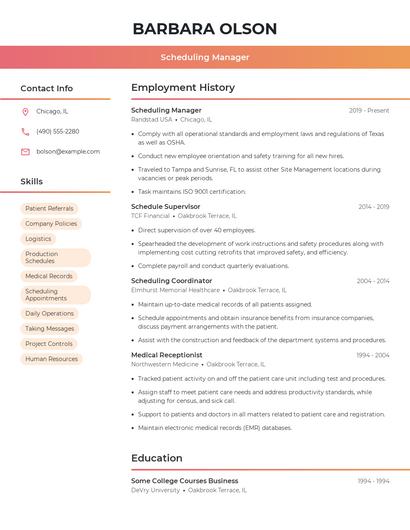
Apply for scheduling manager jobs
Now it's time to start searching for a scheduling manager job. Consider the tips below for a successful job search:
- Browse job boards for relevant postings
- Consult your professional network
- Reach out to companies you're interested in working for directly
- Watch out for job scams
How did you land your first scheduling manager job

Are you a scheduling manager?
Share your story for a free salary report.
Average scheduling manager salary
The average scheduling manager salary in the United States is $77,213 per year or $37 per hour. Scheduling manager salaries range between $51,000 and $116,000 per year.
What am I worth?

How do scheduling managers rate their job?
Updated January 8, 2025
