Explore jobs
Find specific jobs
Explore careers
Explore professions
Best companies
Explore companies
What is a seafood processor and how to become one
Being a seafood processor entails several job responsibilities. Working as a seafood processor can have you cleaning machinery to adhere FDA regulations, maintaining and operating machines, revising plans for regulatory compliance, cleaning stations, and performing duties in relation to fish processing for retail sale.
With the things you need to do as a seafood processor, you need to have the necessary skills for a good and smooth workflow. You need to possess dexterity to be able to accomplish physical activities using your hands. Along with this, you need to have physical strength to carry, lift, and move the objects around. Lastly, you should also know how to use technology to know about the industry you're working on.
You can be a seafood processor with a high school degree or GED. With an average salary of $20,564 a year and a job growth rate of 8%, this is a good job to consider at the moment. As long as you meet the minimum requirements like education and skills, you have a chance to land this job.
Avg. Salary $23,630
Avg. Salary $59,228
Growth rate 2%
Growth rate 0.3%
American Indian and Alaska Native 1.03%
Asian 7.77%
Black or African American 6.06%
Hispanic or Latino 24.10%
Unknown 3.65%
White 57.38%
Genderfemale 25.97%
male 74.03%
Age - 42American Indian and Alaska Native 3.00%
Asian 7.00%
Black or African American 14.00%
Hispanic or Latino 19.00%
White 57.00%
Genderfemale 47.00%
male 53.00%
Age - 42Stress level is manageable
7.1 - high
Complexity level is challenging
7 - challenging
Work life balance is good
6.4 - fair
Key steps to become a seafood processor
Explore seafood processor education requirements
Start to develop specific seafood processor skills
Skills Percentages Cleanliness 21.15% Processing Equipment 20.01% Gut 16.77% Processing Plant 8.96% Food Products 6.09% Complete relevant seafood processor training and internships
Accountants spend an average of 1-3 months on post-employment, on-the-job training. New seafood processors learn the skills and techniques required for their job and employer during this time. The chart below shows how long it takes to gain competency as a seafood processor based on U.S. Bureau of Labor Statistics data and data from real seafood processor resumes.Research seafood processor duties and responsibilities
- Utilize CMMS system to address and make equipment changes to improve equipment operational uptime and minimize equipment downtime.
- Work in the case-up department.
- Clean machinery to FDA regulations.
- Review workspace for cleanliness and safety.
Prepare your seafood processor resume
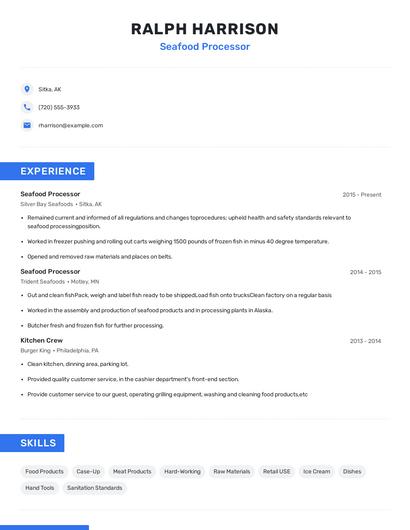
When your background is strong enough, you can start writing your seafood processor resume.
You can use Zippia's AI resume builder to make the resume writing process easier while also making sure that you include key information that hiring managers expect to see on a seafood processor resume. You'll find resume tips and examples of skills, responsibilities, and summaries, all provided by Zippi, your career sidekick.
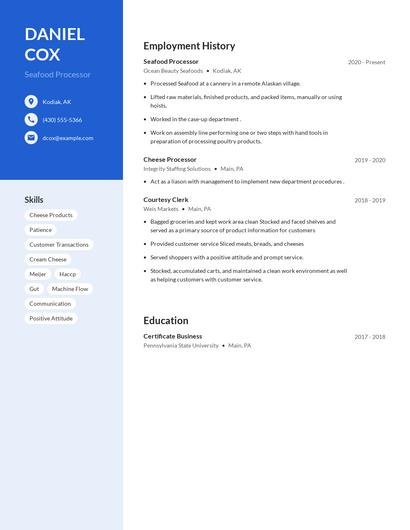
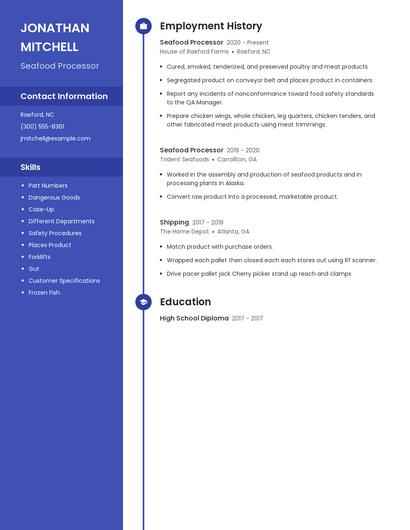
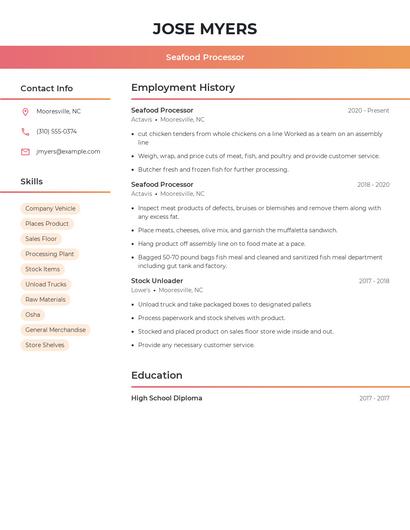
Choose from 10+ customizable seafood processor resume templates
Build a professional seafood processor resume in minutes. Browse through our resume examples to identify the best way to word your resume. Then choose from 10+ resume templates to create your seafood processor resume.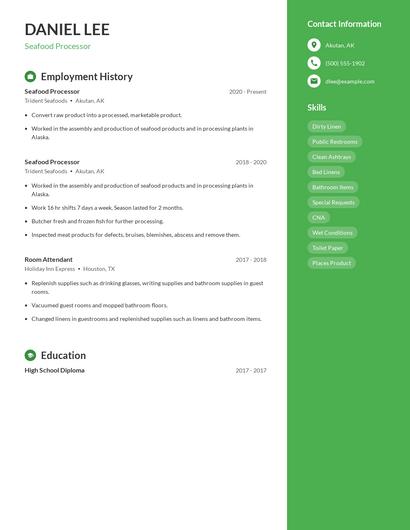
Apply for seafood processor jobs
Now it's time to start searching for a seafood processor job. Consider the tips below for a successful job search:
- Browse job boards for relevant postings
- Consult your professional network
- Reach out to companies you're interested in working for directly
- Watch out for job scams
How did you land your first seafood processor job

Are you a seafood processor?
Share your story for a free salary report.
Average seafood processor salary
The average seafood processor salary in the United States is $23,630 per year or $11 per hour. Seafood processor salaries range between $19,000 and $29,000 per year.
What am I worth?

How do seafood processors rate their job?
Updated January 8, 2025
