
Automatically apply for jobs with Zippia
Upload your resume to get started.
Security systems installer skills for your resume and career
15 security systems installer skills for your resume and career
1. Troubleshoot
Troubleshooting is the process of analyzing and fixing any kind of problem in a system or a machine. Troubleshooting is the detailed yet quick search in the system for the main source of an issue and solving it.
- Installed security devices in commercial and residential buildings Troubleshoot system
- Experience in DSC and Honeywell Linxs and Vista.Troubleshoot, Programing Fire Alarm Installment and Cable pulling.
2. Control Systems
- Install and service alarm, CCTV and access control systems in both a residential and commercial environment.
- Install, service, and maintain, fire, security and access control systems.
3. Ladders
- Operate vehicles, hand tools, power tools, ladders, leakage detection devices, and test equipment.
- Crawl into tight spaces, onto ladders, and into attics to complete projects.
4. Hand Tools
- Utilized hand tools, power tools, and testing devices to perform installations and repairs.
- Carried and operated power tools, company equipment, and hand tools.
5. Test Equipment
Test equipment is a mechanical tool or a device which is used create signals and gather response from an electronic device under test. It helps in detecting any faults in the device and it also proves the proper operation of the electronic device.
- Located and diagnosed signal transmission defects using various test equipment and visual inspection.
- Used electrical test equipment to determine the placement of existing electrical throughout residence.
6. Security Cameras
- Install Security Cameras for residential and commercial buildings.
- Installed, programmed and serviced closed-circuit television, security cameras, card access and theater systems within businesses and private residences.
7. Intercom Systems
- Install various systems aside from security including; magnetic door locking systems, door intercom systems, and emergency/panic button systems.
- Installed Interactive Central Station Video; Intercom Systems, Fire, Burglar & Emergency Alarm Systems
8. Camera Systems
- Installed, maintained, and repaired residential security systems including camera systems
- Installed residential and commercial camera systems
9. Cctv Systems
- Set up CCTV systems, laser and radar escape detection, door controls, intercom and PA systems.
- Installed and Programmed Burglar, Fire, Access Control, CCTV Systems and installed Intercom and Wireless Systems.
10. Control Panels
A control panel is a flat, enclosed unit, often the vertical part of a system in which the control or monitoring instruments are displayed and accessible to users. Control panels are typically closed-circuit boards with connections to all peripheral devices in their area. They can be found in factories to monitor and control machines or production lines and in places like nuclear power plants, ships, airplanes, and mainframe computers.
- Networked control panels to insure proper functionality of security systems.
- Troubleshooted many situations from the control panels to properly educating the customer on the options they had with each individual panel.
11. Switches
- Administered Sidewinder Firewall, Cisco routers/switches, and Microsoft Proxy server.
- Mounted two racks of HP ProCurve 2600 switches, one in data room cabinet, the other at receiving dock.
12. Emergency Calls
- Coordinate installation with police/fire departments and handle necessary records for notification of emergency calls.
- Coordinate installation with police/fire departments and handle necessary records for notification of emergency calls.
13. System Specifications
- Tested and repaired circuits and sensors, following wiring and system specifications.
- Tested and repaired circuits and sensors, following wiring and system specifications.
14. Security Devices
- Routed various wire throughout buildings Installed security devices indoors and outdoors
- Installed, programed and maintained security devices and related equipment Advised home owners of current home invasions in their neighborhood
15. Repair Security Systems
- Install and repair security systems for residential and commercial property
- Install, maintain, or repair security systems, alarm devices, or related equipment.

What skills help Security Systems Installers find jobs?
Tell us what job you are looking for, we’ll show you what skills employers want.
List of security systems installer skills to add to your resume
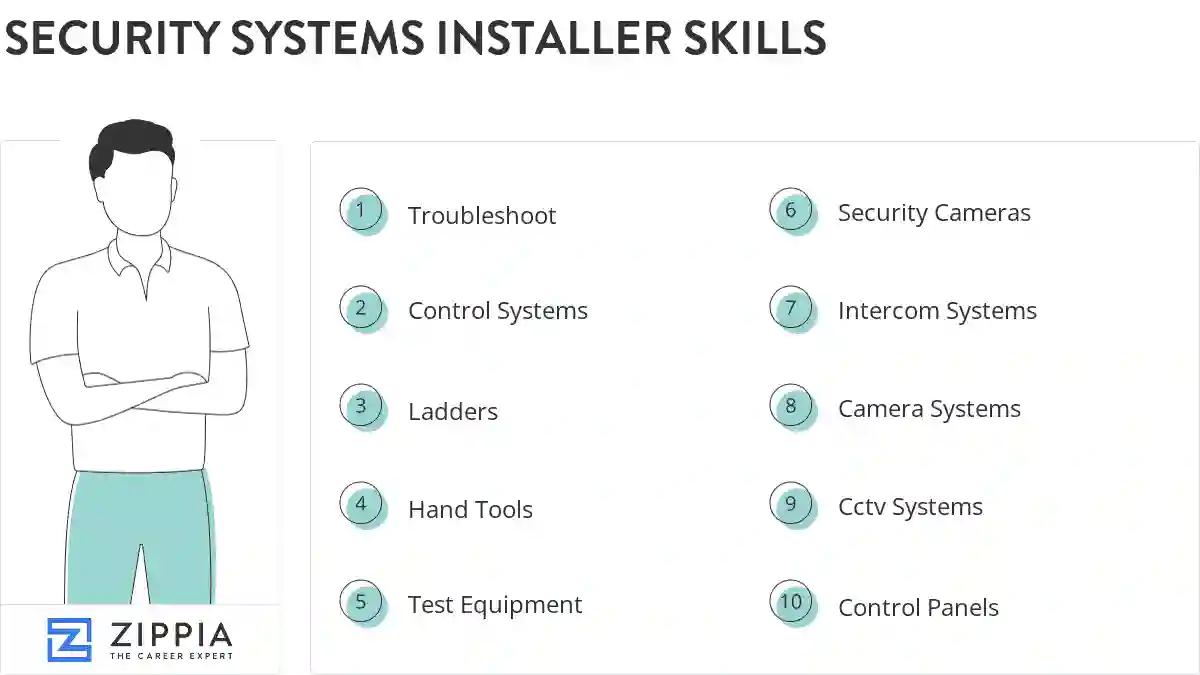
The most important skills for a security systems installer resume and required skills for a security systems installer to have include:
- Troubleshoot
- Control Systems
- Ladders
- Hand Tools
- Test Equipment
- Security Cameras
- Intercom Systems
- Camera Systems
- Cctv Systems
- Control Panels
- Switches
- Emergency Calls
- System Specifications
- Security Devices
- Repair Security Systems
- False Alarms
- Surveillance Cameras
- Alarm Devices
- Repair Circuits
- Service Calls
- DSC
- ADT
- Electrical Layouts
- Fire Alarm Systems
- Cat-5
- Motion Sensors
- Motion Detectors
- Video Cameras
- Commercial Buildings
- RAN
- Card Readers
- Test Runs
- Installation Procedures
- Alarm Panels
- Smoke Detectors
- Door Locks
- Residential Buildings
- Installation Sites
- Telephone Lines
- Residential Homes
Updated January 8, 2025
