
Automatically apply for jobs with Zippia
Upload your resume to get started.
Semiconductor processor skills for your resume and career
15 semiconductor processor skills for your resume and career
1. Etching
- Prepare etching chemicals according to formulas, diluting acid with water to obtain solutions of specified concentration.
- Perform regular plasma Silicon etchings and Cryogen temperature etching at -100 C to get perfect etch depth and vertical wall.
2. JMP
- Analyzed data using Excel and JMP applications.
3. Continuous Improvement
Continuous improvement is an ongoing process of improvement of products, services, and processes with the help of innovative ideas. It is an organized approach that helps an organization to find its weaknesses and improve them.
- Developed continuous improvement on frontline processes related to new product design and materials.
4. Film Deposition
- Manage tools qualification and perform target change/qualification in thin film deposition tools.
- Process Engineer in Metals and Dielectric thin film deposition sector in Microelectronic Research Lab (pilot fabrication line).
5. Thin Films
- Preformed, Analyzed and Documented DOE's in Thin Films, Thermal and Etch to drive process characteristics to optimization.
- Characterize and support metal deposition and thin film processes.
6. DOE
DOE, DOX, or design of experiments is a term used to refer to a part of applied statistics whose main focus is to conduct and observe controlled tests with the ultimate goal of understanding and explaining how information and results might vary under different hypotheses and circumstances and how such variables affect the results and tests. Design of experiments is used in marketing, politics, various sciences, and, of course, experiments.
- Trained individual on day to day sustaining and process characterization through DOE, SPC, and data analysis
- Performed DOE to understand process behavior.
Choose from 10+ customizable semiconductor processor resume templates
Build a professional semiconductor processor resume in minutes. Our AI resume writing assistant will guide you through every step of the process, and you can choose from 10+ resume templates to create your semiconductor processor resume.7. SPC
SPC stands for "statistical process control," a method that uses statistical tools and charts to analyze a process or procedure over time. This could reveal an error in production or an internal system by highlighting data points outside the expected results. These anomalies, likely caused by outside sources, can then be studied and remedied.
- Reduced lithography patterning defects through better monitors and SPC charting.
- Maintained process log books, monitor process with SPC.
8. Process Control
Process control is a method pertaining to continuous production processes that uses the aid of ICS (Industrial Control Systems) for production. This method enables production to be done with a level of consistency and safety in an economically friendly manner that is impossible to achieve solely through manual control.
- Experience of monitoring process performance through capability charts and implementing/creating process control limits.
- Process integration from wafer inspection to final testing, data analysis, process control and yield improvement.
9. Sigma
In Greek alphabets, sigma is the 18th letter that means "to sum up". In statistics, the lower case symbol of sigma is the unit of measurement for standard deviation which is used to assess the variability in a given set of data. While the upper case symbol is for summation notation means to add up all the given numbers in the data set.
- Lean Manufacturing and GEMBA Six Sigma meeting process to focus for developing and processing near perfect products and services.
10. Silicon
- Modified a commercial reactive ion etch tool to create textured silicon for high efficiency solar cells.
- Developed fabrication processes for thin film silicon solar cells, in a start-up company.
11. Metrology
Metrology is the scientific study of measurement. It establishes the understanding of units which is crucial to linking human activity.
- Demonstrated knowledge in the use of all Semiconductor Metrology equipment.
- Operated metrology equipment to verify process and wafer reliability.
12. CMOS
- Developed lithography fabrication process for CMOS and SiGe technologies.
- Performed reliability test result on 1.75um BSI CMOS sensor RGB and micro lens different process window.
13. Dry Etch
- Trained in Wet Etch, Dry etch, Glass Lab *Perform incoming/Outgoing inspection of devices.
- Wet and Dry etch operations.
14. Sputtering
- Applied Materials Amorphous Silicon Sputtering system.
- Deposited aluminum silicon and aluminum onto production wafers by sputtering method, using the Perkin - Elmer 4450 and Mrc 662.
15. III-V
- Experience with processing III-V wafers / pieces.
5 Semiconductor Processor resume examples
Build a professional semiconductor processor resume in minutes. Browse through our resume examples to identify the best way to word your resume. Then choose from 5+ resume templates to create your semiconductor processor resume.

What skills help Semiconductor Processors find jobs?
Tell us what job you are looking for, we’ll show you what skills employers want.
List of semiconductor processor skills to add to your resume
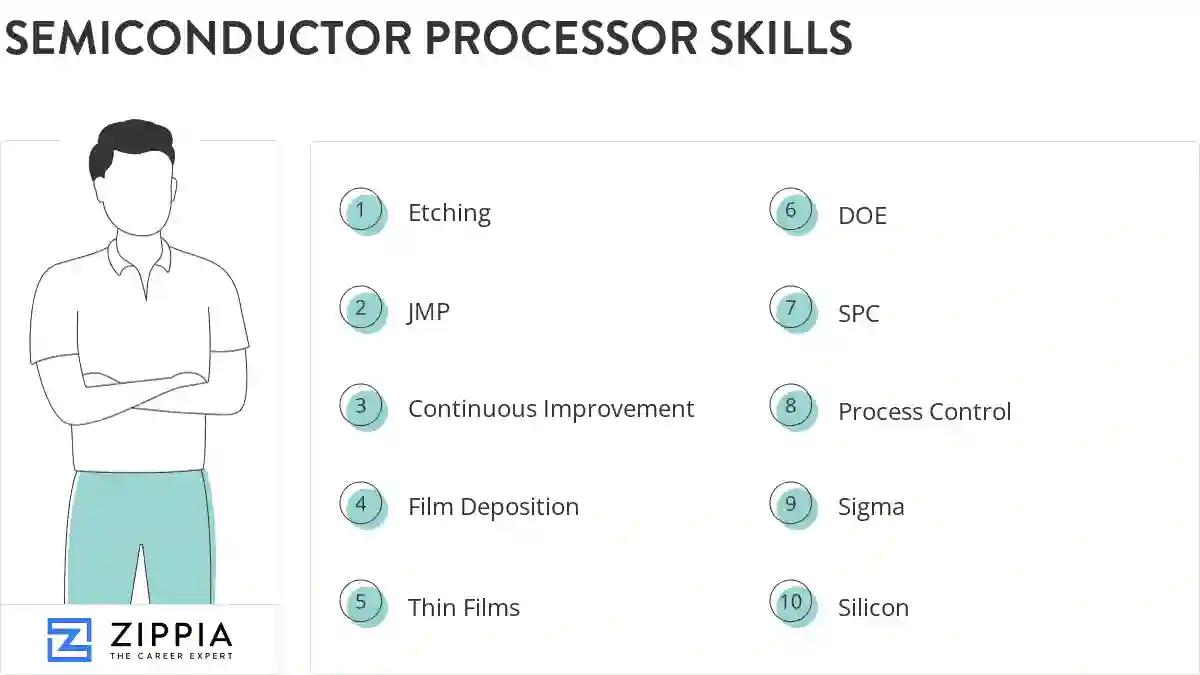
The most important skills for a semiconductor processor resume and required skills for a semiconductor processor to have include:
- Etching
- JMP
- Continuous Improvement
- Film Deposition
- Thin Films
- DOE
- SPC
- Process Control
- Sigma
- Silicon
- Metrology
- CMOS
- Dry Etch
- Sputtering
- III-V
- Failure Analysis
- Clean Room Environment
- Microprocessors
- PVD
- CVD
- UV
- Processing Charts
- Tweezers
- Surface Defects
Updated January 8, 2025
