What does a semiconductor processor do?
Semiconductor processor responsibilities
Here are examples of responsibilities from real semiconductor processor resumes:
- Achieve L2 and L3 equipment certification in the copper polish area, performing machine maintenance and troubleshooting.
- Experience with PVD, CVD, and ALD process.
- Apply lean manufacturing and SPC principles to improve process capability and prevent excursions.
- Sustain fab activities, maintain process specs and SPC charts for PECVD dielectric process.
- Operate metal deposition, oxford, and metrology tools.
- Experience in PVD, Pre-Clean, and reactive Pre-clean chamber hardware and mainframes.
- Modify a commercial reactive ion etch tool to create texture silicon for high efficiency solar cells.
- Lead a team to evaluate thin film metrology tools for thickness measurements of photo-resists and dielectrics.
- Single crystal silicon ingot growth development engineer.
- Repair to board level and troubleshot photolithography equipment.
- Develop lithography fabrication process for CMOS and SiGe technologies.
- Maintain, troubleshoot and repair equipment used to manufacture semiconductors.
- Process and development work for new microprocessors and research on interconnect reliability.
- Work directly with mortgage lenders and foreclosure attorneys to negotiate timely and cost effective repayment plans or modifications for delinquent loans.
- Perform preventative maintenance and repairs on semiconductor manufacturing equipment such as the CMP microplanarizer and Ontrak wafer scrubber.
Semiconductor processor skills and personality traits
We calculated that 15% of Semiconductor Processors are proficient in Etching, JMP, and Continuous Improvement. They’re also known for soft skills such as Analytical skills, Communication skills, and Detail oriented.
We break down the percentage of Semiconductor Processors that have these skills listed on their resume here:
- Etching, 15%
Prepare etching chemicals according to formulas, diluting acid with water to obtain solutions of specified concentration.
- JMP, 11%
Analyzed data using Excel and JMP applications.
- Continuous Improvement, 10%
Developed continuous improvement on frontline processes related to new product design and materials.
- Film Deposition, 9%
Manage tools qualification and perform target change/qualification in thin film deposition tools.
- Thin Films, 8%
Preformed, Analyzed and Documented DOE's in Thin Films, Thermal and Etch to drive process characteristics to optimization.
- DOE, 8%
Trained individual on day to day sustaining and process characterization through DOE, SPC, and data analysis
Common skills that a semiconductor processor uses to do their job include "etching," "jmp," and "continuous improvement." You can find details on the most important semiconductor processor responsibilities below.
Analytical skills. To carry out their duties, the most important skill for a semiconductor processor to have is analytical skills. Their role and responsibilities require that "industrial engineering technologists and technicians assess changes in conditions, operations, and the environment to help industrial engineers figure out how systems should work." Semiconductor processors often use analytical skills in their day-to-day job, as shown by this real resume: "performed failure analysis on wafer using curve tracer other measurement tools. "
Communication skills. Another essential skill to perform semiconductor processor duties is communication skills. Semiconductor processors responsibilities require that "industrial engineering technologists and technicians must listen carefully to instructions from engineers and must clearly articulate problems to their supervisors." Semiconductor processors also use communication skills in their role according to a real resume snippet: "demonstrated customer service orientation and strong verbal analytical skills and written communication skills. "
Detail oriented. Another skill that relates to the job responsibilities of semiconductor processors is detail oriented. This skill is critical to many everyday semiconductor processor duties, as "industrial engineering technologists and technicians must record precisely what they measure and observe." This example from a resume shows how this skill is used: "provide detailed information on available navy federal mortgage loanproducts, clarify questions/concerns and resolve problems regarding the loan. "
Math skills. For certain semiconductor processor responsibilities to be completed, the job requires competence in "math skills." The day-to-day duties of a semiconductor processor rely on this skill, as "industrial engineering technologists and technicians use mathematics and statistical techniques to analyze data collected from studies." For example, this snippet was taken directly from a resume about how this skill applies to what semiconductor processors do: "record patients' medical history, vital statistics, or information such as test results in medical records. "
The three companies that hire the most semiconductor processors are:
- IBM8 semiconductor processors jobs
- Intel6 semiconductor processors jobs
- Raytheon Technologies5 semiconductor processors jobs
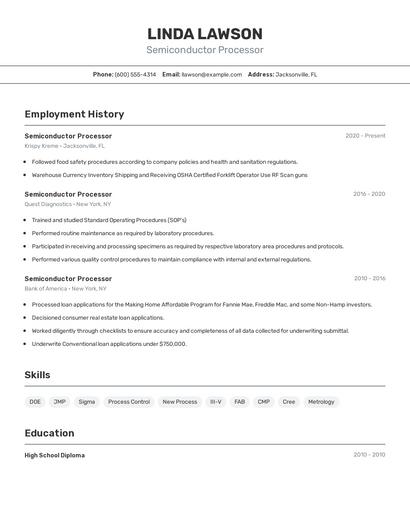
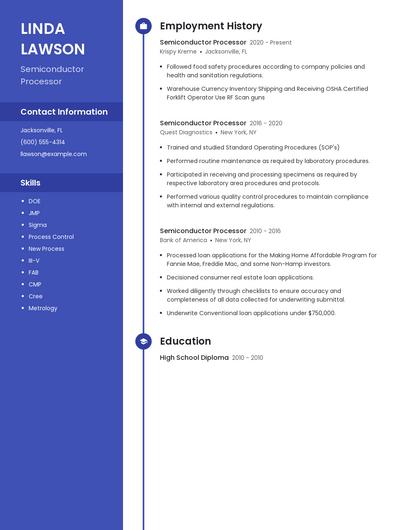
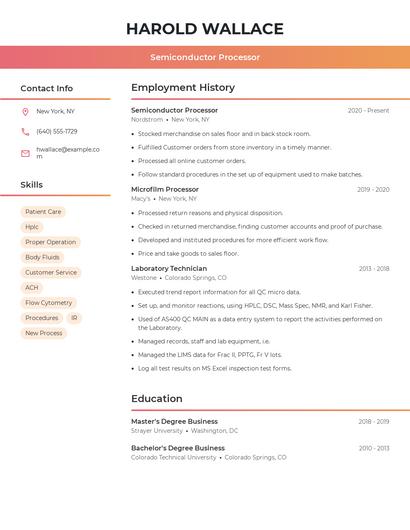
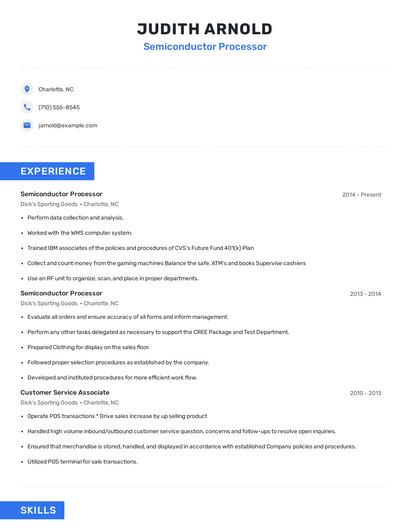
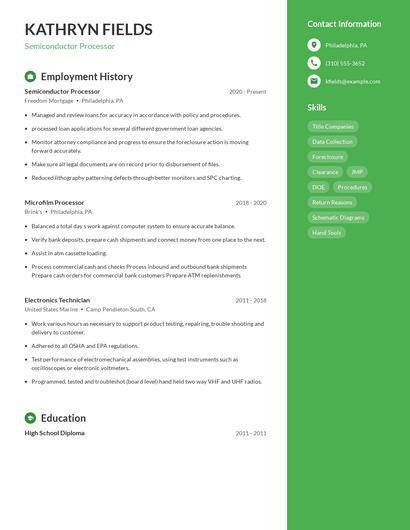
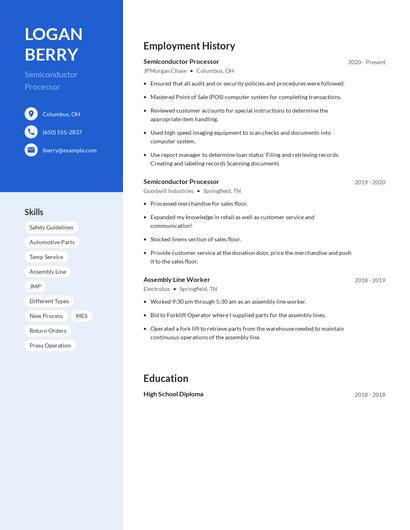
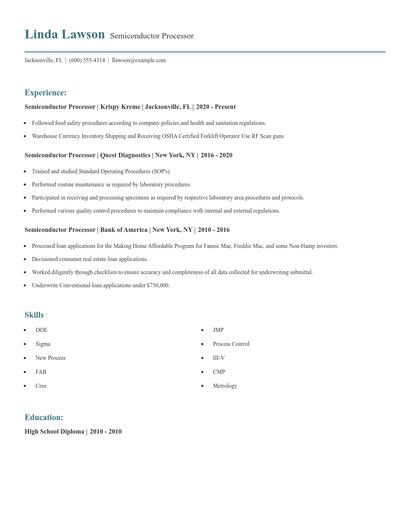
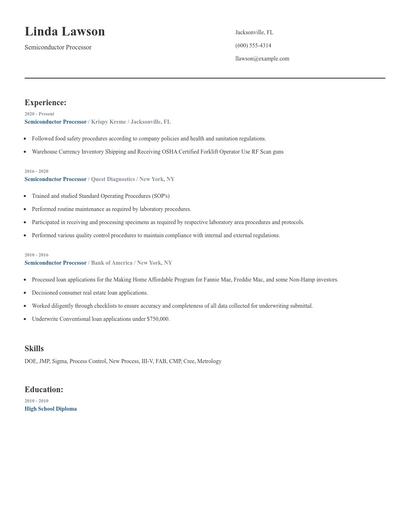
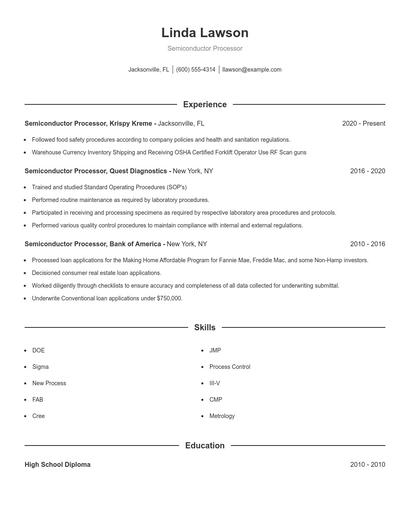
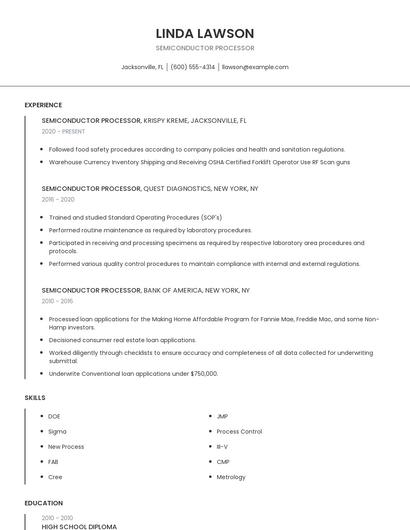
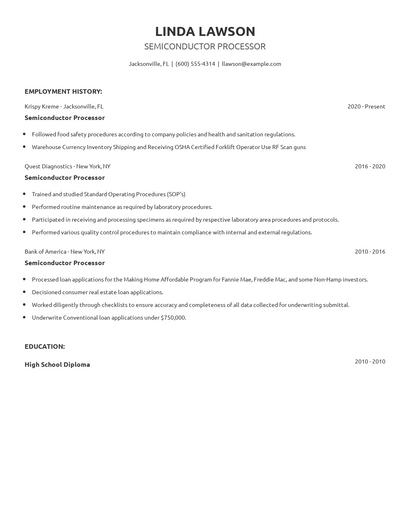
Choose from 10+ customizable semiconductor processor resume templates
Build a professional semiconductor processor resume in minutes. Our AI resume writing assistant will guide you through every step of the process, and you can choose from 10+ resume templates to create your semiconductor processor resume.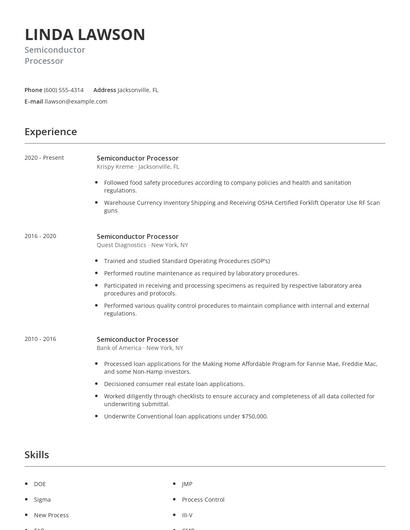
Compare different semiconductor processors
Semiconductor processor vs. Crystal growing technician
There are some key differences in the responsibilities of each position. For example, semiconductor processor responsibilities require skills like "jmp," "continuous improvement," "film deposition," and "thin films." Meanwhile a typical crystal growing technician has skills in areas such as "harvest," "calipers," "clone," and "computer programs." This difference in skills reveals the differences in what each career does.
The education levels that crystal growing technicians earn slightly differ from semiconductor processors. In particular, crystal growing technicians are 17.7% less likely to graduate with a Master's Degree than a semiconductor processor. Additionally, they're 5.2% less likely to earn a Doctoral Degree.Semiconductor processor vs. Probe operator
While some skills are similar in these professions, other skills aren't so similar. For example, resumes show us that semiconductor processor responsibilities requires skills like "etching," "jmp," "continuous improvement," and "film deposition." But a probe operator might use other skills in their typical duties, such as, "cdl," "semiconductor," "augers," and "electronic devices."
Average education levels between the two professions vary. Probe operators tend to reach lower levels of education than semiconductor processors. In fact, they're 22.7% less likely to graduate with a Master's Degree and 5.2% less likely to earn a Doctoral Degree.Semiconductor processor vs. Charge preparation technician
Some important key differences between the two careers include a few of the skills necessary to fulfill the responsibilities of each. Some examples from semiconductor processor resumes include skills like "etching," "jmp," "continuous improvement," and "film deposition," whereas a charge preparation technician is more likely to list skills in "parts inventory," "laboratory procedures," "chemistry," and "microbiology. "
Most charge preparation technicians achieve a lower degree level compared to semiconductor processors. For example, they're 16.5% less likely to graduate with a Master's Degree, and 5.2% less likely to earn a Doctoral Degree.Semiconductor processor vs. Crystal machining coordinator
Types of semiconductor processor
Updated January 8, 2025
