What does a senior network analyst do?
A senior network analyst is responsible for facilitating network automation, installation, and configuration of processes and systems. They are tasked with ensuring the monitoring of applications across various platforms in line with the company's values and set privacy principles. Their responsibilities include monitoring inbound emails and calls, maintaining high-level production support and quality services to clients, reviewing challenges and system errors with the management, submitting permanent solutions to prevent recurring issues, and gathering documentation.
Senior network analyst responsibilities
Here are examples of responsibilities from real senior network analyst resumes:
- Manage DNS initiative for the campus intranet and internet.
- Implement and manage Linux base network monitoring and auditing.
- Recommend, engineer and manage office systems, including centralize productivity and communication systems such as e-mail and centralize desktop environments.
- Experience in several routing protocols, including OSPF and BGP.
- Charge with configuring, installing and troubleshooting all classify and unclassify routers and switches as well as TACLANE encryption devices.
- Support core technologies such as BGP, OSPF, voice, data, wireless, security, and video services.
- Implement day-to-day DNS changes and assign IP addresses.
- Initiate the use of Wireshark to analyze packets.
- Produce SQL store procedures to construct forecasting and SLA reports.
- Network environment include Cisco [] routers/switches running OSPF routing protocol.
- Monitor network and appliances using Cisco ADSM6.1, Solarwinds and Wireshark.
- Implement Cisco IOS upgrades and gather performance data on different wan devices.
- Develop SAN storage systems at plant level for data sharing and backup.
- Network analysis using SolarWinds, Netflow, NMap, Iperf, and Wireshark.
- Configure and support remote access services such as dial-up, dial backup and VPN connectivity.
Senior network analyst skills and personality traits
We calculated that 8% of Senior Network Analysts are proficient in Firewall, Routers, and VoIP. They’re also known for soft skills such as Analytical skills, Communication skills, and Problem-solving skills.
We break down the percentage of Senior Network Analysts that have these skills listed on their resume here:
- Firewall, 8%
Authored corporate standards & guidelines for naming conventions, software revisions, switch/router configurations, firewall security and network time synchronization.
- Routers, 7%
Supported, configured and repaired Cisco switches, routers and wireless devices Manage all DNS and DHCP services throughout the company.
- VoIP, 6%
Supported Cisco Call Manager VOIP installation including end user devices and server infrastructure.
- Lan, 6%
Designed and maintained several long range wireless LAN and WAN using radio communications emphasizing security and data encryption.
- DNS, 5%
Designed, implemented and managed Active Directory infrastructure and supporting networking protocols and services such as TCP/IP, DNS, DHCP.
- TCP/IP, 5%
Developed designs for the event/fault monitoring and automation of TCP/IP networks and UNIX/WINTEL systems, applications, infrastructure components and databases.
Most senior network analysts use their skills in "firewall," "routers," and "voip" to do their jobs. You can find more detail on essential senior network analyst responsibilities here:
Analytical skills. To carry out their duties, the most important skill for a senior network analyst to have is analytical skills. Their role and responsibilities require that "administrators need to evaluate networks and systems to make sure that they perform reliably and to anticipate new requirements as customers’ needs change." Senior network analysts often use analytical skills in their day-to-day job, as shown by this real resume: "implement all circuit orders for both voice and data for world-wide network, from mpls to pots. "
Communication skills. Another soft skill that's essential for fulfilling senior network analyst duties is communication skills. The role rewards competence in this skill because "administrators must describe problems and their solutions to non-it workers." According to a senior network analyst resume, here's how senior network analysts can utilize communication skills in their job responsibilities: "trouble shoot network problems covering a variety of computer and communications hardware and software, as well as transmission facilities. "
Problem-solving skills. senior network analysts are also known for problem-solving skills, which are critical to their duties. You can see how this skill relates to senior network analyst responsibilities, because "administrators must quickly resolve problems that arise with computer networks." A senior network analyst resume example shows how problem-solving skills is used in the workplace: "helped upgrade entire company wan consisting of 48 remote locations from frame relay to mpls tunneling solution. "
The three companies that hire the most senior network analysts are:
- Peloton Interactive, Inc.53 senior network analysts jobs
- CVS Health25 senior network analysts jobs
- Aetna
17 senior network analysts jobs
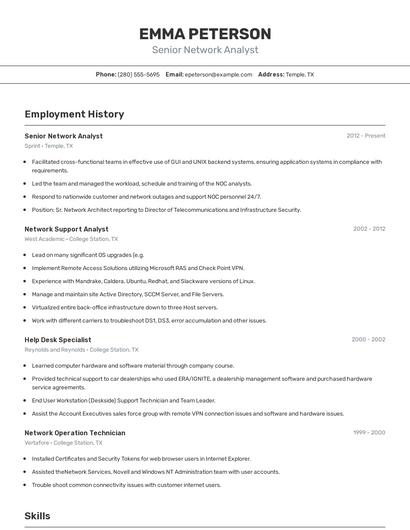
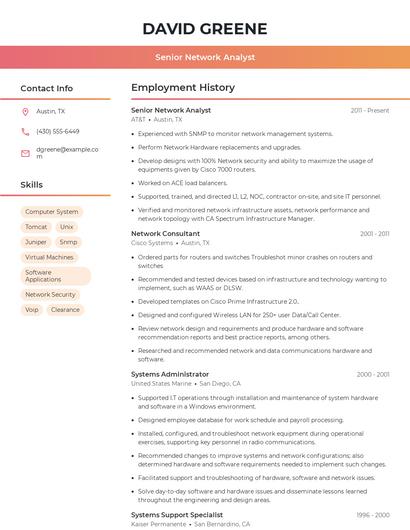
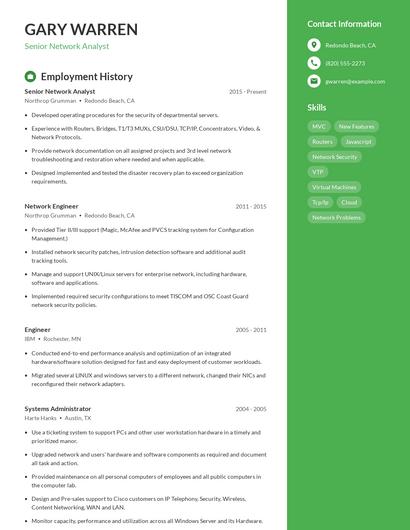
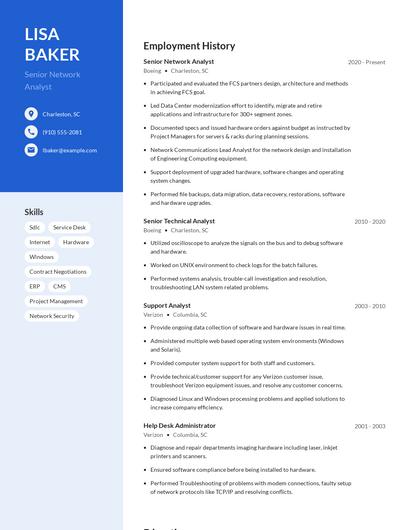
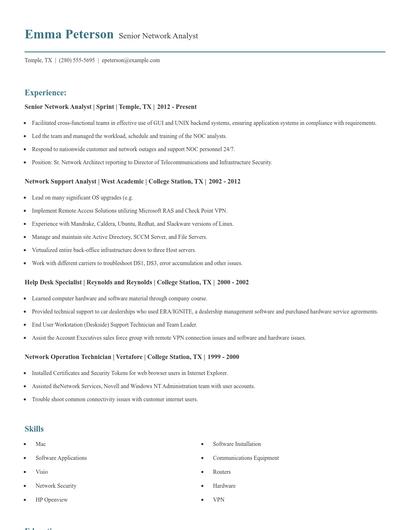
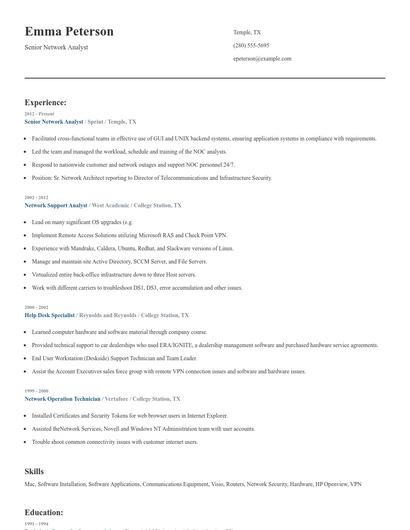
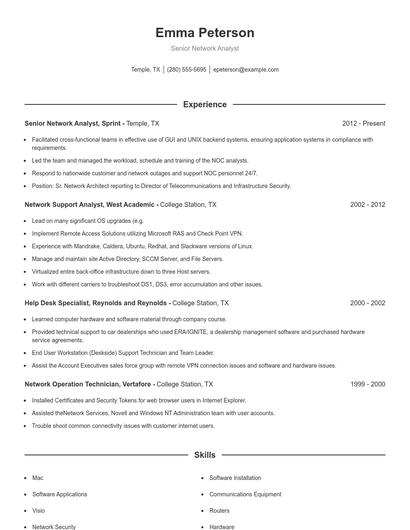
Choose from 10+ customizable senior network analyst resume templates
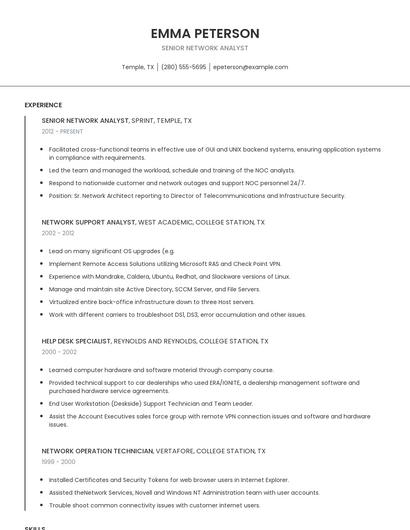
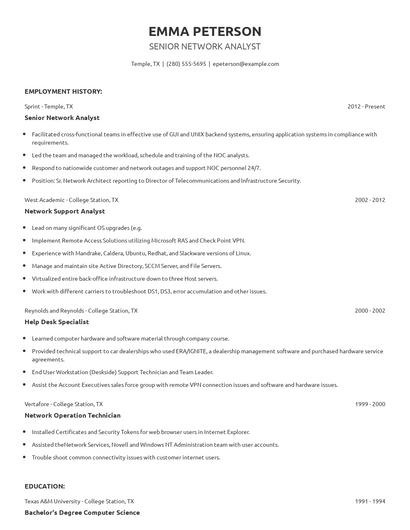
Build a professional senior network analyst resume in minutes. Our AI resume writing assistant will guide you through every step of the process, and you can choose from 10+ resume templates to create your senior network analyst resume.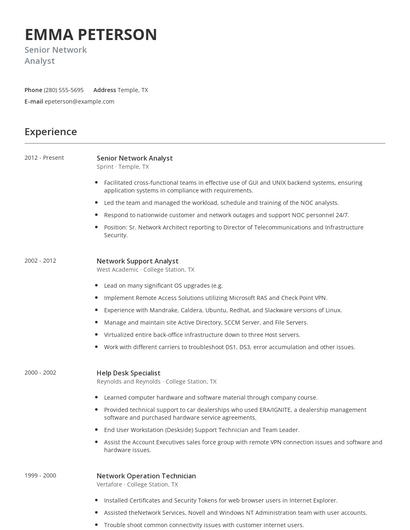


Compare different senior network analysts
Senior network analyst vs. Network operations manager
Network operations managers are information technology (IT) professionals who are responsible for managing the operation and stability of an organization's network. These managers usually work with local area networks (LAN) or sometimes with wide area networks (WAN), where information can be shared in a building or between different locations. They serve as the middlemen between the IT department and the company's management team to provide an understanding of their IT needs. Network operations managers must also assist the human resource team in recruiting new employees and providing training related to the field of information technology.
These skill sets are where the common ground ends though. The responsibilities of a senior network analyst are more likely to require skills like "firewall," "routers," "troubleshoot," and "java." On the other hand, a job as a network operations manager requires skills like "customer service," "itil," "network services," and "level agreements." As you can see, what employees do in each career varies considerably.
Network operations managers tend to make the most money working in the hospitality industry, where they earn an average salary of $109,619. In contrast, senior network analysts make the biggest average salary, $95,825, in the finance industry.network operations managers tend to reach similar levels of education than senior network analysts. In fact, network operations managers are 1.3% more likely to graduate with a Master's Degree and 0.1% less likely to have a Doctoral Degree.Senior network analyst vs. Network support technician
A network support technician specializes in optimizing a company's information technology (IT) networks for a smooth and efficient workflow. Their responsibilities revolve around addressing issues and concerns, troubleshooting, installing systems, executing upgrades, conducting diagnostic tests, and performing corrective measures as needed. They must also coordinate with staff in developing new IT systems, evaluate existing networks for areas needing improvement, and develop protocols while adhering to the company's policies and regulations. Furthermore, as a network support technician, it is essential to maintain regular network maintenance checks to ensure the security and safety of company data.
While some skills are similar in these professions, other skills aren't so similar. For example, resumes show us that senior network analyst responsibilities requires skills like "firewall," "java," "project management," and "network management." But a network support technician might use other skills in their typical duties, such as, "customer service," "provides technical support," "desk support," and "network printers."
Network support technicians earn a lower average salary than senior network analysts. But network support technicians earn the highest pay in the technology industry, with an average salary of $48,633. Additionally, senior network analysts earn the highest salaries in the finance with average pay of $95,825 annually.Average education levels between the two professions vary. Network support technicians tend to reach lower levels of education than senior network analysts. In fact, they're 7.3% less likely to graduate with a Master's Degree and 0.1% less likely to earn a Doctoral Degree.What technology do you think will become more important and prevalent for senior network analysts in the next 3-5 years?
Eduardo Zambrano
Professor of Economics, Orfalea College of Business
Senior network analyst vs. Network engineer
A network engineer is responsible for managing a network system, monitoring its performance, and upgrading its features to optimize performance and boost efficiency. Network engineers also create new systems, designing them based on clients' specifications and business needs. They also check network defects, perform troubleshooting, improve data security systems, and install security updates. A network engineer must have excellent knowledge of the technology industry, as well as a broad understanding of system codes, programming languages, and network configurations.
There are many key differences between these two careers, including some of the skills required to perform responsibilities within each role. For example, a senior network analyst is likely to be skilled in "routers," "network operations," "network hardware," and "project management," while a typical network engineer is skilled in "network design," "load balancers," "series routers," and "azure."
Network engineers earn the highest salary when working in the technology industry, where they receive an average salary of $90,927. Comparatively, senior network analysts have the highest earning potential in the finance industry, with an average salary of $95,825.When it comes to education, network engineers tend to earn similar degree levels compared to senior network analysts. In fact, they're 1.4% less likely to earn a Master's Degree, and 0.2% less likely to graduate with a Doctoral Degree.Senior network analyst vs. Senior administrator
A senior administrator is responsible for managing the overall administrative duties in an organization, including coordinating with higher management to identify process and operations improvement and other business opportunities to grow revenues and increase profitability. Senior administrators monitor and delegate tasks to the administrative staff, resolve discrepancies on record-keeping, respond to the customers' inquiries and concerns, ensure the adequacy of inventory, and train new staff. They also inspect and update the database regularly for business information and customer details, as well as handling complaints or directing them to the appropriate personnel and department.
Types of senior network analyst
Updated January 8, 2025
