What does a senior requirements analyst do?
Senior requirements analyst responsibilities
Here are examples of responsibilities from real senior requirements analyst resumes:
- Manage integrated functionality & technology dependencies, usability, reliability, performance and support requirements of legacy CRM and web applications.
- Participate in JAD sessions with DEA stakeholders to gather business requirements as part of an effort to update legacy DEA applications.
- Facilitate and document requirements driven through JAD /Requirements workshops.
- Host and maintain a repository of project artifacts on Microsoft SharePoint portal.
- Create and maintain a SharePoint data repository to track all enhancement requests and development projects.
- Provide gap analysis skills to determine system enhancements or process updates to accommodate Medicare and Medicaid growth initiatives for new business.
- Increase efficiency/productivity/data integrity through technology & ERP functionality.
Senior requirements analyst skills and personality traits
We calculated that 14% of Senior Requirements Analysts are proficient in DOD, SharePoint, and Sprint. They’re also known for soft skills such as Creativity, Analytical skills, and Communication skills.
We break down the percentage of Senior Requirements Analysts that have these skills listed on their resume here:
- DOD, 14%
Developed repeatable process to guide current and future architecture efforts conforming to the DOD Architecture Framework.
- SharePoint, 9%
Created and maintained a SharePoint data repository to track all enhancement requests and development projects.
- Sprint, 7%
Developed a standardized bill format that clarified new AT&T, SPRINT and MCI bills and eliminated customer complaint calls.
- SDLC, 5%
Completed onsite HP-ALM 11.5 training for managing full SDLC from Management-Requirements-Testing-Defect Tracking.
- SME, 5%
Gathered data requirements by conducting detailed interviews with business users, stakeholders, and Subject Matter Experts (SME's).
- Provisioning, 5%
Create process flows of data and provisioning system for as is and to be requirements.
Common skills that a senior requirements analyst uses to do their job include "dod," "sharepoint," and "sprint." You can find details on the most important senior requirements analyst responsibilities below.
Creativity. To carry out their duties, the most important skill for a senior requirements analyst to have is creativity. Their role and responsibilities require that "because analysts are tasked with finding innovative solutions to computer problems, an ability to “think outside the box” is important." Senior requirements analysts often use creativity in their day-to-day job, as shown by this real resume: "enlightened specializes in business process reengineering, systems integration, integrated justice solutions, asset and inventory management and information assurance. "
Analytical skills. Another essential skill to perform senior requirements analyst duties is analytical skills. Senior requirements analysts responsibilities require that "analysts must interpret complex information from various sources and decide the best way to move forward on a project." Senior requirements analysts also use analytical skills in their role according to a real resume snippet: "create process flows of data and provisioning system for as is and to be requirements. "
Communication skills. This is an important skill for senior requirements analysts to perform their duties. For an example of how senior requirements analyst responsibilities depend on this skill, consider that "analysts work as a go-between with management and the it department and must explain complex issues in a way that both will understand." This excerpt from a resume also shows how vital it is to everyday roles and responsibilities of a senior requirements analyst: "established project management controls including communication plans, project status reporting, issues/risk tracking and escalation. ".
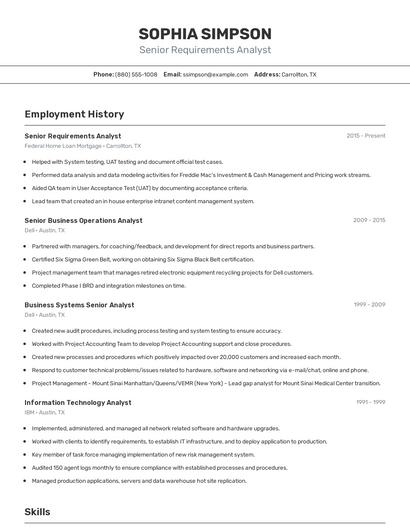
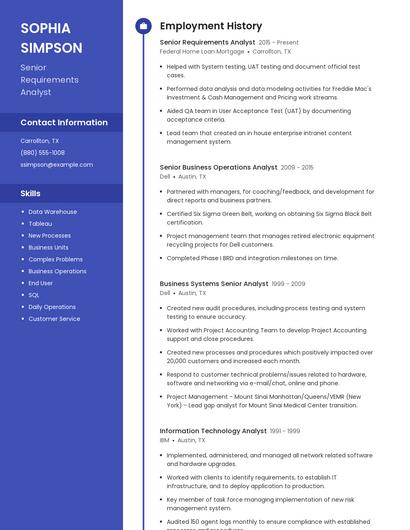
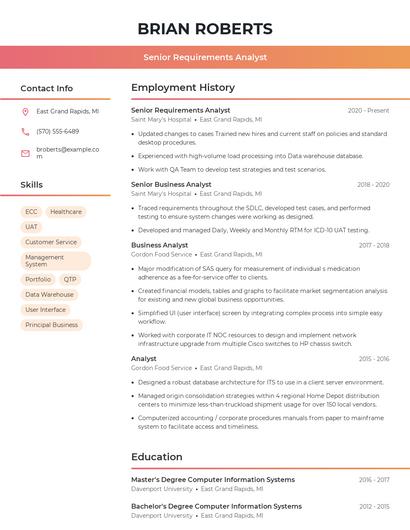
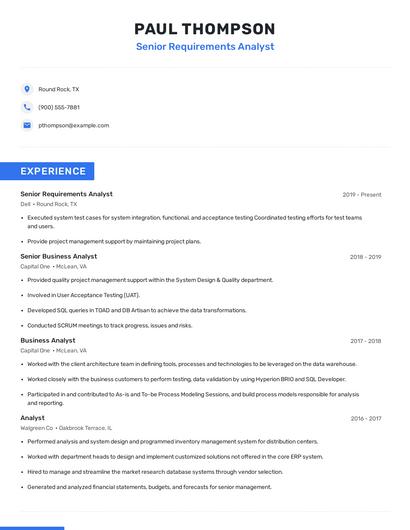
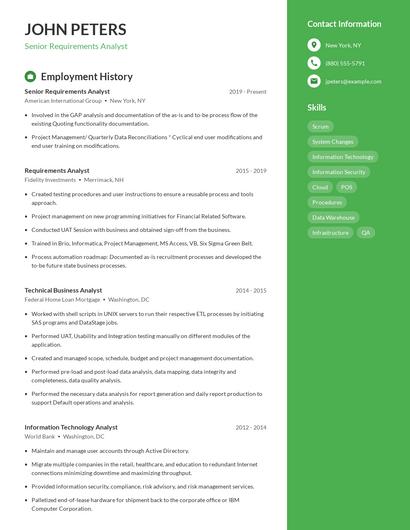
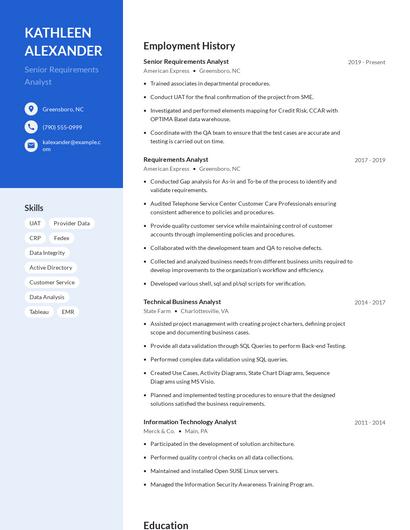
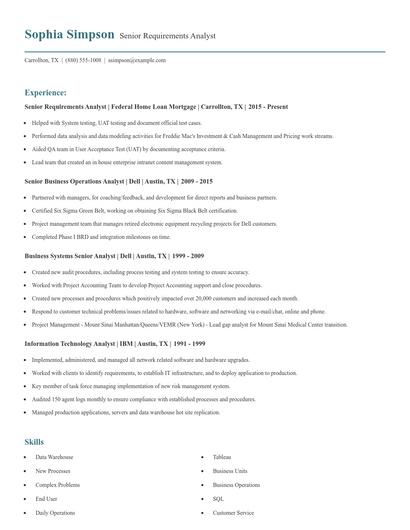
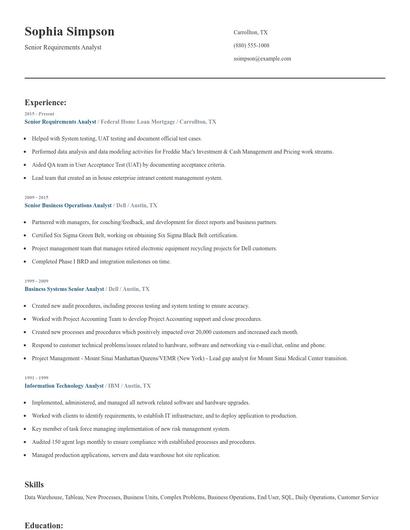
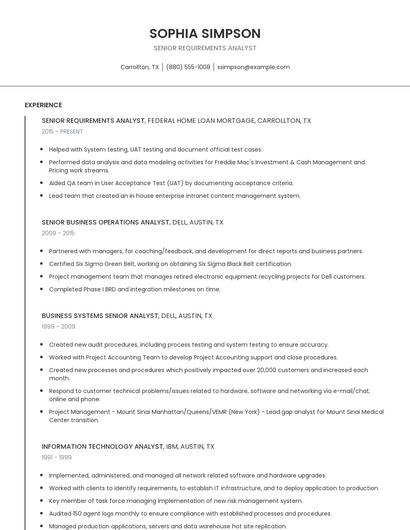
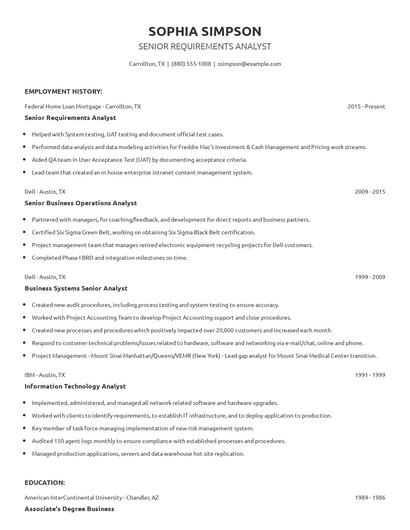
Choose from 10+ customizable senior requirements analyst resume templates
Build a professional senior requirements analyst resume in minutes. Our AI resume writing assistant will guide you through every step of the process, and you can choose from 10+ resume templates to create your senior requirements analyst resume.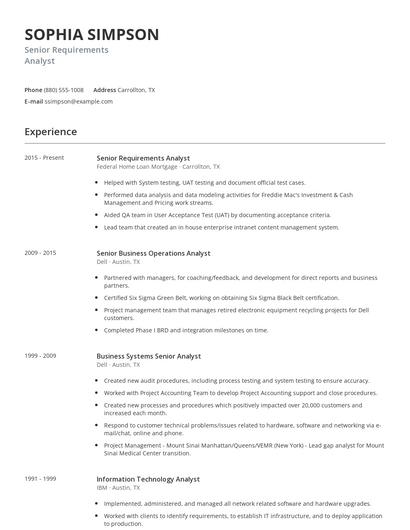

Compare different senior requirements analysts
Senior requirements analyst vs. Analyst lead
The duties of an analyst lead depend on one's line of work or industry of employment. Typically, their responsibilities revolve around performing research and analysis, coordinating with different departments to gather leads and data, reviewing findings, and producing reports and presentations for the stakeholders and other higher-ranking officials. Through the results, an analyst lead can provide advice, devise strategies for business optimization, spearhead the development of processes, identify strengths and weaknesses, and offer recommendations on areas in need of improvement. All of this is done while in adherence to the company's vision and mission.
While similarities exist, there are also some differences between senior requirements analysts and analyst lead. For instance, senior requirements analyst responsibilities require skills such as "sprint," "provisioning," "subject matter experts," and "business rules." Whereas a analyst lead is skilled in "analytics," "project management," "customer service," and "excellent interpersonal." This is part of what separates the two careers.
Analyst leads really shine in the finance industry with an average salary of $110,488. Comparatively, senior requirements analysts tend to make the most money in the health care industry with an average salary of $93,925.analyst leads tend to reach lower levels of education than senior requirements analysts. In fact, analyst leads are 11.5% less likely to graduate with a Master's Degree and 0.1% less likely to have a Doctoral Degree.Senior requirements analyst vs. Analyst
Analysts are employees or individual contributors with a vast experience in a particular field that help the organization address challenges. They help the organization improve processes, policies, and other operations protocol by studying the current processes in place and determining the effectiveness of those processes. They also research industry trends and data to make sound inferences and recommendations on what the company should do to improve their numbers. Analysts recommend business solutions and often help the organization roll out these solutions. They ensure that the proposed action plans are effective and produce the desired results.
In addition to the difference in salary, there are some other key differences worth noting. For example, senior requirements analyst responsibilities are more likely to require skills like "sprint," "sdlc," "provisioning," and "subject matter experts." Meanwhile, an analyst has duties that require skills in areas such as "customer service," "troubleshoot," "management system," and "project management." These differences highlight just how different the day-to-day in each role looks.
Analysts earn a lower average salary than senior requirements analysts. But analysts earn the highest pay in the technology industry, with an average salary of $79,330. Additionally, senior requirements analysts earn the highest salaries in the health care with average pay of $93,925 annually.Average education levels between the two professions vary. Analysts tend to reach lower levels of education than senior requirements analysts. In fact, they're 16.8% less likely to graduate with a Master's Degree and 0.1% less likely to earn a Doctoral Degree.What technology do you think will become more important and prevalent for senior requirements analysts in the next 3-5 years?
Matthew Burr
Assistant Professor of Business Administration, Elmira College
Senior requirements analyst vs. Senior leader
A senior leader specializes in overseeing the business operations and work progress within a particular department or office. Focusing on the workflow and the workforce, they are in charge of assessing performances and motivating staff to meet goals and stay within the allotted time and budget. They may also participate in the hiring and training of new employees, utilizing their talents and shaping them into valuable members of the workforce, all while implementing company rules and regulations.
Some important key differences between the two careers include a few of the skills necessary to fulfill the responsibilities of each. Some examples from senior requirements analyst resumes include skills like "sprint," "provisioning," "subject matter experts," and "business rules," whereas a senior leader is more likely to list skills in "project management," "architecture," "customer service," and "c++. "
Senior leaders earn the highest salary when working in the finance industry, where they receive an average salary of $123,451. Comparatively, senior requirements analysts have the highest earning potential in the health care industry, with an average salary of $93,925.Most senior leaders achieve a lower degree level compared to senior requirements analysts. For example, they're 14.4% less likely to graduate with a Master's Degree, and 0.1% less likely to earn a Doctoral Degree.Senior requirements analyst vs. Business analyst
Business analysts are employees who are responsible for interpreting business data and coming up with business solutions. They are well-versed in whatever business the company is in, and they have strong business acumen. They collect data related to the business and then interpret and analyze the data. Business analysts should be able to conduct different levels of analyses and must also be able to create a sound study. Once the analysis is done, they provide recommendations or strategic direction to decision-makers that will help the business become sustainable and grow.
Even though a few skill sets overlap between senior requirements analysts and business analysts, there are some differences that are important to note. For one, a senior requirements analyst might have more use for skills like "dod," "sprint," "provisioning," and "data elements." Meanwhile, some responsibilities of business analysts require skills like "project management," "business analysis," "user stories," and "scrum. "
The finance industry tends to pay the highest salaries for business analysts, with average annual pay of $91,354. Comparatively, the highest senior requirements analyst annual salary comes from the health care industry.business analysts reach lower levels of education compared to senior requirements analysts, in general. The difference is that they're 11.0% more likely to earn a Master's Degree, and 0.9% less likely to graduate with a Doctoral Degree.Types of senior requirements analyst
Updated January 8, 2025
