What does a senior security architect do?
Senior security architects deal with developing solutions to accomplish goals and providing ideas about structure, growth, and solutions. Their job revolves around a quick moving environment, constant communication, and working with partners to identify business opportunities. Having this position requires leadership and mentoring skills to help junior team members succeed in this field. They should have technical skills to design and develop solutions to improve an already existing technology. Also, they will be responsible for developing, planning, and executing security systems and strategies.
Senior security architect responsibilities
Here are examples of responsibilities from real senior security architect resumes:
- Achieve full compliance for industry specification standards (UL, NEMA, NIST).
- Manage logistics of moving necessary equipment for test across country to newly designed/built NSA certify test facility.
- Provide governance and direction for proper use of data.
- Implement logging, Nessus, write policies and develop encryption from framework for PCI/SOX compliance.
- Ensure encryption solutions are in compliance with company policies, regulatory directives, and best practices.
- Develop enterprise security policy, standards, controls and guidelines base on PCI, SOX, HIPPA, and NIST standards.
- Develop a cloud-computing model to demonstrate SAAS base enterprise solutions.
- Develop and install IBM/BigFix solution and agents to implement patch management for Microsoft and Linux devices.
- Evaluate threats to infrastructure base on technology evolution curve, anticipate business models and competitive landscape changes.
- Develop standardized packages for internal security assessments, external security assessments, network penetrations and network infrastructure assessments.
- Design and create custom high-performance and highly available webservices in java to reduce implementation effort and license costs.
- Assign by Sr. Management to develop a comprehensive vulnerability response governance structure to meet risk, audit, and regulatory requirements.
- Coordinate solution architecture implementation and modification activities.
- Perform application impact analysis in support of SDLC and request for access supporting multiple lines of business.
- Update McAfee products via SDLC process to provide the highest level of security without impacting the user experience.
Senior security architect skills and personality traits
We calculated that 8% of Senior Security Architects are proficient in Cloud Security, Cloud, and Risk Assessments. They’re also known for soft skills such as Analytical skills, Detail oriented, and Problem-solving skills.
We break down the percentage of Senior Security Architects that have these skills listed on their resume here:
- Cloud Security, 8%
Analyzed mobile and cloud security markets and performed competitive and performance analysis for Saturnus Cloud Security application.
- Cloud, 8%
Collaborated with Product Managers for future, cloud ready design modifications.
- Risk Assessments, 5%
Managed Information Security Risks through coordinating internal Security Risk Assessments and the creation of the Corporate Information Security risk acceptance process.
- Encryption, 5%
Introduced Data Masking and Data Encryption to sensitive data platforms in the United States to meet regulatory and customer requirements.
- Firewall, 5%
Designated as lead engineer for design and implementation of revenue-generating managed security and monitoring system for customer firewall and IDS systems.
- Windows, 4%
Designed Windows auditing and alerting strategy and event log correlation infrastructure.
Common skills that a senior security architect uses to do their job include "cloud security," "cloud," and "risk assessments." You can find details on the most important senior security architect responsibilities below.
Analytical skills. To carry out their duties, the most important skill for a senior security architect to have is analytical skills. Their role and responsibilities require that "information security analysts must carefully study computer systems and networks and assess risks to determine how security policies and protocols can be improved." Senior security architects often use analytical skills in their day-to-day job, as shown by this real resume: "install and maintain large scale linux platforms to provide security, database, web and other services. "
Detail oriented. Another essential skill to perform senior security architect duties is detail oriented. Senior security architects responsibilities require that "because cyberattacks can be difficult to detect, information security analysts must pay careful attention to computer systems and watch for minor changes in performance." Senior security architects also use detail oriented in their role according to a real resume snippet: "develop detailed technical security standards for infrastructure components. "
Problem-solving skills. senior security architects are also known for problem-solving skills, which are critical to their duties. You can see how this skill relates to senior security architect responsibilities, because "information security analysts must respond to security alerts and uncover and fix flaws in computer systems and networks." A senior security architect resume example shows how problem-solving skills is used in the workplace: "developed and installed ibm/bigfix solution and agents to implement patch management for microsoft and linux devices. "
The three companies that hire the most senior security architects are:
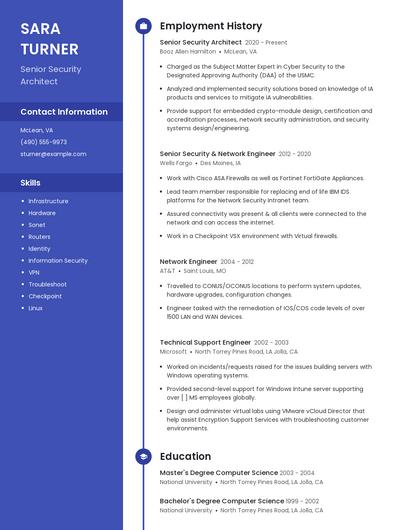
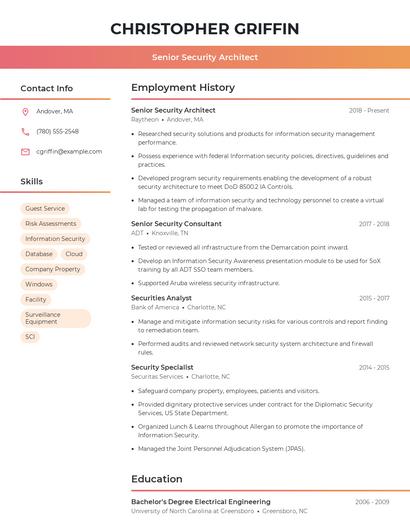
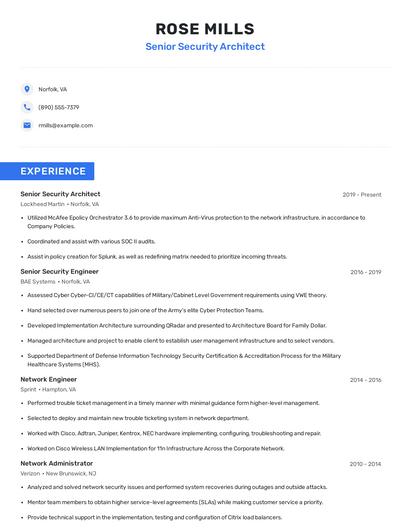
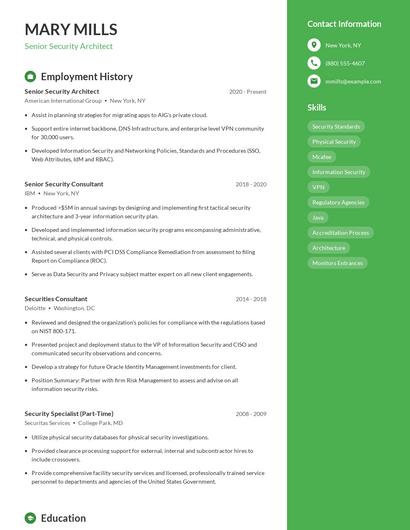
Choose from 10+ customizable senior security architect resume templates
Build a professional senior security architect resume in minutes. Our AI resume writing assistant will guide you through every step of the process, and you can choose from 10+ resume templates to create your senior security architect resume.



Compare different senior security architects
Senior security architect vs. Information assurance engineer
Information assurance engineers are responsible for protecting an organization's data. They act as a team of security specialists that use their skill in securely operating and keeping data to protect the organization's most essential asset. Their main role is to guarantee the quality, security, and retrievability of the organization's information. Also, they outline security systems that make certain the integrity, confidentiality, and accessibility of data. Additionally, they secure IT infrastructure, maintain hardware and software updated, establish security standards, and monitor threats like breaches.
While similarities exist, there are also some differences between senior security architects and information assurance engineer. For instance, senior security architect responsibilities require skills such as "cloud," "firewall," "security architecture," and "security tools." Whereas a information assurance engineer is skilled in "rmf," "acas," "poa," and "assurance support." This is part of what separates the two careers.
Information assurance engineers really shine in the professional industry with an average salary of $97,153. Comparatively, senior security architects tend to make the most money in the professional industry with an average salary of $135,087.On average, information assurance engineers reach similar levels of education than senior security architects. Information assurance engineers are 2.9% less likely to earn a Master's Degree and 3.6% less likely to graduate with a Doctoral Degree.Senior security architect vs. Access control specialist
An Access Control Specialist is in charge of implementing security protocols and systems to prevent unauthorized access into different facilities. They usually stand guard at entry points to greet and verify visitors' identity, conduct inspections to detect and collect prohibited items and work together with security teams to enforce security policies and regulations. Moreover, an Access Control Specialist may also handle and monitor security alarms and systems, respond to distress, and keep an eye on any suspicious activities.
While some skills are similar in these professions, other skills aren't so similar. For example, resumes show us that senior security architect responsibilities requires skills like "cloud security," "cloud," "risk assessments," and "encryption." But an access control specialist might use other skills in their typical duties, such as, "control devices," "ts/sci," "customer service functions," and "customer facilities."
Average education levels between the two professions vary. Access control specialists tend to reach lower levels of education than senior security architects. In fact, they're 15.0% less likely to graduate with a Master's Degree and 3.6% less likely to earn a Doctoral Degree.What technology do you think will become more important and prevalent for senior security architects in the next 3-5 years?
Dr. Barry Stiefel Ph.D.
Associate Professor, College of Charleston
My suggestion is to try to be aware, as much as possible, of the latest and upcoming tech but focus on a specific set (or two) of hardware and software that most interests you. When I was younger, I tried staying on top of it all but quickly found that so much was coming out so fast that soon I spent all my time just trying to be on top of it all and unable to do much else. Technology has become so vast and diversified that to be good at something, you may not be able to do it all.
Professional and social networking can create professional communities where people who specialize in one set or two of technology or skills can share and exchange knowledge and expertise with colleagues and friends that complement each other. This is a strategy that I recommend.
Senior security architect vs. Securities consultant
A securities consultant is responsible for maintaining the safety and security of the company's premises, including enforcing protection for all the employees and company assets. Securities consultants also handle the confidentiality and stability of data network systems to prevent potential breaches and unauthorized access to information. They coordinate with the system analysts to design programs and databases as part of technical solutions to maximize productivity and increase efficiency. A securities consultant writes incident reports, recommend strategic techniques, and research threat risks that may put the company in jeopardy.
Some important key differences between the two careers include a few of the skills necessary to fulfill the responsibilities of each. Some examples from senior security architect resumes include skills like "cloud," "security architecture," "security tools," and "switches," whereas a securities consultant is more likely to list skills in "security management," "security issues," "customer service," and "architecture. "
Securities consultants make a very good living in the technology industry with an average annual salary of $99,249. On the other hand, senior security architects are paid the highest salary in the professional industry, with average annual pay of $135,087.Most securities consultants achieve a lower degree level compared to senior security architects. For example, they're 7.4% less likely to graduate with a Master's Degree, and 3.4% less likely to earn a Doctoral Degree.Senior security architect vs. Information technology security manager
An information technology security manager is responsible for maintaining the safety and security of the organization's network systems to prevent unauthorized access and illegal dissemination of information from the database. Information technology security managers resolve technical issues, configure network updates, and upgrade system infrastructures to enhance optimal performance and navigation. They also install applications, inspect security breaches, and fix faulty servers to avoid system downtimes and operational delays. An information technology security manager must have excellent technical and communication skills, especially in writing reports for system findings and design networks according to business requirements.
Types of senior security architect
Updated January 8, 2025
