
Automatically apply for jobs with Zippia
Upload your resume to get started.
Senior security & network engineer skills for your resume and career
15 senior security & network engineer skills for your resume and career
1. Network Security
- Job duties include support for large-scale managed network security infrastructure consisting of customer-premises Linux-based Rampart firewalls and intrusion detection systems.
- Project planning, design, implementation/installation, as well as general technical support on Network Security Infrastructure and Applications.
2. Cisco Asa
- Configure Cisco ASA5520 firewall cluster for disaster recovery location.
- Provided support for 2Tier and 3Tier firewall architecture, which includes various Check Point, Cisco ASA firewalls and Palo-Alto firewalls.
3. Switches
- Manage and support NetApp, Dell, QNAP and EMC storage arrays, utilizing Cisco 9124 fabric switches for fiber zoning.
- Designed and Implemented redundant 4506 layer 3 switches at 2 facilities using HSRP, also configured GLBP on Layer 2 links.
4. Network Infrastructure
- Design and implemented network infrastructure and configured all the network Infrastructure devices including Network Printers and Registers.
- Reviewed the existing network infrastructure around worldwide data centers of the company and re-mediated non-standard environments.
5. BGP
The Border Gateway Protocol (BGP) is a procedure that facilitates the exchange of routing information among different networks connected through the internet. It also refers to the electronic language used among internet routers, to determine how a piece of information is sent from one router to the other over the network. This process is extremely quick that occurs within mini-seconds, enabling the internet to function properly.
- Configured and tuned BGP attributes to achieve maximum efficiency and redundancy.
- Implemented diverse and redundant Internet connections between carriers utilizing BGP.
6. ASA
- Recommended various lacking best practices for ASA Firewalls for improving efficiency and better resource utilization for production networks.
- Led the firm's proof-of-concept and implementation of Checkpoint next-generation firewall solutions to replace dated Pix and ASA firewalls.
Choose from 10+ customizable senior security & network engineer resume templates
Build a professional senior security & network engineer resume in minutes. Our AI resume writing assistant will guide you through every step of the process, and you can choose from 10+ resume templates to create your senior security & network engineer resume.7. Troubleshoot
Troubleshooting is the process of analyzing and fixing any kind of problem in a system or a machine. Troubleshooting is the detailed yet quick search in the system for the main source of an issue and solving it.
- Work with end users to identify and troubleshoot firewall related connectivity issues.
- Monitored network activity and troubleshoot resolution issues.
8. Windows
Windows is a chain of operating systems that controls a computer and is developed by Microsoft. Every version of Windows consists of GUI (graphical user interface), with a desktop that allows the user to open their files.
- Provided on-call 24/7 support for Windows/Linux compute environment.
- Implement group policies for campus desktops and servers regarding patch management via campus Windows Server Updates Services (WSUS) server.
9. OSPF
- Configured routers for Frame Relay, DSL, OSPF, and EIGRP to provide connectivity for remote users and offices.
- Configure and support static and OSPF routing protocols on the firewalls with MD5 authentication.
10. Intrusion Detection
Intrusion Detection is the job of an intrusion detection system which is a software application that maintains 24-hour surveillance on a system or network to detect an intrusion or breach of privacy. The system then reports the intrusion to its administrator who then takes necessary steps to prevent the intrusion by activating a firewall or blocking out the violator. They are used in the IT industry mostly and in areas where security is held in high esteem.
- Support architecture design for business applications with regard to security controls including access lists, firewalls, and intrusion detection systems.
- Designed and deployed Checkpoint high availability security gateways and intrusion detection gateways for client with multiple Internet service providers.
11. Network Devices
- Managed security of 500+ network devices in addition to security-specific devices and firewalls.
- Connect all security department network devices to network management networks.
12. Linux
Linux is a Unix-like operating system. Just like Windows, Mac OS, and IOS, Linux is an operating system used by millions across the globe. Android itself is powered by the Linux operating system. Linux manages all the hardware resources that are associated with your computer. The software is famous because of the protection it grants from viruses, malware, and crashes. The Linux operating system is entirely free and is an open-source software meaning it can be altered by those equipped with the knowledge to code.
- Provided on-call 24/7 support for Windows/Linux compute environment.
- Implement Linux proxy servers (Squid 2.6) for WAN caching optimization.
13. TCP/IP
- Delivered maintenance and administration for TCP/IP LAN and WAN connections (T1, MAN, ATM)
- Involved in Network Designing, Routing, DNS, IP Subnetting, and TCP/IP protocol.
14. Servers
Servers are computers or systems that provide services to other computers known as clients connected to them via a network. The services can range from data, resources, programs, or any other service that has to do with computing and computers.
It may also refer to someone at a restaurants that delivers the food to patrons from the kitchen.
- Implemented and maintain anti-virus solution for campus enterprise desktops and servers.
- Administered distributed enterprise virus protection for corporate servers and workstations.
15. Load Balancers
- Configured and secured load balancers on the Disaster Recovery & Business Continuity.
- Upgraded the F5's BigIP load balancers, which has over 500 VIPs running different services.
5 Senior Security & Network Engineer resume examples
Build a professional senior security & network engineer resume in minutes. Browse through our resume examples to identify the best way to word your resume. Then choose from 5+ resume templates to create your senior security & network engineer resume.

What skills help Senior Security & Network Engineers find jobs?
Tell us what job you are looking for, we’ll show you what skills employers want.
What senior security & network engineer skills would you recommend for someone trying to advance their career?
Dr. Bobby Roohparvar Ph.D.
Professor of Computer Science and Computer Engineering, California State University - East Bay
*Variety: Each day presents new challenges and opportunities for problem-solving.*
*Demand: The field offers strong job growth and stability.*
*Impact: Your work ensures businesses and organizations remain connected and operational.*
*Learning: There's always something new to learn with emerging technologies.*
*Dislike:*
*Troubleshooting: Issues can be complex and take a lot of time to resolve.*
*On-call: Network problems can occur at any time, requiring on-call availability.*
*Pressure: Maintaining network uptime can be stressful, especially during critical periods.*
*Keeping Up-to-Date: Rapid technological changes necessitate continuous learning.*
What soft skills should all senior security & network engineers possess?
Dr. Steven MacMartin
Director, Associate Professor, Medaille College
List of senior security & network engineer skills to add to your resume
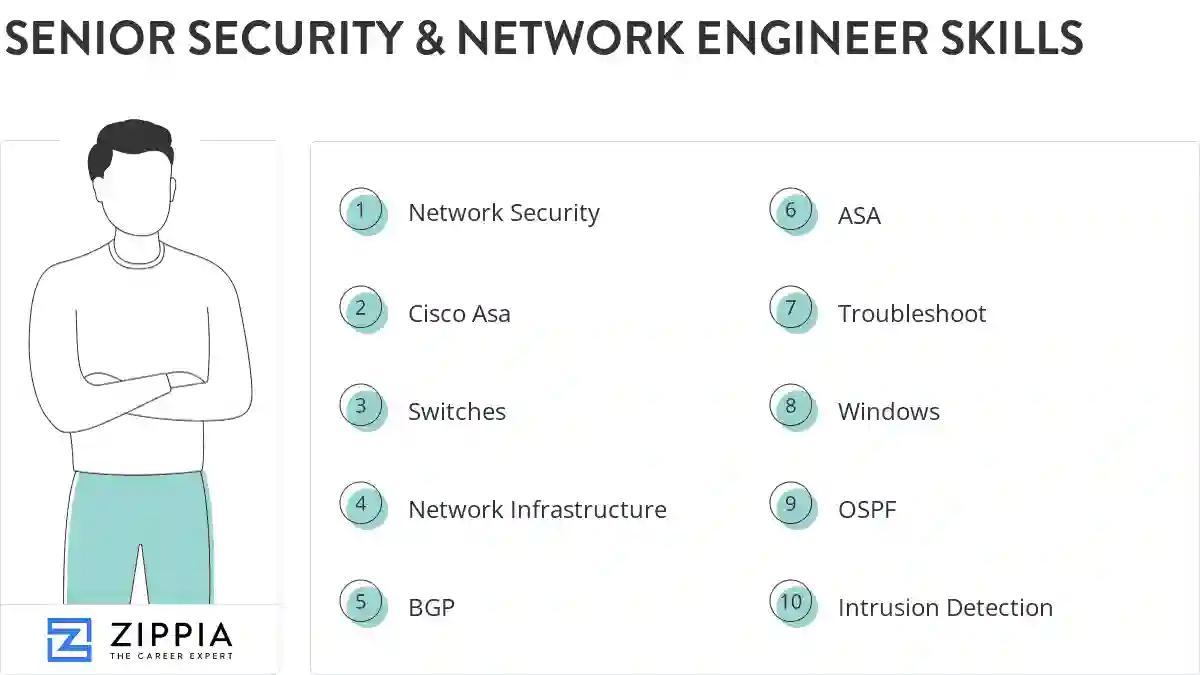
The most important skills for a senior security & network engineer resume and required skills for a senior security & network engineer to have include:
- Network Security
- Cisco Asa
- Switches
- Network Infrastructure
- BGP
- ASA
- Troubleshoot
- Windows
- OSPF
- Intrusion Detection
- Network Devices
- Linux
- TCP/IP
- Servers
- Load Balancers
- NIST
- Lan
- Cloud Security
- Lan Wan
- Security Policies
- EIGRP
- SIEM
- Http
- Nexus
- Azure
- DNS
- Technical Support
- Splunk
- Wireshark
- IOS
- Radius
- PCI
- NAT
- MPLS
- Encryption
- Tacacs+
- VMware
- Nessus
- Bluecoat
- STP
- Data Loss Prevention
- Emerging Technologies
- Checkpoint Firewall
- Visio
- HSRP
- Cisco Ios
- Ipsec VPN
- SolarWinds
- Virtualization
Updated January 8, 2025
