Explore jobs
Find specific jobs
Explore careers
Explore professions
Best companies
Explore companies
Job outlook for senior software support engineers in the United States
Senior software support engineer job growth summary. After extensive research, interviews, and analysis, Zippia's data science team found that:
The projected senior software support engineer job growth rate is 21% from 2018-2028.
About 284,100 new jobs for senior software support engineers are projected over the next decade.
Senior software support engineer salaries have increased 10% for senior software support engineers in the last 5 years.
There are over 47,514 senior software support engineers currently employed in the United States.
There are 356,284 active senior software support engineer job openings in the US.
The average senior software support engineer salary is $115,444.
Are senior software support engineer jobs in demand?
Senior software support engineer job and salary trends over time
Senior software support engineer jobs over time
Senior software support engineer job growth rate over time
| Year | # of jobs | % of population |
|---|---|---|
| 2021 | 47,514 | 0.01% |
| 2020 | 97,833 | 0.03% |
| 2019 | 65,650 | 0.02% |
| 2018 | 142,225 | 0.04% |
| 2017 | 133,732 | 0.04% |
Average senior software support engineer salary over time
Senior software support engineer salary by year
| Year | Avg. salary | Hourly rate | % Change |
|---|---|---|---|
| 2025 | $115,444 | $55.50 | +3.4% |
| 2024 | $111,640 | $53.67 | +2.3% |
| 2023 | $109,112 | $52.46 | +1.8% |
| 2022 | $107,185 | $51.53 | +1.7% |
| 2021 | $105,385 | $50.67 | +1.9% |
Senior software support engineer jobs by state
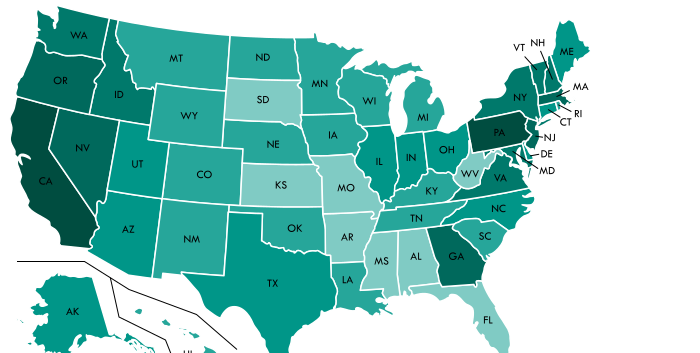
Most common states for senior software support engineers
| Rank | State | Population | # of jobs | Employment/ 1000ppl |
|---|---|---|---|---|
| 1 | District of Columbia | 693,972 | 1,009 | 145% |
| 2 | Washington | 7,405,743 | 6,448 | 87% |
| 3 | Delaware | 961,939 | 590 | 61% |
| 4 | Virginia | 8,470,020 | 4,917 | 58% |
| 5 | Massachusetts | 6,859,819 | 3,946 | 58% |
| 6 | Oregon | 4,142,776 | 2,380 | 57% |
| 7 | Vermont | 623,657 | 350 | 56% |
| 8 | Maryland | 6,052,177 | 3,326 | 55% |
| 9 | Rhode Island | 1,059,639 | 575 | 54% |
| 10 | California | 39,536,653 | 20,981 | 53% |
| 11 | Utah | 3,101,833 | 1,606 | 52% |
| 12 | Nebraska | 1,920,076 | 990 | 52% |
| 13 | South Dakota | 869,666 | 401 | 46% |
| 14 | Colorado | 5,607,154 | 2,500 | 45% |
| 15 | New Hampshire | 1,342,795 | 573 | 43% |
| 16 | Kansas | 2,913,123 | 1,172 | 40% |
| 17 | Montana | 1,050,493 | 409 | 39% |
| 18 | Georgia | 10,429,379 | 3,978 | 38% |
| 19 | Wyoming | 579,315 | 215 | 37% |
| 20 | Minnesota | 5,576,606 | 2,022 | 36% |
Most common cities for senior software support engineers
| Rank | City | # of jobs | Employment/ 1000ppl | Avg. salary |
|---|---|---|---|---|
| 1 | Lakeland | 1 | 1% | $91,152 |
| 2 | Denver | 1 | 0% | $93,954 |
Senior Software Support Engineer job outlook: Expert opinions
Our panel of senior software support engineer experts
California State University - Sacramento
Nova Southeastern University
Northwestern University
University of Wisconsin - Eau Claire
Texas A&M University
Nova Southeastern University
Aurora University
Southern Illinois University Edwardsville
Oklahoma State University Institute of Technology - Okmulgee
Texas A&M University San Antonio
Middle Georgia State University
University of Minnesota - Duluth
Mount St. Joseph University
University of Richmond
Idaho State University
Southern Illinois University Edwardsville
What general advice would you give to a Senior Software Support Engineer?
Sepehr Mohammadian: 2. Computer science remains in high demand in today's job market, with California exemplifying this trend. In recent years, the number of open positions in the state has exceeded the average demand rate by 1.5 times. At the University of the Pacific, our CS program is designed to equip students with the necessary skills and experiences to thrive in this landscape. Through our co-op program, in collaboration with recruiters such as Nvidia, HP, and Lawrence Livermore National Lab, students have the opportunity to participate in paid internships lasting approximately 8 months. These internships provide invaluable exposure to real-world work settings and allow students to apply their knowledge in practical contexts and gain valuable industry insights. It is worth noting that many of our graduates choose to return to the same company post-graduation.
What Senior Software Support Engineer skills would you recommend for someone trying to advance their career?
Sepehr Mohammadian: 1. This is a pretty broad question. CS degree graduates can engage in different tasks and responsibilities based on the nature of their profession. Examples include 1) software engineering, in which the individual's efforts are toward leading or contributing to software development projects, 2) IT management, where the individual mainly oversees technology strategies and their implementation, 3) cybersecurity, where the individual's responsibilities are associated with the protection of systems and data from cyber threats, and 4) data and AI engineering, where the individual works on machine learning applications and analyze and derive insights from large datasets.
What general advice would you give to a Senior Software Support Engineer?
Dr. Sridhar Ramachandran: As a Computer Science graduate, it’s vital to work on independent projects outside of course projects or assigned tasks. This allows you to apply your knowledge and explore new areas and opportunities. Showcasing these projects in a digital portfolio provides a visual and tangible representation of your skills and growth. Emphasizing your attention to clean coding and documentation reflects your professionalism and attention to detail. The field is vast and rapidly evolving, so stay curious, keep learning, and enjoy your professional journey. Avoid getting caught up in fleeting trends. Understanding the difference between work, job, and career is crucial; find work and jobs that contribute to your long-term career aspirations while steadily maintaining your focus on your career goals. In addition, being aware of the organization’s environment and culture at the workplace you intend to work at is important. Familiarize yourself with workplace methodologies like Agile, Just-In-Time (JIT), DevOps, Scrum, Kanban, Lean, Feature-Driven Development (FDD), Extreme Programming (XP), Rapid Application Development (RAD), and Software Development Life Cycle (SDLC) (to name a few). Each organization will have its unique blend of these elements, and knowing what works best for you will help you thrive in your chosen career path. Remember, the key to success in this dynamic field is continuous learning and adaptation.
What Senior Software Support Engineer skills would you recommend for someone trying to advance their career?
Dr. Sridhar Ramachandran: To optimize your earning potential in the field of Computer Science, it’s important to establish a solid educational foundation and master widely-used programming languages and technologies. Internships offer invaluable hands-on experience, and obtaining industrial certifications in specialized areas can significantly increase your marketability. Cultivating a robust professional network and honing your salary negotiation skills are also key. It’s important to stay updated with the latest technological advancements, salary trends, and consider focusing on a niche area in high demand. From the outset of your career conversations, it’s beneficial to communicate clear salary expectations. Conduct thorough research on the current market rates for the role you’re targeting to ensure your expectations are realistic. Understanding your worth in the market is crucial, and you should aim for a salary that not only reflects your skills and experience but also keeps you motivated and invested in your work. Remember, while salary is a significant factor, aspects like work-life balance and job satisfaction also play a vital role in your overall career satisfaction. Aim for a win-win salary negotiation where both you and your employer feel the compensation is fair and equitable.
What will help Senior Software Support Engineers increase their earning potential?
Kin Chung Kwan: Programming is the cornerstone of computer science. Solving problems effectively through proficient programming is a vital key to career success. Learning programming is like athletic training. One cannot become a skilled athlete solely through attending lectures. Programming skills can only be improved with consistent practice. Learning new techniques and repeated practice can help professionals refine their programming abilities and achieve career success.
Junping Sun Ph.D.
ProfessorNova Southeastern University
Computer Software And Media Applications
What Senior Software Support Engineer skills would you recommend for someone trying to advance their career?
Junping Sun Ph.D.: Computer Science and its applications in various fields are very dynamic and constantly evolving, and anyone in the fields needs to prepare to be adaptive by lifelong learning.
David Ostrowski
Northwestern University
Information Science/Studies
What will help Senior Software Support Engineers increase their earning potential?
David Ostrowski: Deep technical software skills, incorporating and innovating with AI, programming languages like Golang, Solidity, Rust, JavaScript, understanding and appreciation of the functional programming paradigm. Innovation and pushing the limits of technology.
What Senior Software Support Engineer skills would you recommend for someone trying to advance their career?
Lyle Ford: Be flexible and open to new experiences. Technology changes rapidly and your skills will have to evolve to keep up. You will always need your creativity and problem solving skills, but the way in which you implement them will change with your environment which will require you to constantly update your skillset. Always look for opportunities to network. This can give you insights into developing areas and open doors for future paths you may be unaware of.
What will help Senior Software Support Engineers increase their earning potential?
Lyle Ford: Computer skills (programming, working effectively with AI, and the like) will be important as the world continues to automate. The ability to design, build, and repair electronic and electromechanical systems will also be important for the same reason.
What will help Senior Software Support Engineers increase their earning potential?
Aakash Tyagi: Salary potential is truly in the eyes of the beholder. Technical depth of knowledge and skills is quintessential, followed closely by a demonstrated track record of willingness to learn and adapt, and ability to communicate clearly.
What will help Senior Software Support Engineers increase their earning potential?
Dr. Frank Mitropoulos Ph.D.: As we look toward the future of careers in Computer Applications, several skills stand out for their growing importance. These skills revolve around specific technologies that are expected to continue to grow and evolve. Technologies related to Cloud Computing, Artificial Intelligence (AI), Cybersecurity, and Data Science are quickly evolving and being applied across the technology sector. Cloud Computing: Given the widespread adoption of Cloud services, Cloud computing expertise is indispensable. Understanding how to leverage platforms like Azure, AWS, and Google Cloud is crucial to developing scalable, efficient solutions that meet business needs. Artificial Intelligence: AI and Machine Learning are transforming the world. Skills in these areas to solve real-world problems will be even more critical in the future. Cybersecurity: Digital threats are becoming more sophisticated. Safeguarding data, networks, and systems will require encryption, intrusion detection, development, and regulation skills. Data Science: Skills in Data Science will be increasingly sought after as businesses embrace data-driven decision-making. Extracting meaningful insights from extensive datasets and effectively communicating these findings will be essential. Soft skills: Finally, soft skills such as teamwork, problem-solving, and effective communication cannot be overlooked. Adapting, communicating, and leading will be essential for success.
Dr. Ramona Baima
Senior Lecturer of Mathematics & Field Experience SupervisorAurora University
Mathematics
What general advice would you give to a Senior Software Support Engineer?
Dr. Ramona Baima: For sure, in the next 3-5 years the level of technology will increase exponentially with the addition of AI. It is very important for graduates to continue to want to learn and improve their skills in the field of computer science and advanced mathematics in order to be able to be creative, come up with and implement unique ideas.
What will help Senior Software Support Engineers increase their earning potential?
Dr. Ramona Baima: They can maximize their salary potential by choosing carefully the company they are starting to work for. They should look for companies that offer incentives such as paying for continuing education (such as master degree, certificates), possibility of exchanging ideas with international colleagues, investments within the company (such as 401K and pension). They also should be informed about the actual job hierchacy within the company and the possibilities of advancing their job position.
What Senior Software Support Engineer skills would you recommend for someone trying to advance their career?
Ahmed Imteaj PH.D.: Artificial Intelligence and Machine Learning (LLMs): With the rise of Large Language Models (LLMs) like GPT-3 and BERT, skills in natural language processing (NLP), transfer learning, and fine-tuning pre-trained models will become increasingly valuable. LLMs have applications in areas such as text generation, sentiment analysis, and language translation.
Sustainable AI: As concerns about the environmental impact of AI and computing grow, skills in sustainable AI practices, energy-efficient algorithms, and green computing will be in demand. Professionals who can develop AI solutions that minimize energy consumption and carbon footprint will play a crucial role in building a more sustainable future.
Cybersecurity: With the ever-increasing threat landscape and sophisticated cyberattacks, cybersecurity skills will remain critical. In addition to traditional cybersecurity practices, such as network security and encryption, skills in areas such as threat intelligence, incident response, and penetration testing will be in high demand.
Cloud Computing: As more businesses migrate their infrastructure and services to the cloud, skills in cloud computing will continue to be in high demand. Proficiency with cloud platforms such as AWS, Azure, and Google Cloud, as well as expertise in areas like serverless computing, containerization, and hybrid cloud architectures, will be valuable for building and managing scalable and resilient cloud-based solutions.
What will help Senior Software Support Engineers increase their earning potential?
Evgenia Smirni: Focus on having a strong basis of the fundamentals. The purpose of your education is to teach you asking the right questions to be able to find the right solutions. This field is changing continuously. Learning how to pivot when new, emerging trends happen, is key for success. Last but not least, do not underestimate the value of liberal arts educations - combining CS with liberal arts can offer communication skills that are of paramount importance for your career trajectory in this tech field.
Mr. Mark Pranger
Instructor, School of Creative and Information TechnologiesOklahoma State University Institute of Technology - Okmulgee
Mining And Petroleum Technologies/Technicians
What Senior Software Support Engineer skills would you recommend for someone trying to advance their career?
Mr. Mark Pranger: The biggest advice here is to show the organization the long haul. It costs a lot of money to advertise, find, recruit, hire, and train employees in our field. The company wants to know their return on that investment will be higher. A large technical breadth versus a deep technical understanding is the balance you have to maintain. Many companies I deal with as an internship coordinator tell me that they can train the technical niche needs that they have but the student has to be able to show that they can learn and absorb that knowledge and put it to use. Going back to the portfolio, this gives someone looking at it insight into what extent you can learn, absorb, and produce. I personally am a true believer in the depth over breadth in the computer science programming field. While syntax changes from language to language, the concepts that we use to engineer our software remain the same. So Java does one activity different than C# or Ruby, that concept though will be important and the syntax can be picked up easier if you understand the concept. To me, a deeper understanding of one language and the ability to adapt quickly to another language is more important than having a little knowledge in a wide breadth of language but no depth. I have been in this field for 30 years now and probably know about half that number of languages that I have used over those 30 years. I didn't start with all those languages, but I did start with a very deep understanding of just one or two. I could spend my time quickly learning syntax to pick up a new language for a new position because I understood the concepts so well in my root language. Learn it deep, understand it deep and show you can transfer it across laterally. Put together that portfolio. The portfolio reinforces the narrative I discussed in the earlier question also.
MARLA KRAMER
Assistant Vice President of Marketing and CommunicationsWhat general advice would you give to a Senior Software Support Engineer?
MARLA KRAMER: Do the necessary course work from a reputed institution, where you can get the necessary hands-on experience under the tutelage of an established expert. Create a portfolio of your work on GitHub so that you can share your projects with potential employees. It is more important to demonstrate your skills through code, than it is to provide a list of classes that you have taken. Certification courses are expensive, but getting an accredited certificate in Mobile Application Development or any of the rapidly growing fields is always an advantage. The internet has a lot of uncurated, self-published, and incorrect information, especially when it comes to computer science. It is important that you pick your sources wisely as you build your skills.
What will help Senior Software Support Engineers increase their earning potential?
MARLA KRAMER: It is unlikely that software development will be fully automated in the near future. Writing correct and efficient applications is a skill set that will only grow as we invent more ways to improve the quality of our lives. As more and more commerce and critical services migrate onto the internet, IS development will require a deeper knowledge of cybersecurity, data analytics, and cloud computing. According to the U.S. Bureau of Labor Statistics (BLS), Information Security Analysis jobs are expected to grow by 32% over the next 10 years. The BLS estimates Software Developers, Quality Assurance and Testing will grow by 25% over the next decade.
Right now, however, software development is going through a lull because of competition from abroad. Being an expert in at least two popular programming languages, having a solid theoretical foundation, and being able to innovate is pivotal. Artificial Intelligence is being deployed to solve some problems now, thanks to the powerful computers we have today. Learning to effectively use AI frameworks as part of your application development will add a lot of value to your skillset.
Izzat Alsmadi
Associate ProfessorTexas A&M University San Antonio
Computer Science
What will help Senior Software Support Engineers increase their earning potential?
Izzat Alsmadi: The market is very large, make your deep analysis on top trending jobs, their pays and requirements, unlikely to have high paying jobs for fresh graduates with extra skills, certificates, etc.
Tina Ashford
Professor of Information Technology/Faculty Curator of the Museum of Technology/DoIT Internship CoordinatorMiddle Georgia State University
Computer And Information Sciences And Support Services
What general advice would you give to a Senior Software Support Engineer?
Tina Ashford: Technical expertise is crucial: cloud fluency, cybersecurity awareness, and understanding Artificial Intelligence/Machine Learning (AI/ML) potential, however, soft skills are equally important - clarity in communication, seamless collaboration, and an ever-growing appetite for learning to adapt to the ever-changing tech landscape. Even with AI on the scene, uniquely human problem-solving and fresh ideas will set you apart. This blend of technical and soft skill agility, and never-ending curiosity should bring you success in the field of IT.
Rich Maclin
ProfessorUniversity of Minnesota - Duluth
Computer Systems Networking And Telecommunications
What will help Senior Software Support Engineers increase their earning potential?
Rich Maclin: My advice to my students always starts with the fundamental question--what are you trying to achieve? What do you want out of job? Are you looking for a steady income, job security, a challenge, a particular field, etc.? When I talk to students in our upper division Software Engineering course my suggested approach is to try to understand the culture of the job you were taking on, and by extension, take whatever training they offer you. But honestly, I also tell them BEFORE they graduate that they need to think about what comes next and perhaps work on those other skills that may help them with jobs they want. If they want to go into a finance-related field maybe take some business courses in accounting, etc. If they play multiple instruments (seems like many of our students do) maybe take music courses and look for companies that work in the music field. Computer science and software at this point touch almost every industry, so before they leave I often suggest students take courses in areas that might lead them to be more attractive to companies in that field.
Rebecca Allen
Mount St. Joseph University
Special Education And Teaching
What general advice would you give to a Senior Software Support Engineer?
Rebecca Allen: AI, for sure. I have heard it said that AI might not replace humans, rather humans who know how to use AI well may replace humans who don't.
Ahmed Temani
Senior InstructorUniversity of Richmond
Computer/Information Technology Administration And Management
What general advice would you give to a Senior Software Support Engineer?
Ahmed Temani: A lot of the buzz is about using chatbots to improve coding efficiency. However, there is a great need for systems level thinking and design as software is deployed across cloud and edge computing devices. Gaining more experience in systems design provides you with additional skills that complement whatever AI-based technology gets deployed.
What Senior Software Support Engineer skills would you recommend for someone trying to advance their career?
Ahmed Temani: This one I'm not sure how to answer as it is too broad. I would say work hard and do quality work, but that seems obvious.
What Senior Software Support Engineer skills would you recommend for someone trying to advance their career?
Nikyra Capson: Don't be afraid of being rejected. If they see a job they want, apply. Even if they don't think they'll get it, still apply. The worst thing that could happen is being told no. Not applying is an automatic no, so they might as well try.
John Matta
Associate Professor of CS, SIUESouthern Illinois University Edwardsville
Computer And Information Sciences
What will help Senior Software Support Engineers increase their earning potential?
John Matta: Keep learning. The technology changes quite often, so you'll have to stay current.