What does a senior unix systems engineer do?
Senior unix systems engineer responsibilities
Here are examples of responsibilities from real senior unix systems engineer resumes:
- Develop scripts to upgrade java ear files and to automate maintenance tasks.
- Manage development, manufacturing, test and delivery of custom broadband RF electronic test systems for military and aerospace customers.
- Upgrade the internal and external DNS servers.
- Recover OS and help bring applications back online quickly.
- Install and configure MYSQL and PERL support code for DCYF intranet services.
- Migrate P-690/Regatta-1 Lpars from AIX v5.1 to v5.2 enabling dynamic resource allocation.
- Perform VCS cluster maintenance tasks on Solaris 10 and storage maintenance using VxVM.
- Demonstrate good working knowledge of DNS and Internet mail and troubleshooting application problems on TCP/IP network.
- Perform virtual container/zone installs and migration between servers, OS patching, firmware upgrades, NetBackup tape administration.
- Document and provide the procedures on AIX, TSM to the client's administrators and train them on maintaining their systems.
- Sun Solaris server/zone implementation and administration.
- Perform performance analysis and kernel tuning.
- Install apache and tomcat on few application servers and administer for applications.
- Provide advanced technical support to development teams to ensure accurate product installations on AIX infrastructure.
- Resolve problems involving performance monitoring, system and kernel tuning, finding and eliminating bottlenecks.
Senior unix systems engineer skills and personality traits
We calculated that 7% of Senior Unix Systems Engineers are proficient in Unix, Linux, and Infrastructure. They’re also known for soft skills such as Analytical skills, Communication skills, and Problem-solving skills.
We break down the percentage of Senior Unix Systems Engineers that have these skills listed on their resume here:
- Unix, 7%
Developed scripts monitor all Linux/UNIX servers and for backups using storage-based snapshots reducing database backup downtime.
- Linux, 7%
Developed scripts monitor all Linux/UNIX servers and for backups using storage-based snapshots reducing database backup downtime.
- Infrastructure, 6%
Provided advanced technical support to development teams to ensure accurate product installations on AIX infrastructure.
- Server Builds, 4%
Document and provide standard operations manual for new Server builds.
- Red Hat, 3%
Configured and managed Apache Web Server on Red Hat EnterpriseLinux for web based applications using REST/SOAP, Apache and Weblogic.
- OS, 3%
Deliver 24/7 Tier-2 support for Linux/Unix OS and hardware issues, promoting optimal functionality of systems.
Most senior unix systems engineers use their skills in "unix," "linux," and "infrastructure" to do their jobs. You can find more detail on essential senior unix systems engineer responsibilities here:
Analytical skills. To carry out their duties, the most important skill for a senior unix systems engineer to have is analytical skills. Their role and responsibilities require that "administrators need to evaluate networks and systems to make sure that they perform reliably and to anticipate new requirements as customers’ needs change." Senior unix systems engineers often use analytical skills in their day-to-day job, as shown by this real resume: "perform problem analysis ' understanding java stack traces and thread dumps"
Communication skills. Another soft skill that's essential for fulfilling senior unix systems engineer duties is communication skills. The role rewards competence in this skill because "administrators must describe problems and their solutions to non-it workers." According to a senior unix systems engineer resume, here's how senior unix systems engineers can utilize communication skills in their job responsibilities: "worked as an intern ii in an application support team (dcs: distributed communications software) completed tivoli installations. "
Problem-solving skills. senior unix systems engineers are also known for problem-solving skills, which are critical to their duties. You can see how this skill relates to senior unix systems engineer responsibilities, because "administrators must quickly resolve problems that arise with computer networks." A senior unix systems engineer resume example shows how problem-solving skills is used in the workplace: "conducted analysis, problem-solving and evaluation activities on special topics related to designing it optimization and infrastructure solutions. "
The three companies that hire the most senior unix systems engineers are:
- Leidos8 senior unix systems engineers jobs
- Samsung Electronics Device Solutions (Semiconductor & Display)3 senior unix systems engineers jobs
- Enterprise Holdings2 senior unix systems engineers jobs
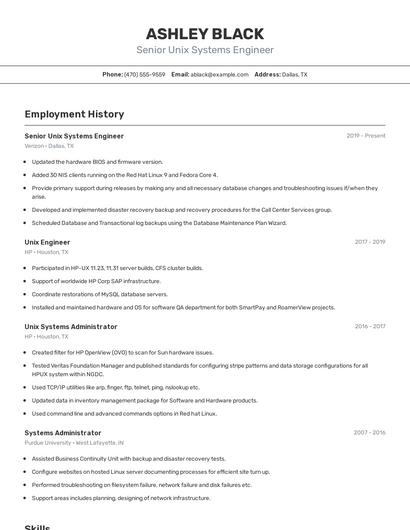
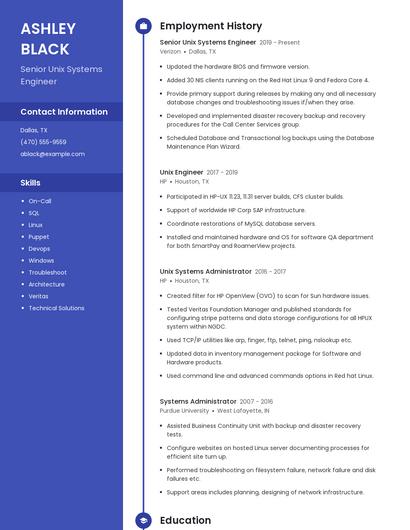
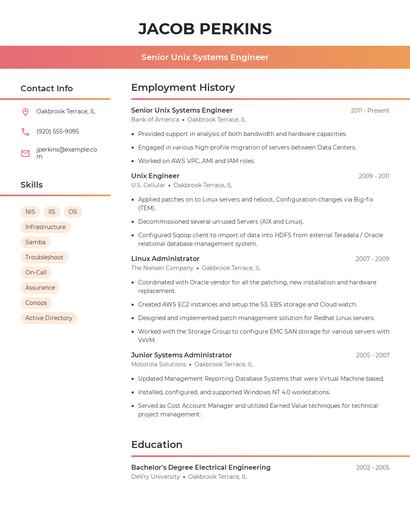
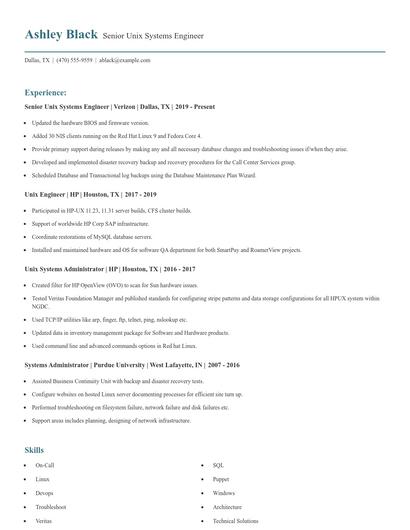
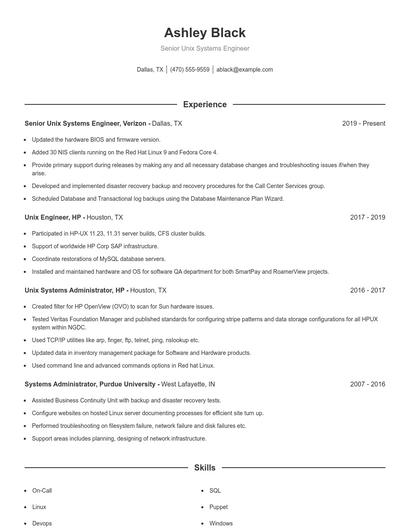
Choose from 10+ customizable senior unix systems engineer resume templates
Build a professional senior unix systems engineer resume in minutes. Our AI resume writing assistant will guide you through every step of the process, and you can choose from 10+ resume templates to create your senior unix systems engineer resume.






Compare different senior unix systems engineers
Senior unix systems engineer vs. Engineer
Engineers are highly trained professionals who determine the feasibility of various projects, usually related to the construction industry. They are considered experts in mathematics and science, two disciplines that they need to use in designing and coming up with plans for projects. They should also be well-versed in different construction or industrial materials, and they ensure that appropriate materials are used for the project. They also ensure that the projects meet the requirements of the groups that hired them. They create spaces that would both address the needs of the end-users and the industry standards. They also ensure that the projects they make would stand the test of time.
These skill sets are where the common ground ends though. The responsibilities of a senior unix systems engineer are more likely to require skills like "infrastructure," "server builds," "red hat," and "ldap." On the other hand, a job as an engineer requires skills like "python," "cloud," "c++," and "c #." As you can see, what employees do in each career varies considerably.
Engineers earn the highest salaries when working in the automotive industry, with an average yearly salary of $97,672. On the other hand, senior unix systems engineers are paid more in the finance industry with an average salary of $132,505.On average, engineers reach similar levels of education than senior unix systems engineers. Engineers are 2.1% less likely to earn a Master's Degree and 0.7% more likely to graduate with a Doctoral Degree.Senior unix systems engineer vs. Systems operator
Systems operators often act as the front liners whose primary job is to ensure the reliable delivery of electricity service to consumers and businesses. They are responsible for overseeing and managing the power grid and controlling electricity flow through transmission lines. Other duties and responsibilities of systems operators include monitoring and operating current converters, observing circuit breakers and voltage transformers, and anticipating the changing needs for power due to weather. They are also responsible for communicating with key stakeholders such as power plant operators to route energy to consumers.
In addition to the difference in salary, there are some other key differences worth noting. For example, senior unix systems engineer responsibilities are more likely to require skills like "infrastructure," "server builds," "red hat," and "os." Meanwhile, a systems operator has duties that require skills in areas such as "lan wan," "computer system," "management system," and "combat." These differences highlight just how different the day-to-day in each role looks.
On average, systems operators earn a lower salary than senior unix systems engineers. Some industries support higher salaries in each profession. Interestingly enough, systems operators earn the most pay in the finance industry with an average salary of $38,937. Whereas senior unix systems engineers have higher pay in the finance industry, with an average salary of $132,505.Average education levels between the two professions vary. Systems operators tend to reach lower levels of education than senior unix systems engineers. In fact, they're 10.3% less likely to graduate with a Master's Degree and 0.7% less likely to earn a Doctoral Degree.Senior unix systems engineer vs. Network security engineer
A network security engineer is responsible for maintaining the safety and security of all the organization's network systems, conducting regular configuration and maintenance to avoid unauthorized access and suspicious activities that may pose risks for the company's integrity. Network security engineers manage security threats and strategize resolutions to mitigate the reoccurrence of security issues. They also develop security enhancement recommendations, update network infrastructure, and monitor system activities. A network security engineer should have excellent communication and technical skills, as well as a strong command of programming languages and system codes.
The required skills of the two careers differ considerably. For example, senior unix systems engineers are more likely to have skills like "infrastructure," "server builds," "red hat," and "os." But a network security engineer is more likely to have skills like "network security," "cisco asa," "routers," and "servers."
Network security engineers earn the best pay in the retail industry, where they command an average salary of $95,160. Senior unix systems engineers earn the highest pay from the finance industry, with an average salary of $132,505.Most network security engineers achieve a similar degree level compared to senior unix systems engineers. For example, they're 0.1% less likely to graduate with a Master's Degree, and 0.2% less likely to earn a Doctoral Degree.Senior unix systems engineer vs. Computer engineer
A computer engineer is someone who examines, designs, and manages computer hardware and software systems. He/She or she helps in solving issues or any concerns that may occur with the computer's hardware and software as well as assists in the innovation of computer technology. Computer engineers are responsible for computer hardware design, development, research, and test computer systems. They examine components like circuit boards, processors, memory devices, routers, and networks. While, those working with the computer software are in charge of the development, design, and administration of software programs.
Types of senior unix systems engineer
Updated January 8, 2025
