
Automatically apply for jobs with Zippia
Upload your resume to get started.
Sensor operator skills for your resume and career
15 sensor operator skills for your resume and career
1. ISR
Intelligence, Surveillance, Reconnaissance, or ISR is a record that contains essential information crucial in the nation. It has a various function such as operation and intelligence that deals with the processing, coordination, providing timely and relevant information helps with the security of a state. Some info that ISR can capture is radar, infrared images, and electronic signals.
- Managed 21 Sensor Operators and advised Mission Commanders in daily execution of 14 combat orbits/$159M total assets/336 ISR hours.
- Worked daily with deployed US forces in support of their Intelligence, Surveillance and Reconnaissance (ISR) needs.
2. Flight Operations
Flight operations refer to the activities within an airport that entails dispatching, flight planning, flight watch, weather data provision, and facilitating ground-to-air communication. They ensure proper integration of the airport crew, making appropriate schedules, and planning maintenance activities.
- Coordinate with maintenance personnel on aircraft configuration for daily flight operations.
- Instructed multiple operators on flight operations and efficient mission planning.
3. Mission Planning
- Decreased mission planning 60+% by developing software for both an automated geographic coordinate creator and updated customer requirement tracker.
- Operate mission planning ancillary equipment to initialize information for download to airborne mission systems.
4. Reconnaissance
Reconnaissance is the act of surveying a particular area or situation before deciding whether to act. Though originally a military term, many employees may be asked to "do reconnaissance" on a potential new hire or on a possible business partner. The term generally implies stealth while gathering information on a subject, which could be an individual or organization.
- Performed aircrew duties to execute special operation forces/Joint Force Air Component Commander missions requiring persistent armed reconnaissance and Close Air Support.
- Provided full motion video Intelligence, Surveillance and Reconnaissance data collection and analysis in support of mission objectives and customer requirements.
5. DOD
Definition of Done (DoD) is a set of deliverables that are needed to devise software. These deliverables are valuable to the system and can be exemplified by writing code, coding comments, unit testing, integration testing, design documents, release notes, and so on.
- Rendered high level of assistance to DOD personnel with information about enemy forces and potential battle areas.
- Conducted combat missions in support of the US DoD throughout the Middle East.
6. Syllabus
- Develop student academic schedule in accordance with current MQ-1/9 syllabus.
Choose from 10+ customizable sensor operator resume templates
Build a professional sensor operator resume in minutes. Our AI resume writing assistant will guide you through every step of the process, and you can choose from 10+ resume templates to create your sensor operator resume.7. UAV
- Provided UAV pilots with navigation information for image collection of specific targets, and determined optimal sensor selection.
- Performed as UAV Pilot responsible for safe operation of aircraft, fuel management and timely response to aircraft emergencies.
8. Oconus
- Deployed to multiple locations, CONUS and OCONUS in support of Operation Enduring Freedom and multiple AFRICOM missions.
- Provide around the clock support of Sense and Warn capability at OCONUS Tactical Operations Center (TOC).
9. RPA
- Logged 4656 RPA flight hours, 498 combat sorties in three areas of responsibility.
- Provide direct RPA knowledge to ground member and fellow flight crews.
10. MQ-9
- Developed MQ-9 Initial qualification academics for MQ-9 difference training course for dual qualification.
- Developed MQ-9 mission qualification academics for mission dictated needs.
11. LiDAR
- Assisted with operating and maintaining an aerial ground mapping EO, LIDAR and Radar system on King Air 200 aircraft.
- Employed, diagnosed and repaired LiDAR system and associated systems.
12. Intelligence Surveillance
- Full motion video intelligence surveillance and training of new platform capabilities and tactics.
13. PIC
A PIC, also known as a Programmable Intelligent Computer and Programmable Interface Controller, is a type of microcontroller component that is used in the development of electronics, computers, robotics, and the likes. It works as a standard microcontroller with small processors, memory, registers, and storage. Typically, a PIC enhances the I/O operations of a device by separating I/O-based data and programs from the core central processing unit (CPU).
- Assisted PIC in complying with all governing regulations and Federal Aviation Administration Regulations.
- Assist the PIC in complying with all governing regulations including service guidance, company procedures and Federal Aviation Administration Regulations.
14. Sensor Systems
- Skilled at evaluating new sensor systems and software packages, building test plans, and evaluating results of test sorties.
- Assisted in the research and development of the MaRSplus sensor system and its employment on Saturn Arch aircraft.
15. GPS
GPS stands from Global Positioning System. It is a navigation system comprising of satellites that helps in determining the location, velocity, and synchronize time data for different modes of travel like air, sea, or land.
- Performed ground based surveys using Trimble R8 GPS units.
- Delivered differential GPS ground control for right-of-way aerial transmission line surveys - Conducted ground-truthing throughout project areas
5 Sensor Operator resume examples
Build a professional sensor operator resume in minutes. Browse through our resume examples to identify the best way to word your resume. Then choose from 5+ resume templates to create your sensor operator resume.

What skills help Sensor Operators find jobs?
Tell us what job you are looking for, we’ll show you what skills employers want.
List of sensor operator skills to add to your resume
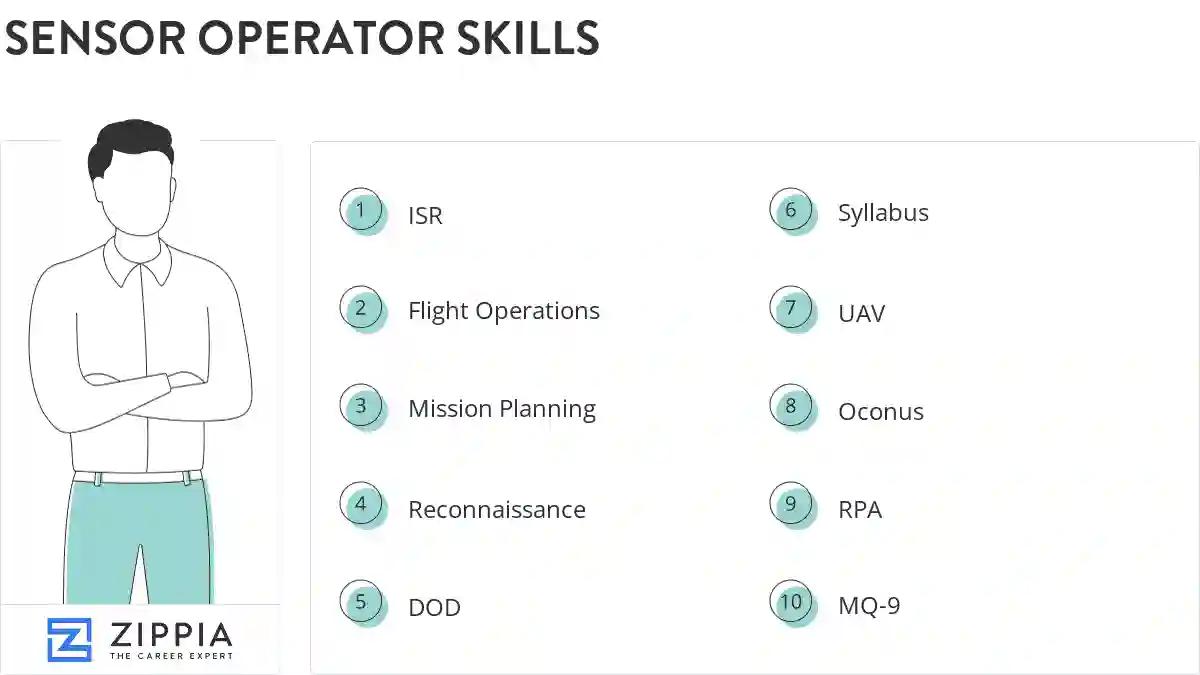
The most important skills for a sensor operator resume and required skills for a sensor operator to have include:
- ISR
- Flight Operations
- Mission Planning
- Reconnaissance
- DOD
- Syllabus
- UAV
- Oconus
- RPA
- MQ-9
- LiDAR
- Intelligence Surveillance
- PIC
- Sensor Systems
- GPS
- Eo
- IRS
- Emergency Procedures
- Continuation Training
- Synthetic Aperture Radar
- Situational Awareness
- USAF
- Ttps
- UAS
- Direct Support
- Delivery Tactics
- SIGINT
- CAS
- Control Station
- Air Support
- Remote Sensing
- Hyperspectral Imaging
- Operations Forces
- Google Earth
- MTS
- ATO
- Target Identification
- Defensive Capabilities
- Air Navigation
- SATCOM
- AOR
Updated January 8, 2025
