
Automatically apply for jobs with Zippia
Upload your resume to get started.
Sheriff officer skills for your resume and career
15 sheriff officer skills for your resume and career
1. Patrol
- Assigned to Temporary Patrol Supervisor Position for Eight Months
- Job duties included: assisted local municipalities with routine patrol and participated in Pro-active Operations in the City of Burlington.
2. Public Safety
Public safety can be defined as the well-being or protection of a community, citizen, or nation as a whole. There are 4 basic elements that come under public safety namely: national security, border policy, countering crime, and emergency management.
- Provide public safety services by enforcing New Jersey Statutes throughout Essex County.
- Managed courtroom and in-custody defendants, including inmate extradition transportation to California, involving logistics, documentation, and public safety.
3. Emergency Situations
- Provided force protection, preserving peace, detecting and investigation crimes, arresting/apprehending violators, and assisting citizens in emergency situations.
- Served as a road patrol deputy providing professional law enforcement and customer service when responding to citizens calls and emergency situations.
4. Law Enforcement Agencies
- Worked cooperatively with neighboring law enforcement agencies.
- Assist any and all other County Law Enforcement agencies.
5. Transport Prisoners
- Transport Prisoners to different Municipalities.
- Transport prisoners from the county Jail to the Courthouse to appear before Superior Court Judge.
6. Criminal Investigations
- Patrolled high crime areas, conducted criminal investigations, made arrests, interviewed victims, suspects and witnesses.
- Assigned to the County Jail and the Regional Enforcement Information Network of the Bureau of Criminal Investigation.
Choose from 10+ customizable sheriff officer resume templates
Build a professional sheriff officer resume in minutes. Our AI resume writing assistant will guide you through every step of the process, and you can choose from 10+ resume templates to create your sheriff officer resume.7. Courtroom Security
- Provided courtroom security for various judges.
- Provide courtroom security, executive protection for court personnel, physical security and the transportation and processing of prisoners.
8. Police Academy
- Attended police academy in Monmouth, New Jersey
- Trained in-service and new recruit officers at The Gloucester County Police Academy.
9. Crime Scenes
Crime scenes refer to places or locations of an offence where forensic evidence may get gathered.
- Qualified in making of arrests, detention and investigation of crime scenes.
- Secured crime scenes, gathered evidence, and questioned witnesses.
10. Subpoenas
Subpoenas are formal and legal documents issued mostly by a court or some other government agency that demands the presence of the person the document is addressed to, to show up at court. Subpoenas are issued to individuals whom the court wants to appear either as a witness in a particular case in order to testify or to provide any evidence such as an object or a document.
- Served or issued subpoenas, summonses, jury summonses, orders to pay alimony, court orders and citations.
- Executed felony warrants and served subpoenas.
11. Court Security
- Advanced procedures on inmate transports and court security Skills Used People skills
- Court security Executed civil warrants.
12. Court Orders
- Managed and analyzed court orders, warrants, and applications for accuracy and eligibility.
- Supervised a variety of domestic visitations per court order.
13. Incident Reports
An Incident Report, in a medical facility such as hospitals and nursing homes, is a type of paperwork filled out immediately after and in the case of an incident of some sort, with the goal of describing the incident and its consequences, as well as the measurements taken after or during the incident, as well as any other information relevant to said incident. Such an incident might be a patient acting out or a patient being injured.
- Review incident reports written by officers.
- Documented information for incident reports and insures all necessary information was included.
14. Civil Process
- Assigned to The Civil Process Unit for eleven years.
- Serve Criminal and Civil Process.
15. Safety Hazards
Safety hazards are defined as any potential source of danger or harm to a person's health and safety. The term commonly refers to the risks associated with the kind of occupation or work. The five common types of occupational safety hazards are; biological (health risks from viruses, bacteria, insect,s, etc.), chemical (dangerous substances used in manufacturing plants), physical (risk of injury associated with labor), Ergonomic (worker's efficiency during work), and Psychosocial (mental health risks involved with certain occupations).
- Reported safety hazards and all related matters to the supervisor and maintenance personnel.
- Observe and report safety hazards, write reports of hazardous conditions or deficiencies affecting security or safety.
5 Sheriff Officer resume examples
Build a professional sheriff officer resume in minutes. Browse through our resume examples to identify the best way to word your resume. Then choose from 5+ resume templates to create your sheriff officer resume.

What skills help Sheriff Officers find jobs?
Tell us what job you are looking for, we’ll show you what skills employers want.
List of sheriff officer skills to add to your resume
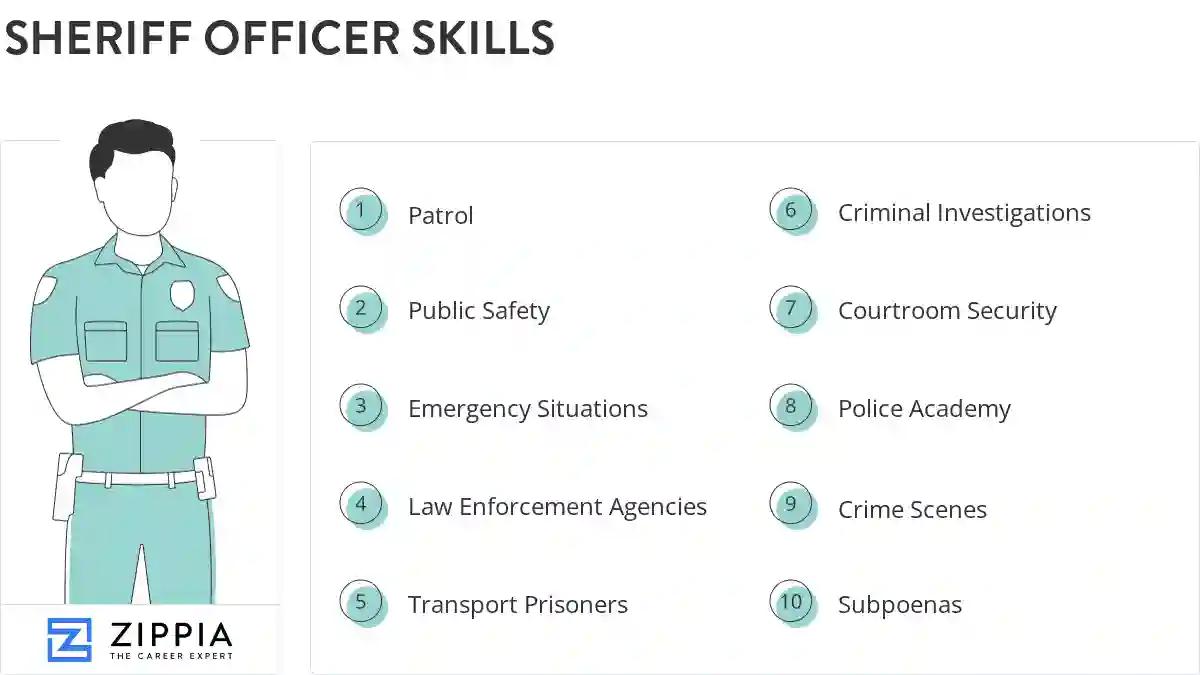
The most important skills for a sheriff officer resume and required skills for a sheriff officer to have include:
- Patrol
- Public Safety
- Emergency Situations
- Law Enforcement Agencies
- Transport Prisoners
- Criminal Investigations
- Courtroom Security
- Police Academy
- Crime Scenes
- Subpoenas
- Court Security
- Court Orders
- Incident Reports
- Civil Process
- Safety Hazards
- Traffic Flow
- Summonses
- Physical Evidence
Updated January 8, 2025
