What does a slasher operator do?
Slasher operator responsibilities
Here are examples of responsibilities from real slasher operator resumes:
- Inspect socks for proper clipping.
- Refabricate and repair equipment by use of a cutting torch and MIG and stick welder.
- Pull maintenance and check quality of product.Skills UsedMechanical, chemical
- Conduct rig movements during drilling operations.
Slasher operator skills and personality traits
We break down the percentage of Slasher Operators that have these skills listed on their resume here:
- RAN, 100%
Communicated well with the company man on site and insured that operations ran smoothly.
Detail oriented. To carry out their duties, the most important skill for a slasher operator to have is detail oriented. Their role and responsibilities require that "woodworkers must pay attention to details in order to meet specifications and to keep themselves safe." Slasher operators often use detail oriented in their day-to-day job, as shown by this real resume: "detailed on-the-job training and instruction received in wastewater plant operations. "
Dexterity. Many slasher operator duties rely on dexterity. "woodworkers must make precise cuts with a variety of handtools and power tools, so they need good hand-eye coordination.," so a slasher operator will need this skill often in their role. This resume example is just one of many ways slasher operator responsibilities rely on dexterity: "confined space, blood borne pathogens. Hazardous materials response.msds, forklift safety,respirator and supplied air training. "
Technical skills. This is an important skill for slasher operators to perform their duties. For an example of how slasher operator responsibilities depend on this skill, consider that "woodworkers must be able to interpret design drawings and technical manuals for a range of products and machines." This excerpt from a resume also shows how vital it is to everyday roles and responsibilities of a slasher operator: "involved responsibility for the technical aspects of plant operations, and compliance with state and federal operating regulations. ".
Mechanical skills. slasher operator responsibilities often require "mechanical skills." The duties that rely on this skill are shown by the fact that "the use of handtools, such as screwdrivers and wrenches, is required to set up, adjust, and calibrate machines." This resume example shows what slasher operators do with mechanical skills on a typical day: "monitored all mechanical and electrical components in the wood yard. "
The three companies that hire the most slasher operators are:
- Standard Textile1 slasher operators jobs
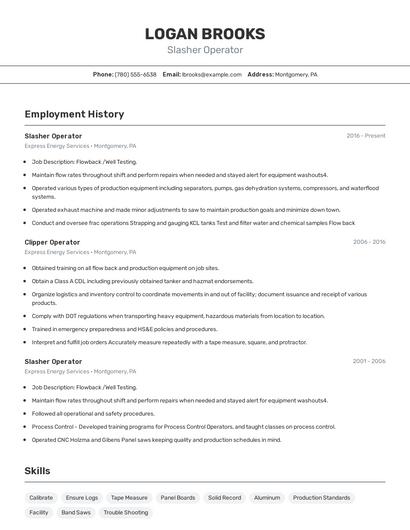
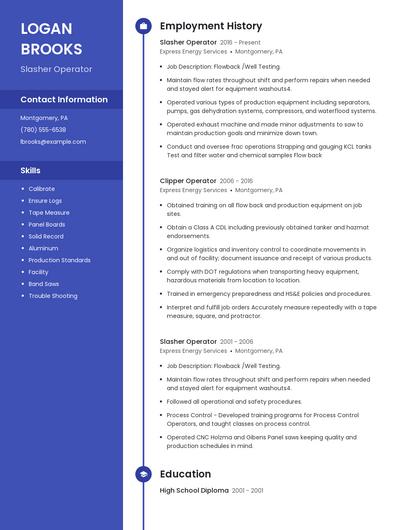
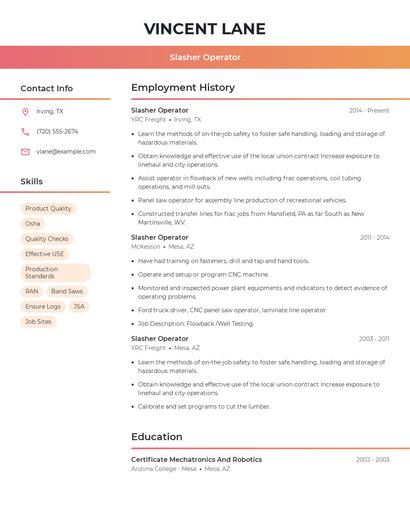
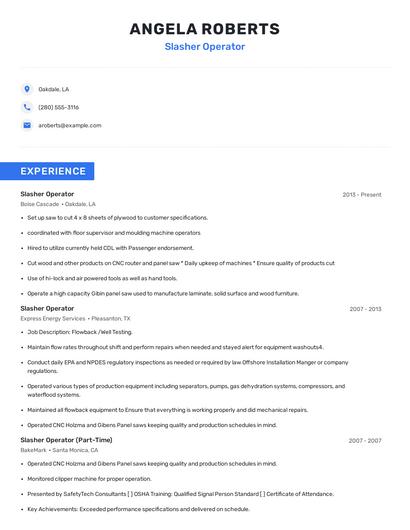
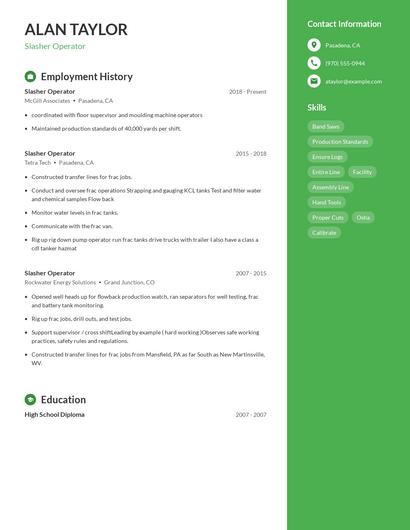
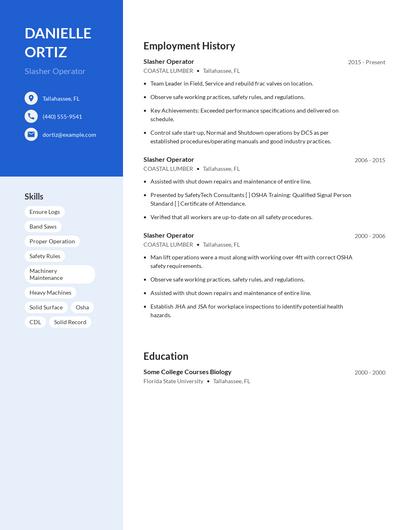
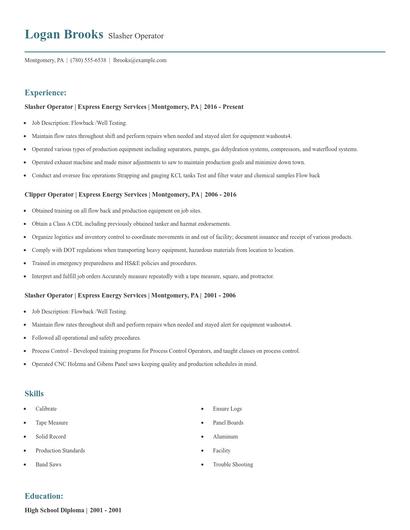
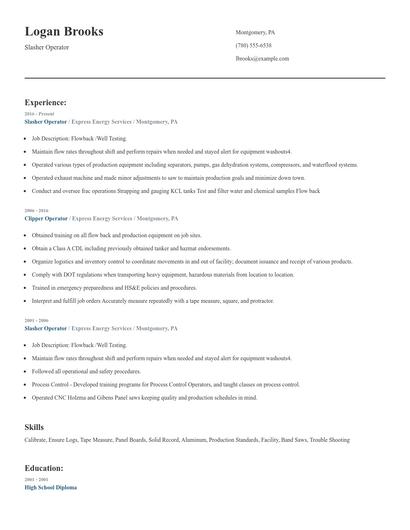
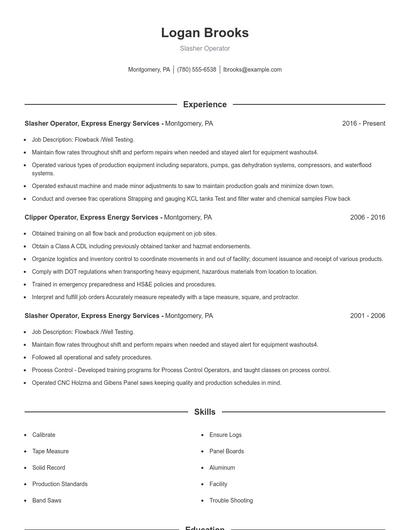
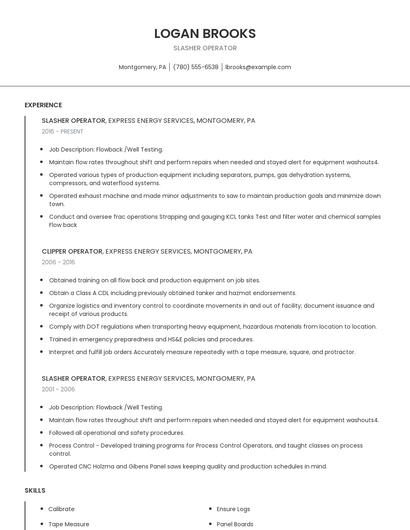
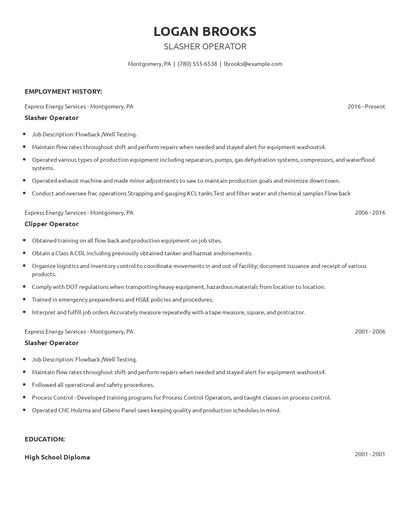
Choose from 10+ customizable slasher operator resume templates
Build a professional slasher operator resume in minutes. Our AI resume writing assistant will guide you through every step of the process, and you can choose from 10+ resume templates to create your slasher operator resume.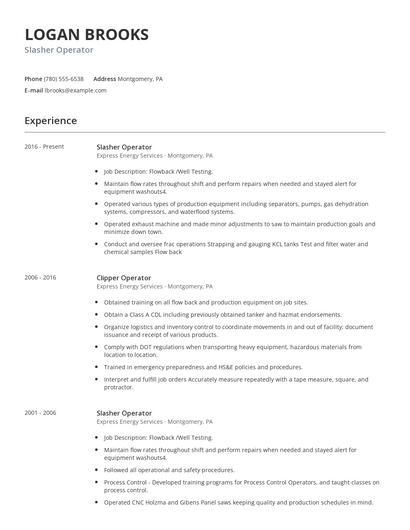
Compare different slasher operators
Slasher operator vs. Edger
These skill sets are where the common ground ends though. The responsibilities of a slasher operator are more likely to require skills like "leadership," "production standards," "cdl," and "jsa." On the other hand, a job as an edger requires skills like "cnc," "assembly line," "design specs," and "quality standards." As you can see, what employees do in each career varies considerably.
Edgers tend to reach lower levels of education than slasher operators. In fact, edgers are 5.4% less likely to graduate with a Master's Degree and 0.0% less likely to have a Doctoral Degree.Slasher operator vs. Chain saw driver
While some skills are similar in these professions, other skills aren't so similar. For example, resumes show us that slasher operator responsibilities requires skills like "ran," "safety regulations," "leadership," and "production standards." But a chain saw driver might use other skills in their typical duties, such as, "dot," "delivery truck," "computer system," and "nissan."
In general, chain saw drivers achieve lower levels of education than slasher operators. They're 5.4% less likely to obtain a Master's Degree while being 0.0% less likely to earn a Doctoral Degree.Slasher operator vs. Sawyer
There are many key differences between these two careers, including some of the skills required to perform responsibilities within each role. For example, a slasher operator is likely to be skilled in "ran," "safety regulations," "production standards," and "cdl," while a typical sawyer is skilled in "safety procedures," "tape measure," "cnc," and "load trucks."
Most sawyers achieve a similar degree level compared to slasher operators. For example, they're 4.5% less likely to graduate with a Master's Degree, and 0.0% less likely to earn a Doctoral Degree.Slasher operator vs. Portable sawmill operator
Even though a few skill sets overlap between slasher operators and portable sawmill operators, there are some differences that are important to note. For one, a slasher operator might have more use for skills like "ran," "safety regulations," "leadership," and "production standards." Meanwhile, some responsibilities of portable sawmill operators require skills like "bobcat," "semi trucks," "routine maintenance," and "circular saws. "
The average resume of portable sawmill operators showed that they earn similar levels of education compared to slasher operators. So much so that theyacirc;euro;trade;re 1.6% less likely to earn a Master's Degree and less likely to earn a Doctoral Degree by 0.0%.Types of slasher operator
Updated January 8, 2025
