Explore jobs
Find specific jobs
Explore careers
Explore professions
Best companies
Explore companies
Job outlook for software applications specialists in the United States
Are software applications specialist jobs in demand?
Software applications specialist job and salary trends over time
Software applications specialist jobs over time
Software applications specialist job growth rate over time
| Year | # of jobs | % of population |
|---|---|---|
| 2021 | 86 | 0.00% |
| 2020 | 177 | 0.00% |
| 2019 | 184 | 0.00% |
| 2018 | 90 | 0.00% |
| 2017 | 88 | 0.00% |
Average software applications specialist salary over time
Software applications specialist salary by year
| Year | Avg. salary | Hourly rate | % Change |
|---|---|---|---|
| 2025 | $100,491 | $48.31 | +3.4% |
| 2024 | $97,180 | $46.72 | +2.3% |
| 2023 | $94,980 | $45.66 | +1.5% |
| 2022 | $93,545 | $44.97 | +1.7% |
| 2021 | $92,017 | $44.24 | +1.6% |
Software applications specialist jobs by state
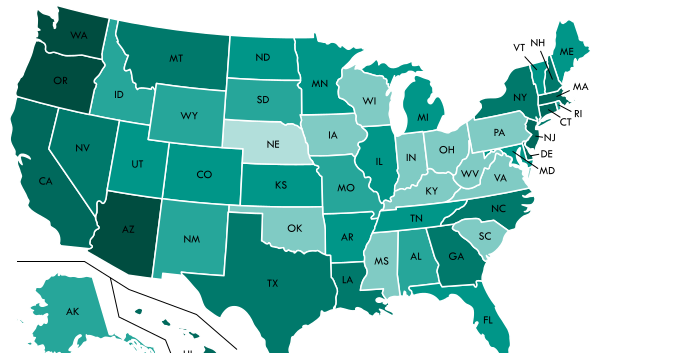
Most common states for software applications specialists
| Rank | State | Population | # of jobs | Employment/ 1000ppl |
|---|---|---|---|---|
| 1 | District of Columbia | 693,972 | 311 | 45% |
| 2 | Kansas | 2,913,123 | 769 | 26% |
| 3 | New Mexico | 2,088,070 | 509 | 24% |
| 4 | Missouri | 6,113,532 | 1,321 | 22% |
| 5 | Wisconsin | 5,795,483 | 1,286 | 22% |
| 6 | Arkansas | 3,004,279 | 651 | 22% |
| 7 | Vermont | 623,657 | 117 | 19% |
| 8 | Tennessee | 6,715,984 | 1,054 | 16% |
| 9 | Kentucky | 4,454,189 | 725 | 16% |
| 10 | Nebraska | 1,920,076 | 315 | 16% |
| 11 | Massachusetts | 6,859,819 | 1,049 | 15% |
| 12 | West Virginia | 1,815,857 | 265 | 15% |
| 13 | New Hampshire | 1,342,795 | 195 | 15% |
| 14 | Rhode Island | 1,059,639 | 162 | 15% |
| 15 | Delaware | 961,939 | 142 | 15% |
| 16 | North Dakota | 755,393 | 116 | 15% |
| 17 | Virginia | 8,470,020 | 1,178 | 14% |
| 18 | South Carolina | 5,024,369 | 718 | 14% |
| 19 | Maine | 1,335,907 | 190 | 14% |
| 20 | Montana | 1,050,493 | 143 | 14% |
Most common cities for software applications specialists
| Rank | City | # of jobs | Employment/ 1000ppl | Avg. salary |
|---|---|---|---|---|
| 1 | Greenville | 2 | 3% | $78,807 |
Software Applications Specialist job outlook: Expert opinions
Our panel of software applications specialist experts
Texas A&M University San Antonio
Lawrence Technological University

University of Nebraska at Omaha
Grand Valley State University
Tiffin University
Robert Vinaja Ph.D.
Assistant Professor of Computer Information SystemsTexas A&M University San Antonio
Computer Information Systems Department
What soft skills should all Software Applications Specialists possess?
Robert Vinaja Ph.D.: -Ability to work as part of a team.
-Attention to detail.
-Problem-solving and analytical skills.
What hard/technical skills are most important for Software Applications Specialists?
Robert Vinaja Ph.D.: -Programming.
-Understand algorithms and data structures.
What technical skills for a Software Applications Specialist stand out to employers?
Oriehi Destiny Anyaiwe: Attitude. Anyone can memorize a programming language and have a perfect syntax, but if you cannot find your way out of a paper bag you do the company no good. In today's marketplace, problems/business are tackled with a collaborative view. Employers will like to hire employees that have the skill set and potential to explain problems/solutions to non experts as well as working amicably with them.
Deepak Khazanchi Ph.D.
Associate Dean for Academic Affairs, Community Engagement & Internationalization Officer, Professor of Information Systems & Quantitative Analysis, Director, Executive Master’s of Science in Information Technology (EMIT) Program, Executive Director, Center for Management of IT (CMIT), Fulbright Grantee (Specialist 2014; Core 2020-21)University of Nebraska at Omaha
College of Information Science & Technology
What's a good job out of college for Software Applications Specialists?
Deepak Khazanchi Ph.D.: I think the "best" and "interesting" jobs in my view will be those that leverage emerging technical skills such as AI/ML, data analytics, cybersecurity and medical informatics, with the nontechnical capabilities mentioned above.
What technical skills for a Software Applications Specialist stand out to employers?
Chirag Parikh Ph.D.: If you ask me, I consider valuable experience over good paycheck. Once you have gained that experience the paycheck will follow. As soon as you are out of college, the knowledge gained is very fresh and raring to go. If put into the right place can enhance your technical skills and you can do wonders.
As a Computer Engineering professor, I would say the job opportunities are tremendous for students out of college as they can venture into hardware field (technical support, hardware engineer, test engineer and much more) as well as software field (software engineer, software developer, software tester and much more). The possibilities are endless.
With COVID and employees working remotely there is still ample opportunity to enhance your technical and interpersonal skills as I believe remote working might stay for a while till things get back to normal.
What type of skills will young Software Applications Specialists need?
George Miller: Many organizations realize graduates cannot learn everything in college about their major but want the graduate to have a solid foundation on their field of study. The organization wants to mold the graduate to their company environment with how they do things related to the field of study. Most companies want college graduates to have good communication skills (both oral and written), critical thinking skills and be able to work well in teams. These skills have been a staple for graduates since I can remember. This is why a college graduate takes many general education courses related to these skills and many of their major courses emphasize these skills.
Going back to the previous answer I believe graduates in all fields of study will need a better knowledge of technology and easier adaptability to changing technology. Again, an IS degree is already preparing students for this.