What does a software verification engineer do?
Software verification engineer responsibilities
Here are examples of responsibilities from real software verification engineer resumes:
- Work with scrum master and developer leads to optimize resource allocation for accelerating user story delivery process.
- Review other QA design documentation for technical accuracy and perform formal verification, including FDA require artifacts.
- Assist with providing directions and guiding junior QA engineers.
- Test suites used JavaScript, Perl, Unix and oscilloscope.
- Experience with direct FDA interaction on in-process testing as part of the audit.
- Analyze any current QA roadblocks or challenges and advise in a timely manner to management.
- Verify that data in reports generate from the web pages match with the data from corresponding SQL queries.
- Handle common (SQL) database procedures such as upgrade, backup, recovery, migration, etc.
- Design test plans and define test scenarios for functional, integration system, and user acceptance testing on LINUX base system.
- Document relevant procedures need for OS acceptance testing.
- Configure application on servers with various flavors of Linux and perform screen comparison.
- Generate and maintain project status report including various metrics such as defect regression and requirement tractability matrix.
- Code and deploy automated regression test suites and track results to ensure usability and functionality of entire system.
- Participate in the design and development of a prototype relational database system; are responsible for SQL processor/optimizer and query parsing.
- Provide validation and ITQA support throughout the SDLC to ensure compliance with company and departmental policies, procedures, and standards.
Software verification engineer skills and personality traits
We calculated that 12% of Software Verification Engineers are proficient in C #, Software Verification, and Python. They’re also known for soft skills such as Analytical skills, Communication skills, and Creativity.
We break down the percentage of Software Verification Engineers that have these skills listed on their resume here:
- C #, 12%
Created unit test in C # VSTS (Visual studio Team System testing) 2008 and was responsible for code coverage.
- Software Verification, 8%
Developed software verification checklists per DO178B, Level-A
- Python, 7%
Automated testing using Python scripting and in-house automation framework.
- Software Development, 5%
Collaborated with quality management, software development management and hardware design management on software releases.
- Java, 5%
Developed test app in Java for QA staff to use for validating the functionality of the Ad SDK.
- Test Cases, 4%
Developed Verification test cases to stress test the functional and structural properties of microprocessors under extreme temperatures.
Common skills that a software verification engineer uses to do their job include "c #," "software verification," and "python." You can find details on the most important software verification engineer responsibilities below.
Analytical skills. One of the key soft skills for a software verification engineer to have is analytical skills. You can see how this relates to what software verification engineers do because "developers must analyze users’ needs and then design software to meet those needs." Additionally, a software verification engineer resume shows how software verification engineers use analytical skills: "use of node.js application server, mysql for data persistence, embedded java script for frond end. "
Communication skills. Another essential skill to perform software verification engineer duties is communication skills. Software verification engineers responsibilities require that "developers must be able to give clear instructions to others working on a project." Software verification engineers also use communication skills in their role according to a real resume snippet: "developed test and debugging tools for many proprietary communication interfaces. "
Creativity. Another skill that relates to the job responsibilities of software verification engineers is creativity. This skill is critical to many everyday software verification engineer duties, as "developers are the creative minds behind new computer software." This example from a resume shows how this skill is used: "design and develop user's scenarios, test plan, test cases for the creative cloud membership e-commerce. "
Detail oriented. software verification engineer responsibilities often require "detail oriented." The duties that rely on this skill are shown by the fact that "developers often work on many parts of an application or system at the same time and must therefore be able to concentrate and pay attention to detail." This resume example shows what software verification engineers do with detail oriented on a typical day: "developed test cases with detailed test steps in hp quality center 11.0. "
Problem-solving skills. Another common skill required for software verification engineer responsibilities is "problem-solving skills." This skill comes up in the duties of software verification engineers all the time, as "because developers are in charge of software from beginning to end, they must be able to solve problems that arise throughout the design process." An excerpt from a real software verification engineer resume shows how this skill is central to what a software verification engineer does: "verified all solutions with automotive controller hardware on test bench. "
The three companies that hire the most software verification engineers are:
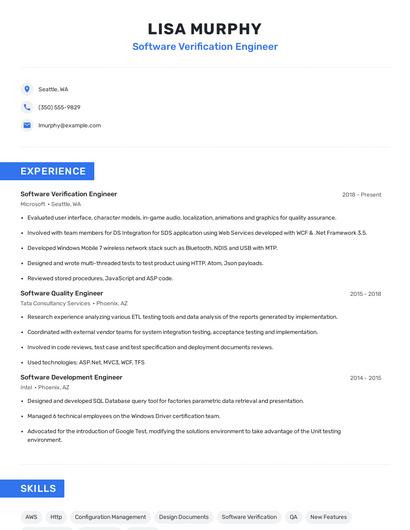
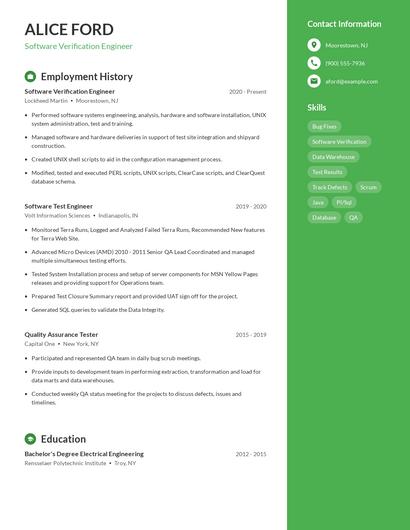
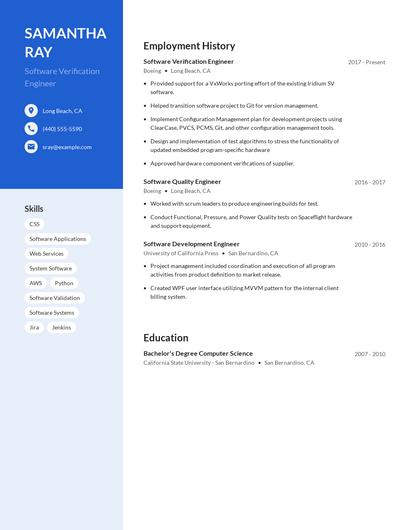
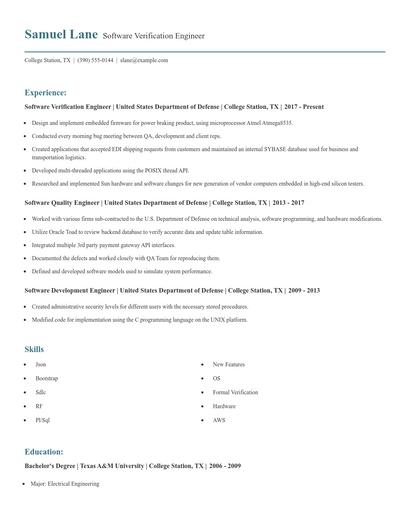
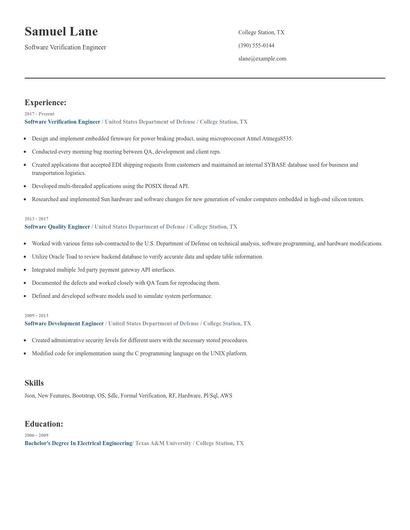
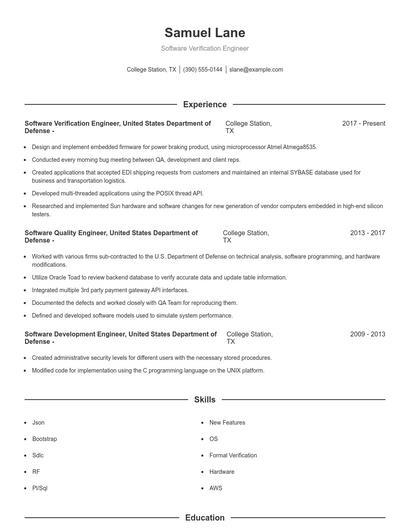
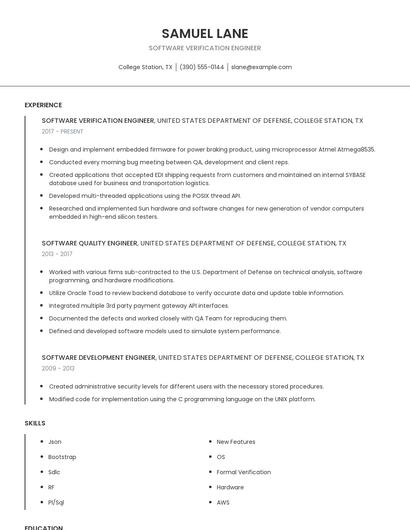
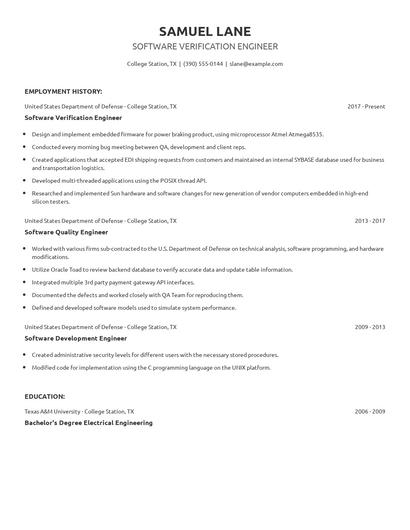
Choose from 10+ customizable software verification engineer resume templates
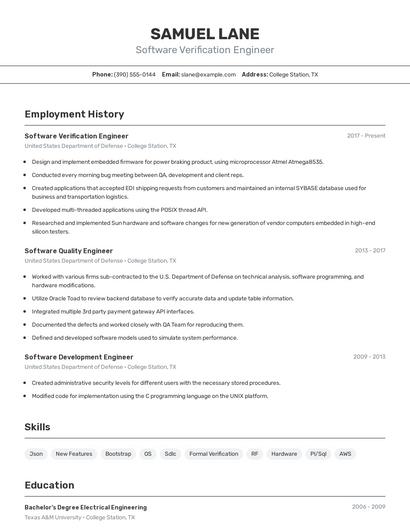
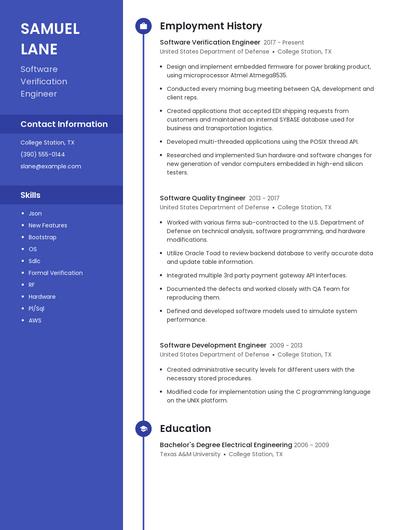
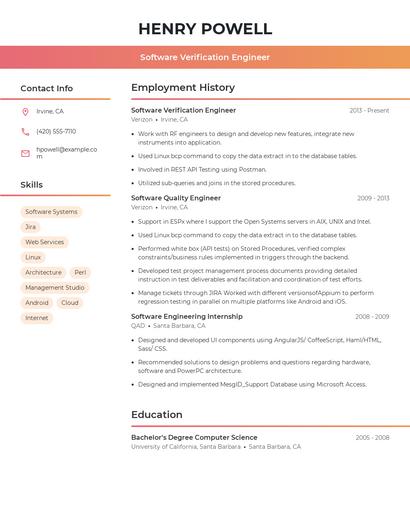
Build a professional software verification engineer resume in minutes. Our AI resume writing assistant will guide you through every step of the process, and you can choose from 10+ resume templates to create your software verification engineer resume.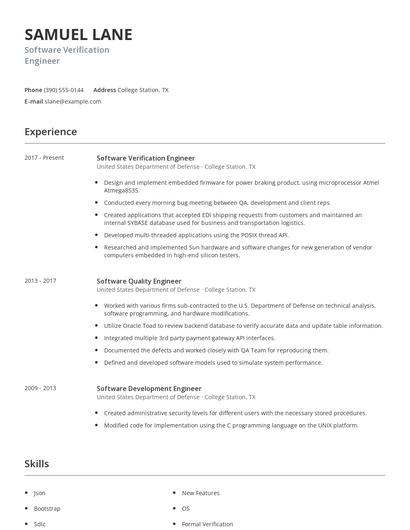
Compare different software verification engineers
Software verification engineer vs. Engineer
Engineers are highly trained professionals who determine the feasibility of various projects, usually related to the construction industry. They are considered experts in mathematics and science, two disciplines that they need to use in designing and coming up with plans for projects. They should also be well-versed in different construction or industrial materials, and they ensure that appropriate materials are used for the project. They also ensure that the projects meet the requirements of the groups that hired them. They create spaces that would both address the needs of the end-users and the industry standards. They also ensure that the projects they make would stand the test of time.
These skill sets are where the common ground ends though. The responsibilities of a software verification engineer are more likely to require skills like "software verification," "software development," "medical devices," and "fda." On the other hand, a job as an engineer requires skills like "cloud," "aws," "javascript," and "azure." As you can see, what employees do in each career varies considerably.
Engineers earn the highest salaries when working in the automotive industry, with an average yearly salary of $97,672. On the other hand, software verification engineers are paid more in the telecommunication industry with an average salary of $99,174.The education levels that engineers earn slightly differ from software verification engineers. In particular, engineers are 4.1% less likely to graduate with a Master's Degree than a software verification engineer. Additionally, they're 1.3% more likely to earn a Doctoral Degree.Software verification engineer vs. Test engineer
Test engineers are professionals who observe and record the quality of products, which includes functionality, durability, speed, and safety. They are responsible for checking the materials and procedures thoroughly throughout the production cycle. It is their duty to run tests on different criteria to identify and fix technical issues. They analyze reactions to determine the causes of malfunctions and recommend potential improvements. Moreover, they test products before they are launched to ensure customers get high-quality and functional products.
Each career also uses different skills, according to real software verification engineer resumes. While software verification engineer responsibilities can utilize skills like "software verification," "software development," "test cases," and "medical devices," test engineers use skills like "test procedures," "test data," "data analysis," and "rf."
On average, test engineers earn a lower salary than software verification engineers. Some industries support higher salaries in each profession. Interestingly enough, test engineers earn the most pay in the telecommunication industry with an average salary of $88,414. Whereas software verification engineers have higher pay in the telecommunication industry, with an average salary of $99,174.Average education levels between the two professions vary. Test engineers tend to reach similar levels of education than software verification engineers. In fact, they're 2.8% less likely to graduate with a Master's Degree and 1.3% more likely to earn a Doctoral Degree.What technology do you think will become more important and prevalent for software verification engineers in the next 3-5 years?
Frank McCown Ph.D.
Associate Professor, Harding University
Software verification engineer vs. Software analyst
A software analyst is responsible for creating and designing software programs and applications, as well as modifying existing ones for optimization according to business requirements. Software analysts work with the technical team to draw system codes, analyze programming languages, and ensure the stability and efficiency of software navigation by running multiple quality checks to the system. They inspect the application's performance, configure servers, and improve software infrastructure according to quality findings. A software analyst records resolution reports and provides progress updates, ensuring that the project adheres to budget limitations and set timetables.
Some important key differences between the two careers include a few of the skills necessary to fulfill the responsibilities of each. Some examples from software verification engineer resumes include skills like "c #," "software verification," "python," and "medical devices," whereas a software analyst is more likely to list skills in "test data," "scrum," "sql server," and "business process. "
Software analysts make a very good living in the manufacturing industry with an average annual salary of $86,986. On the other hand, software verification engineers are paid the highest salary in the telecommunication industry, with average annual pay of $99,174.software analysts typically earn similar educational levels compared to software verification engineers. Specifically, they're 3.5% less likely to graduate with a Master's Degree, and 0.7% less likely to earn a Doctoral Degree.Software verification engineer vs. Data engineer
A data engineer is someone who makes data science possible. This IT job requires the search for data set trends and algorithm development to make raw data more beneficial to the enterprise. Data engineers are responsible for establishing and maintaining an environment that permits other data functions. The necessary skills for the job include in-depth knowledge of multiple programming languages and SQL database design. Among the other skills data engineers should develop include data warehousing and architecture, data mining and modeling, and statistical regression analysis.
Even though a few skill sets overlap between software verification engineers and data engineers, there are some differences that are important to note. For one, a software verification engineer might have more use for skills like "software verification," "software development," "medical devices," and "fda." Meanwhile, some responsibilities of data engineers require skills like "cloud," "etl," "scala," and "kafka. "
In general, data engineers earn the most working in the technology industry, with an average salary of $125,579. The highest-paying industry for a software verification engineer is the telecommunication industry.In general, data engineers hold higher degree levels compared to software verification engineers. Data engineers are 5.5% more likely to earn their Master's Degree and 1.9% more likely to graduate with a Doctoral Degree.Types of software verification engineer
Updated January 8, 2025
