What does a sound engineer do?
Sound engineers are audio engineering professionals who are responsible for performing audio mixes and reproduction while manipulating the equalization and electronic effects of sound. These engineers must design and control the sound at different locations such as theaters, conferences, and any other venue that requires sound projection. By using their well-trained ears, sound engineers must control the combination of microphones, sound levels, and sound outputs. Sound engineers must also maintain and sound up sound equipment such as amplifiers, complex PA systems, and speakers for bands and other sound engineers.
Sound engineer responsibilities
Here are examples of responsibilities from real sound engineer resumes:
- Manage PowerPoint and mixing music at the same time.
- Work for local contractor designing spreader bars for crane rigging using AutoCAD.
- Provide equipment and engineering services for performers, musicians, bands, and DJ's.
- Mix all live services FOH and maintain all audio, broadcasting and media system as well.
- Experience tuning, calculating EQ settings, as well as appropriate delay times within an automobile.
- Master multiple projects albums by working on song levels plus EQ and correct minor mix deficiencies with equalization.
- Administrate sound management system utilizing analog & digital consoles in a smaller environment.
- Dub, labele and archive all types of media (tapes, DVD, DAT, etc.
- Coordinate schedules with various studios and operate ISDN equipment for remote recording.
- Ensure flawless transmission, routing, and mixing of live audio feeds using ISDN and ip-base protocols.
- Work as a recording engineer for a major recording studio in the NYC metroarea.
- Record EP's and singles for various Orlando recording artists.
- Mix and record an EP for Atlantis, a local San Antonio band.
- Present lyric presentations, and design CD and DVD covers.
- Provide excellent customer service to members and guest purchasing CD'S and DVD's.
Sound engineer skills and personality traits
We calculated that 15% of Sound Engineers are proficient in Audio Equipment, Venues, and A/V. They’re also known for soft skills such as Communication skills, Computer skills, and Manual dexterity.
We break down the percentage of Sound Engineers that have these skills listed on their resume here:
- Audio Equipment, 15%
Installed and maintained all hardware and software including networking and audio equipment
- Venues, 11%
Provided excellent stage management for venues and festivals around California.
- A/V, 10%
Assisted in general A/V troubleshooting and support.
- Technical Aspects, 8%
Provided customers with the technical aspects of recording, editing, mixing and specific equipment needed to meet desired results.
- Live Sound, 5%
Engineered live sound at rehearsals and Drum Corps International competitions in constantly changing performance environments.
- Stage Equipment, 4%
Coordinate with promoters/vendors of assigned event for load in and load out times of all stage equipment.
"audio equipment," "venues," and "a/v" are among the most common skills that sound engineers use at work. You can find even more sound engineer responsibilities below, including:
Communication skills. To carry out their duties, the most important skill for a sound engineer to have is communication skills. Their role and responsibilities require that "technicians need to communicate with supervisors and coworkers to ensure that clients’ needs are met and that equipment is set up properly before broadcasts, live performances, and presentations." Sound engineers often use communication skills in their day-to-day job, as shown by this real resume: "prepare and run powerpoint slides for use in pre-service communications as well as in-service media support. "
Computer skills. Another soft skill that's essential for fulfilling sound engineer duties is computer skills. The role rewards competence in this skill because "technicians use computer systems to program equipment and edit audio and video recordings." According to a sound engineer resume, here's how sound engineers can utilize computer skills in their job responsibilities: "produce quality mixing of live band and dj, using fully computerize system. "
Manual dexterity. Another skill that relates to the job responsibilities of sound engineers is manual dexterity. This skill is critical to many everyday sound engineer duties, as "some technicians set up audio and video equipment and cables, a job that requires a steady hand and good hand-eye coordination." This example from a resume shows how this skill is used: "set up audio equipment - run and maintain quality sound for performances - tore down audio equipment, intense manual labor"
Problem-solving skills. sound engineer responsibilities often require "problem-solving skills." The duties that rely on this skill are shown by the fact that "technicians need to recognize equipment problems and propose possible solutions to them." This resume example shows what sound engineers do with problem-solving skills on a typical day: "managed setup of sound equipment.operated analog console and light board.demonstrated problem-solving skills by troubleshooting equipment. "
The three companies that hire the most sound engineers are:
- Live Nation Entertainment45 sound engineers jobs
- House of Blues14 sound engineers jobs
- Hired2 sound engineers jobs
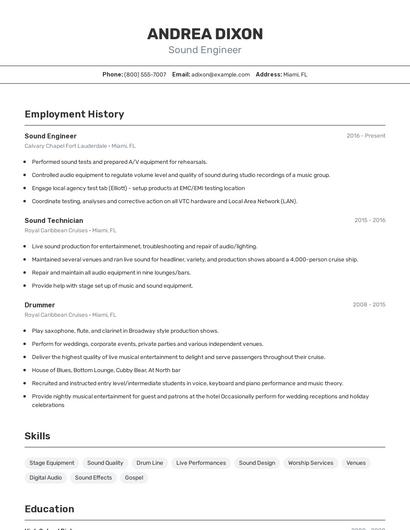
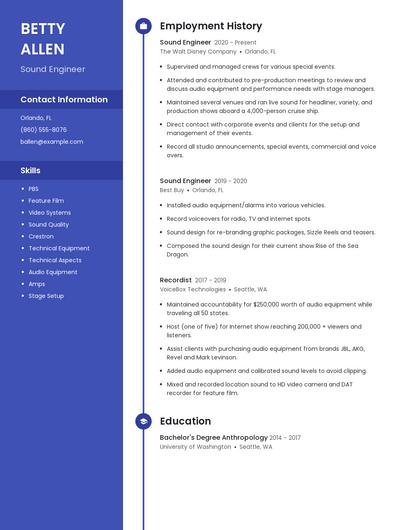
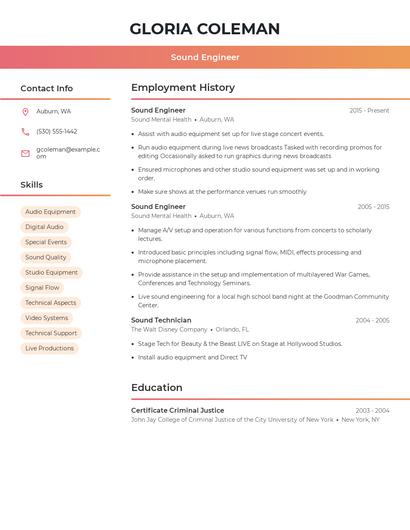
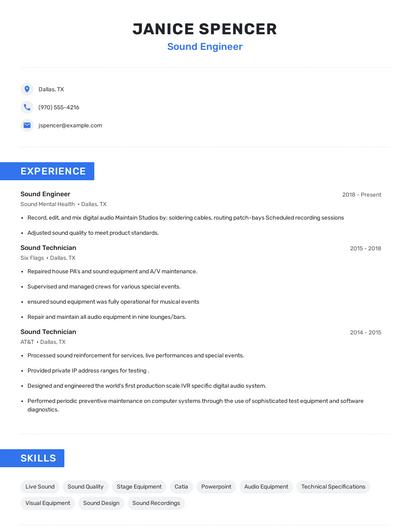
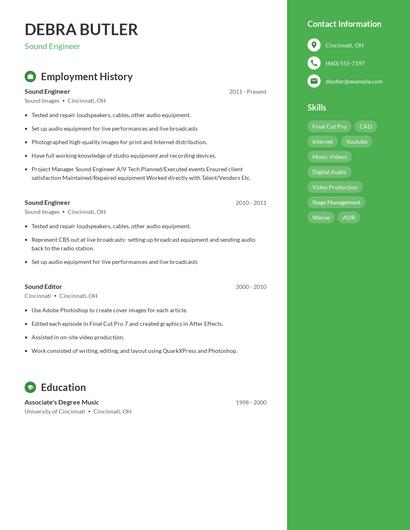
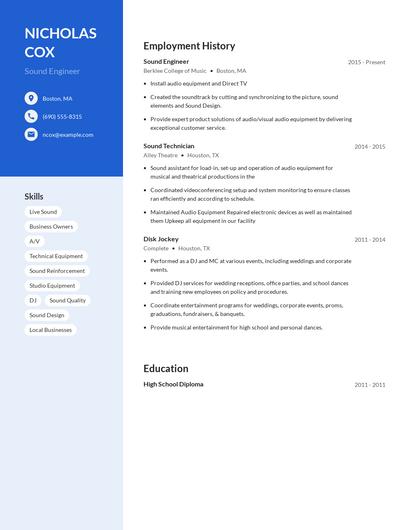
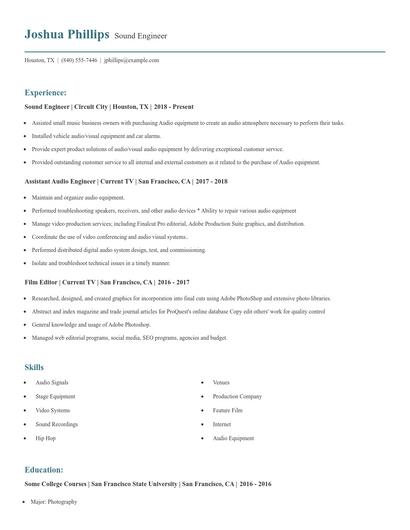
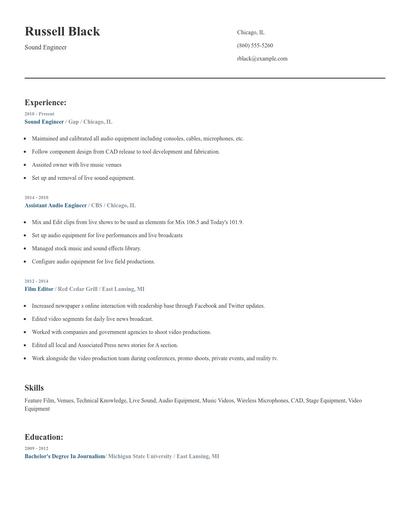
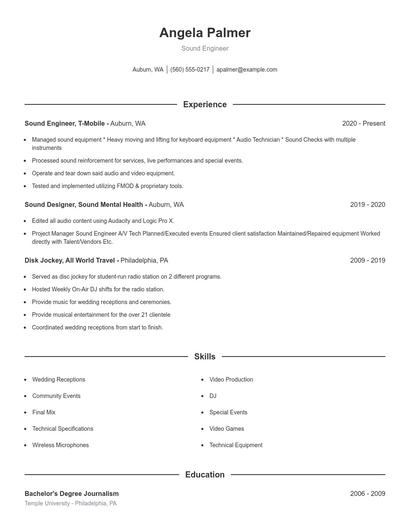
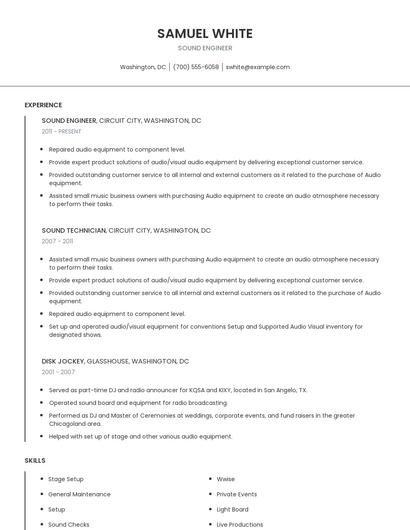
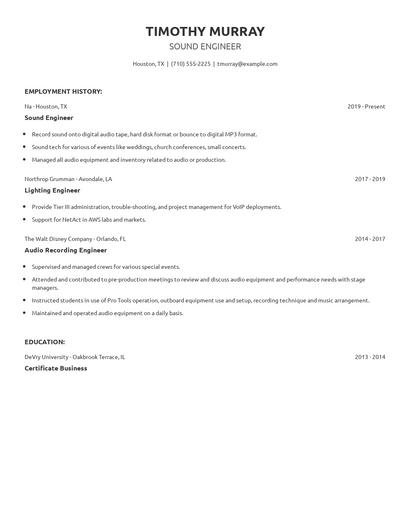
Choose from 10+ customizable sound engineer resume templates
Build a professional sound engineer resume in minutes. Our AI resume writing assistant will guide you through every step of the process, and you can choose from 10+ resume templates to create your sound engineer resume.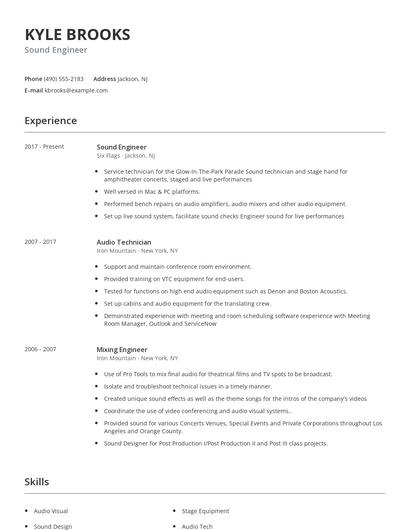
Compare different sound engineers
Sound engineer vs. Public address technician
An audio technician is a person who works in a variety of media fields and broadcasting and is responsible for capturing audio signals. They are involved in maintaining audio equipment, setup, speakers and sound mixer, and everything from the cables and microphones to the monitor. Also, audio technicians repair equipment that is faulty to continue recording with minimal disruption to the recording session. They are needed for live production venues, recording studios, television, radio broadcasts, and worship spaces. An audio technician works under a sound engineer who handles the creative process and final mixing involved with audio production.
While similarities exist, there are also some differences between sound engineers and public address technician. For instance, sound engineer responsibilities require skills such as "audio equipment," "venues," "a/v," and "technical aspects." Whereas a public address technician is skilled in "technical publications," "technical manuals," "photoshop," and "framemaker." This is part of what separates the two careers.
The education levels that public address technicians earn slightly differ from sound engineers. In particular, public address technicians are 1.0% more likely to graduate with a Master's Degree than a sound engineer. Additionally, they're 0.2% less likely to earn a Doctoral Degree.Sound engineer vs. Audio technician
While some skills are similar in these professions, other skills aren't so similar. For example, resumes show us that sound engineer responsibilities requires skills like "venues," "live sound," "stars," and "live music." But an audio technician might use other skills in their typical duties, such as, "audio systems," "control room," "live audio," and "mac."
In general, audio technicians achieve similar levels of education than sound engineers. They're 0.2% less likely to obtain a Master's Degree while being 0.2% less likely to earn a Doctoral Degree.Sound engineer vs. Recordist
Some important key differences between the two careers include a few of the skills necessary to fulfill the responsibilities of each. Some examples from sound engineer resumes include skills like "venues," "a/v," "technical aspects," and "live sound," whereas a recordist is more likely to list skills in "promotional videos," "r," "vo," and "hd. "
Most recordists achieve a similar degree level compared to sound engineers. For example, they're 4.4% more likely to graduate with a Master's Degree, and 0.2% more likely to earn a Doctoral Degree.Sound engineer vs. Sound truck operator
Types of sound engineer
Updated January 8, 2025
