What does a state patrol officer do?
State patrol officer responsibilities
Here are examples of responsibilities from real state patrol officer resumes:
- Supervise cadets (new highway patrol cadets) undergoing firearms training and accurately detect causative factors for inadequacies.
- Provide patrol duties on the state's highways being vigilant for any factors compromising the safety of all motorist and pedestrians.
- Qualify and utilize firearms provide emergency assistance, conduct investigations, report writing and presenting testimony in a court of law.
- Conduct driving while intoxicate (DWI) and traffic-relate investigations.
State patrol officer skills and personality traits
We calculated that 79% of State Patrol Officers are proficient in Patrol, Field Training, and Background Investigations. They’re also known for soft skills such as Communication skills, Good judgment, and Leadership skills.
We break down the percentage of State Patrol Officers that have these skills listed on their resume here:
- Patrol, 79%
Supervised troopers in the Motor Carrier Section of the N.C. State Highway Patrol.
- Field Training, 9%
Promoted to early leadership position as Shift Supervisor/Commander and Field Training Officer.
- Background Investigations, 6%
Supervised four patrol Officers and conducted full background investigations on eighteen police applicants.
- Law Enforcement Agencies, 3%
Performed preliminary investigations at accident scenes, assess damage, assist injured motorists and assist other local law enforcement agencies.
- Emergency Situations, 1%
Respond to all emergency situations maintain, coordinate scene make executive notifications, order any specialized units or personal as needed.
- Traffic Crashes, 1%
Investigated traffic crashes and provides assistance to motorists.
Most state patrol officers use their skills in "patrol," "field training," and "background investigations" to do their jobs. You can find more detail on essential state patrol officer responsibilities here:
Communication skills. To carry out their duties, the most important skill for a state patrol officer to have is communication skills. Their role and responsibilities require that "police and detectives must be able to speak with people and to express details in writing about an incident." State patrol officers often use communication skills in their day-to-day job, as shown by this real resume: "required effective communication skills and the ability to work as a team interdepartmentally and with multiple law enforcement agencies. "
Good judgment. Another soft skill that's essential for fulfilling state patrol officer duties is good judgment. The role rewards competence in this skill because "police and detectives must be able to determine the best way to solve an array of problems." According to a state patrol officer resume, here's how state patrol officers can utilize good judgment in their job responsibilities: "maintained a good working relationship with city, county, state, and federal law enforcement agencies. "
Leadership skills. Another skill that relates to the job responsibilities of state patrol officers is leadership skills. This skill is critical to many everyday state patrol officer duties, as "police officers must be comfortable with being a highly visible member of their community, as the public looks to them for help in emergencies." This example from a resume shows how this skill is used: "provide leadership and direction to road patrol officers during their daily patrols and responses to calls for service. "
Physical strength. state patrol officer responsibilities often require "physical strength." The duties that rely on this skill are shown by the fact that "police officers must be strong enough to physically apprehend suspects and to assist people in precarious situations." This resume example shows what state patrol officers do with physical strength on a typical day: "completed 22 weeks of classroom, physical, and field training for trooper position"
The three companies that hire the most state patrol officers are:
- State of Georgia: Teachers Retirement System of Georgia2 state patrol officers jobs
Choose from 10+ customizable state patrol officer resume templates
Build a professional state patrol officer resume in minutes. Our AI resume writing assistant will guide you through every step of the process, and you can choose from 10+ resume templates to create your state patrol officer resume.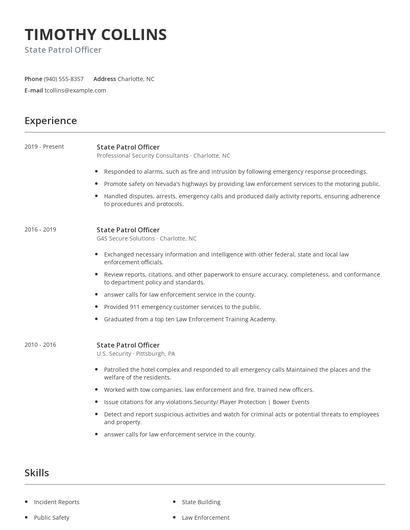
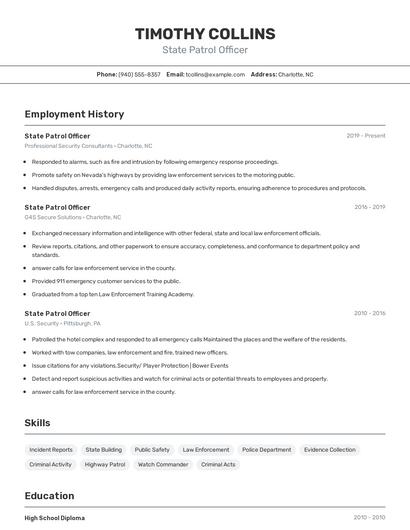
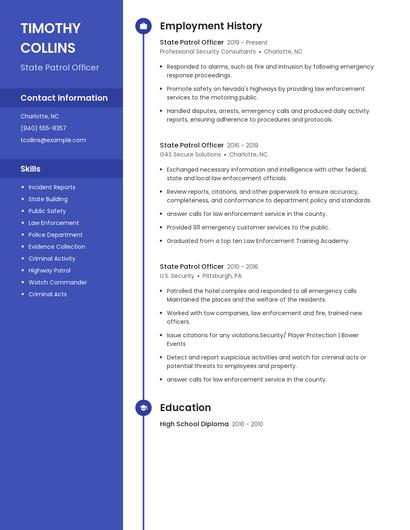
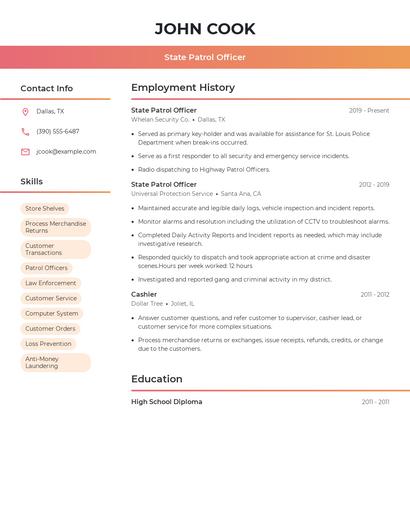
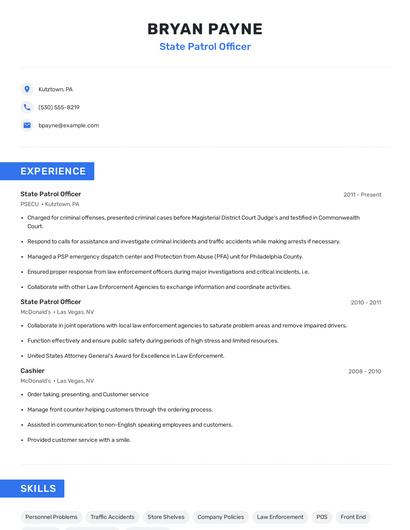
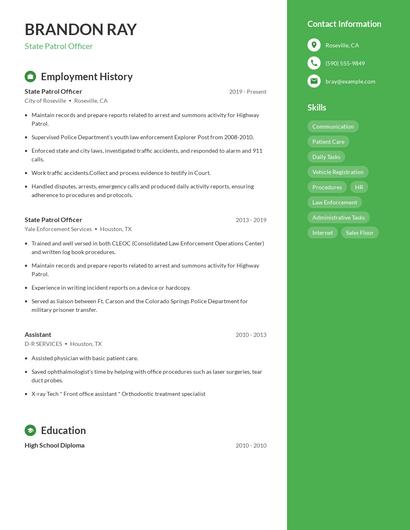
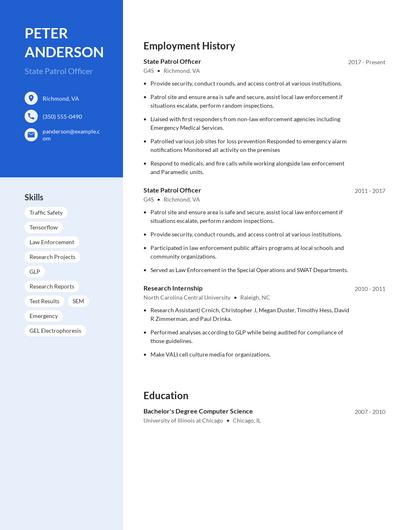
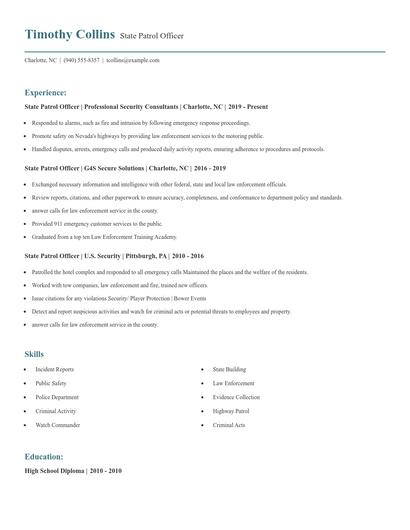
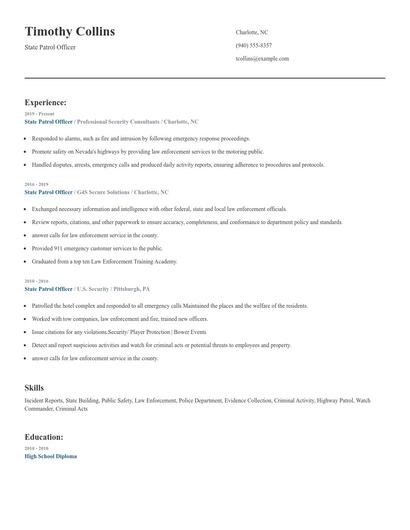
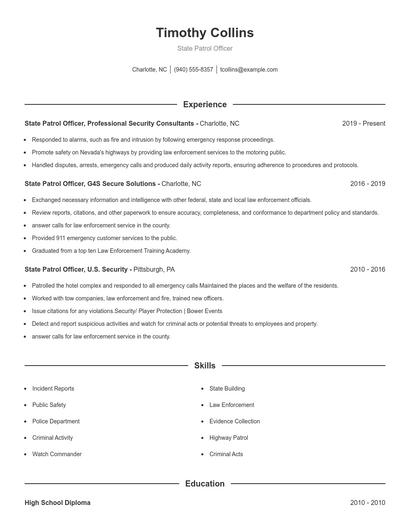
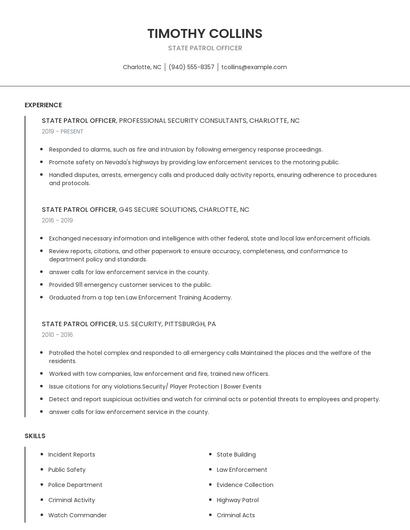
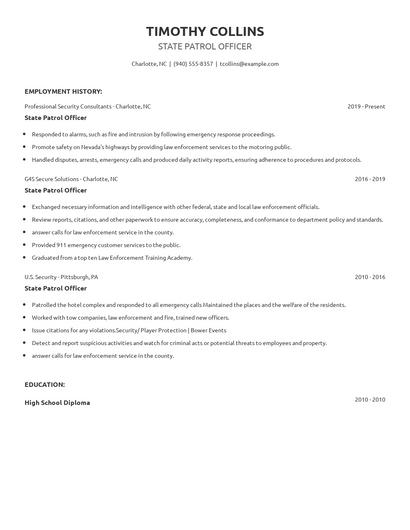
Compare different state patrol officers
State patrol officer vs. Law enforcement specialist
In the military, a law enforcement specialist is in charge of preventing and investigating crimes within the military bases. Although the extent of their responsibilities highly depends on their area of assignment, it usually includes patrolling different places, responding to distress and other emergencies, conducting interviews on witnesses and suspects, and monitoring security systems. There are also instances when they must keep guard of facilities and properties. Moreover, as a law enforcement specialist, it is essential to be proactive and alert in dealing with different situations due to the nature of the job.
While similarities exist, there are also some differences between state patrol officers and law enforcement specialist. For instance, state patrol officer responsibilities require skills such as "background investigations," "emergency services," "traffic crashes," and "dot." Whereas a law enforcement specialist is skilled in "treasury," "physical security," "data entry," and "public safety." This is part of what separates the two careers.
The education levels that law enforcement specialists earn slightly differ from state patrol officers. In particular, law enforcement specialists are 4.6% less likely to graduate with a Master's Degree than a state patrol officer. Additionally, they're 0.1% more likely to earn a Doctoral Degree.State patrol officer vs. Ranger
A ranger is responsible for protecting and conserving natural resources and environmental conditions. Rangers coordinate with environmental institutions and landowners to identify land conservation strategies to prevent destructible threats of wildfires and calamities. They also monitor the operations within the forests and parks, evaluating efficient development through scientific methodologies and research studies. A ranger creates reports of cost estimates for conservation efforts, authorizing various land operations upon inspection to mitigate the risks of pollution and other hazardous circumstances.
In addition to the difference in salary, there are some other key differences worth noting. For example, state patrol officer responsibilities are more likely to require skills like "field training," "background investigations," "law enforcement agencies," and "emergency services." Meanwhile, a ranger has duties that require skills in areas such as "customer service," "reservations," "natural resource management," and "hand tools." These differences highlight just how different the day-to-day in each role looks.
Rangers earn lower levels of education than state patrol officers in general. They're 8.0% less likely to graduate with a Master's Degree and 0.1% less likely to earn a Doctoral Degree.State patrol officer vs. Police cadet
Police cadets require multiple police department-relevant skills in traffic control, police reports, public safety, and special events. Those who choose this career will be responsible for participating in training programs that will introduce them to the fundamentals of law enforcement and prepare them for becoming police officers, supporting police operations like traffic control, working on criminal investigation, and performing administrative duties at the station.
Some important key differences between the two careers include a few of the skills necessary to fulfill the responsibilities of each. Some examples from state patrol officer resumes include skills like "background investigations," "emergency services," "traffic crashes," and "traffic enforcement," whereas a police cadet is more likely to list skills in "traffic control," "public safety," "police academy," and "parking enforcement. "
Most police cadets achieve a lower degree level compared to state patrol officers. For example, they're 8.1% less likely to graduate with a Master's Degree, and 1.2% less likely to earn a Doctoral Degree.State patrol officer vs. Officer candidate
Types of state patrol officer
Updated January 8, 2025
