
Automatically apply for jobs with Zippia
Upload your resume to get started.
Store manager and buyer skills for your resume and career

15 store manager and buyer skills for your resume and career
1. Customer Service
Customer service is the process of offering assistance to all the current and potential customers -- answering questions, fixing problems, and providing excellent service. The main goal of customer service is to build a strong relationship with the customers so that they keep coming back for more business.
- Improved customer service by proactively assessing needs of customers and staff resulting in letters of appreciation and recognition of management.
- Provided exceptional customer service to local and international tourist clientele and effectively catered to a wide variety of needs.
2. Product Knowledge
Product knowledge is the skill of having better information and knowledge about the product you are selling. Product knowledge is essential for the employees of the companies so they can communicate and inform the customers about the product. Having great product knowledge is essential for a better sales pitch and to give the customer a better and complete idea of the product that will influence him to buy the product eventually.
- Operated with extensive product knowledge, with regards to price, quality, and margins with brand awareness.
- Conducted monthly team training, with an emphasis on product knowledge and building strong relationships with clients.
3. Payroll
Payroll is the sum of all the compensation that an organization has to pay to employees at a specified time. Payroll is managed by the finance or HR department while small business owners may handle it themselves. Payroll isn't fixed as it varies every month due to sick leaves, overtime, etc.
- Performed supervisory responsibilities that included employee hiring, scheduling and payroll.
- Directed payroll activities including employee assessments and salary increases.
4. Market Trends
- Market Research: Facilitated research activities and analyzed market trends to determine appropriate merchandise mix needed for upcoming seasons.
- Identify market trends, recognize forthcoming customer initiatives and monitor local competition.
5. Inventory Control
- Created and enforced a new inventory control program which resulted in lower seasonal inventory.
- Supervised inventory control and purchased merchandise, both locally and at international trade shows.
6. Trade Shows
- Developed marketing strategies including participation in trade shows and high visibility at local special events to establish a solid client base
- Coordinated trade shows to cater to client demographics and succeeded in exponential sales exceeding department incentives.
Choose from 10+ customizable store manager and buyer resume templates
Build a professional store manager and buyer resume in minutes. Our AI resume writing assistant will guide you through every step of the process, and you can choose from 10+ resume templates to create your store manager and buyer resume.7. Apparel
Apparel is anything worn especially formal clothes; outerwear; garments; attire; raiment worn on an important occasion to protect, wrap, adorn or beautify the body. Apparel also refers to clothing of a specific type that is sold in stores. Product categories include everything from basic items like underwear, badges, jewelry to luxury items. The general classification of clothing is as follows: men's wear, women's wear, children's wear, and others.
- Designated buyer of apparel and specialty items Managed retail sales staff including hiring, scheduling, training and performance evaluations
- Assisted in determining proper inventory from the intimate apparel show based on customer demographic for multiple locations.
8. Boutique
- Manage day-to-day operations and organize marketing events at convention centers and radio remotes at store locations for two specialty boutique locations.
- Selected and purchased appropriate seasonal ready-to-wear fashion merchandise from national and international clothing manufacturers for boutique retail sales.
9. POS
POS is an abbreviation of "Point of Sale" which is the time and place where a customer completes a transaction. It can either be a physical shop that consists of POS terminals or a virtual shop. A POS system helps simplify the retail functions and track important sales data.
- Utilize and train staff to operate Retail Star POS customized for specialty retail shop commerce.
- Managed all cash management procedures, POS System set-up, programming, and training.
10. Store Operations
- Managed and organized store operations including determining promotions, salary rates and recruitment.
- Oversee all back store operations including shipping/receiving, pricing
11. Sales Floor
The sales floor is the area in a company or a business that is specified for retail activities or is designated as the selling area of the shop. A car showroom can be considered a sales floor, as it has cars in its display which are to be sold. A sales floor is generally crowded with sales assistants who are there to help you out while you can search and check out the products. Generally a sales floor has free access to the public and they can observe, view and get information about the product that is being sold.
- Managed surplus inventory, sales floor organization and cleanliness.
- Merchandised sales floor for Children's department, Men's and Women's athletic department, and Outdoor department.
12. Instagram
- Design Social events and posts using Instagram as our customer base to growing our viewing
- Managed all social media: Facebook, Instagram, Pinterest, Twitter, and company blog.
13. Sales Associates
- Administered extensive hands-on visual merchandising training to management and sales associates.
- Hired and Fired sales associates, Controlled inventory, placed orders for merchandise for store and web store.
14. Retail Store
- Managed daily operations of retail store by following budgeted guidelines.
- Performed sales, buying, merchandising, analysis, scheduling, and day to day operations for a specialty retail store.
15. Store Sales
- Maintained and supervised the daily operations of a retail grocery facility with store sales of 36million dollars annually.
- Developed a couture business clientele and built total store sales in excess of $1M within first year.
5 Store Manager And Buyer resume examples
Build a professional store manager and buyer resume in minutes. Browse through our resume examples to identify the best way to word your resume. Then choose from 5+ resume templates to create your store manager and buyer resume.

What skills help Store Managers And Buyer find jobs?
Tell us what job you are looking for, we’ll show you what skills employers want.
List of store manager and buyer skills to add to your resume
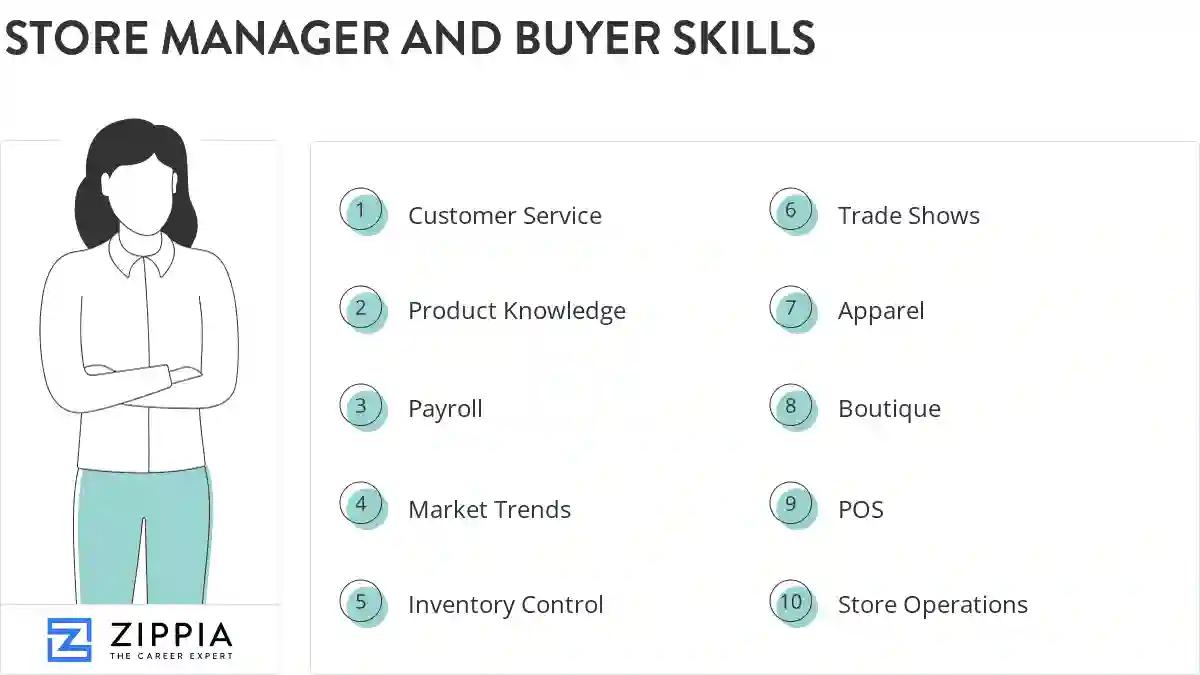
The most important skills for a store manager and buyer resume and required skills for a store manager and buyer to have include:
- Customer Service
- Product Knowledge
- Payroll
- Market Trends
- Inventory Control
- Trade Shows
- Apparel
- Boutique
- POS
- Store Operations
- Sales Floor
- Sales Associates
- Retail Store
- Store Sales
- Vendor Relations
- Sales Reps
- Inventory Management
- Sales Reports
- Retail Sales
- Customer Complaints
- Bank Deposits
- HR
- Product Line
- Store Events
- Loss Prevention
- Customer Relations
- Store Locations
- Product Selection
- Profit Margins
- Store Displays
- NYC
- Retail Operations
- Store Inventory
- Staff Training
- Sales Volume
- Product Development
- Window Displays
- Gross Profit
- Pricing Strategy
- Store Layout
- Fashion Shows
- QuickBooks
- Store Merchandise
- Store Policies
- MRO
- Employee Scheduling
- Customer Issues
Updated January 8, 2025
