
Automatically apply for jobs with Zippia
Upload your resume to get started.
Structural ironworker skills for your resume and career
15 structural ironworker skills for your resume and career
1. Grating
- Bolt up/impact/ operate aerial lifts/ signal cranes/lay grating
- Erected and welded stairways, floor grating, elevator in-beds, X-bracing, beams, channels, angle iron etc.
2. Hoisting
- Assemble hoisting equipment or rigging, such as cables, pulleys, or hooks, to move heavy equipment or materials.
- Signaled and verbally directed workers engaged in hoisting and moving loads, in order to ensure safety of workers and materials.
3. Pulleys
Pulleys are primarily designed to lift heavy items easier through a shaft, cable, and belt. It is also used to support the movement of different systems, facilitating the transport of people and things.
- Selected gear such as cables, pulleys and winches, according to load weights and sizes, facilities and work schedules.
- Replace and comealong Conveyor Belt Pulleys and coal Exchangers.
4. Laser Equipment
- Verified vertical and horizontal alignment of structural steel members, using plumb bobs, laser equipment, transits, or levels.
- Use plumb bobs, levels, and laser equipment to check alignment.
5. Horizontal Alignment
- Verify vertical and horizontal alignment of structural steel members, using necessary equipment.
- Align beams and girders into position and verify vertical and horizontal alignment of the structural steel.
6. I-Beams
- Job description: Connecting I-beams, grits, and channels on a 265 ft structure.
- Connected I-beams, hanged joists, operated fork lift, areal lifts, scissor lifts.
Choose from 10+ customizable structural ironworker resume templates
Build a professional structural ironworker resume in minutes. Our AI resume writing assistant will guide you through every step of the process, and you can choose from 10+ resume templates to create your structural ironworker resume.7. Torches
- Cut bars with metal shears and torches.
- Ignite torches or start power supplies and strike arcs by touching electrodes to metals being welded, completing electrical circuits.
8. Jacks
- Force structural-steel members into final positions, using turnbuckles, crowbars, jacks, and hand tools.
9. SMAW
- Passed an AWS D1.1 Unlimited SMAW Ran mostly 5/32 7018 This was all field work.
- Used welding processes including: SMAW, GTAW, FCAW, Carbon-arc Cutting, Oxy-Fuel Cutting.
10. Safety Equipment
- Use of safety equipment as guidelines set forth by OHSA, which included the installation of Safety equipment.
- Operate safety equipment and use safe work habits.
11. Approximate Positions
- Pull, push, or pry structural-steel members into approximate positions for bolting into place.
- Pull, push, or pry steel members into approximate position in order to bolt the pieces together.
12. FCAW
- Certified welder in FCAW, and Stick Welding.
- Full penetration welds on moment connections using fcaw.
13. Air Arc
Air carbon arc cutting, metal arc gouging, or, more commonly, Air Arc is a term referring to a process in which metal material is cut and melted through the heat of a carbon arc, after which the molten metal is removed via an air jet. Carbon arc is a process and method in which a gaseous form of carbon is broken down and produces heat and light.
- Removed and repaired unacceptable welds with an air arc and grinder to meet quality guidelines.
14. Demo
Flooring demolition needs a particular set of skills and tools to be done properly, like any other big home improvement project. It involves the demolition and removal of the flooring surface, such as tile, wood, carpet, or laminate. And then, removing of thinset or mortar under the floor. Crushing the concrete subfloor to make it stable and sturdy. And finally, cleaning up all trash and dirt generated during the process.
- Erected pipe, bridges, demo and erection on boiler building.
- Performed demo of top level of scoreboard structure using oxy/acetylene torch and cutoff blades.
15. Pipe Supports
Pipe support or pipe hanger is a constructed element that relocates the load from a pipe to the supporting structures. The main functions of pipe support are to guide, absorb shock, anchor, and support load.
- Drill layouts for pipe supports and install supports.
- Read blueprints to layout drilling of holes in either concrete or steel members to installed pipe supports.
5 Structural Ironworker resume examples
Build a professional structural ironworker resume in minutes. Browse through our resume examples to identify the best way to word your resume. Then choose from 5+ resume templates to create your structural ironworker resume.

What skills help Structural Ironworkers find jobs?
Tell us what job you are looking for, we’ll show you what skills employers want.
List of structural ironworker skills to add to your resume
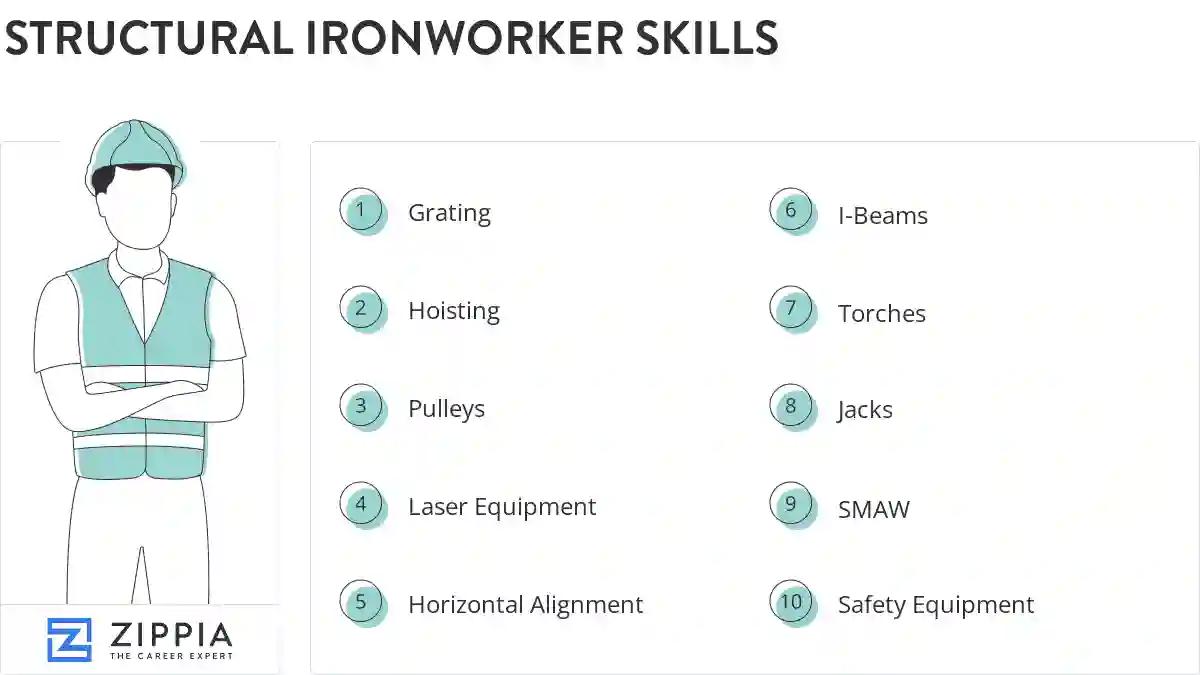
The most important skills for a structural ironworker resume and required skills for a structural ironworker to have include:
- Grating
- Hoisting
- Pulleys
- Laser Equipment
- Horizontal Alignment
- I-Beams
- Torches
- Jacks
- SMAW
- Safety Equipment
- Approximate Positions
- FCAW
- Air Arc
- Demo
- Pipe Supports
- Arc Welding
- Hoists
- Hand Signals
- GMAW
Updated January 8, 2025
