What does a survey engineer do?
Survey engineer responsibilities
Here are examples of responsibilities from real survey engineer resumes:
- Create maps and graphs, using GIS software and relate equipment.
- Select the control point (BM) by GPS or global positioning system.
- Utilize hands on equipment, total stations, GPS units, data collectors, and optical levels.
- Perform calculations necessary to prepare individual residential lot permit and as-built plans necessary for township approval.
- Adjust and operate surveying instruments such as prisms, theodolites and electronic distance-measuring equipment.
- Job types include residential, commercial/industrial staking, water management elevations and wetland location.
Survey engineer skills and personality traits
We calculated that 31% of Survey Engineers are proficient in GPS, Vertical Control, and Autocad. They’re also known for soft skills such as Leadership skills, Math skills, and Speaking skills.
We break down the percentage of Survey Engineers that have these skills listed on their resume here:
- GPS, 31%
SURVEY ENGINEER: Responsible for preventive and corrective maintenance of all survey equipment, including several differential GPS receivers, i.e.
- Vertical Control, 11%
Provide horizontal and vertical control for various auto plant locations.
- Autocad, 6%
Updated and improved manually drafted existing survey drawings using AutoCAD.
- CAD, 6%
Prepared reports on Auto Cad Maps, and provided the necessary data to support the GIS requirements of the drawings.
- RF, 6%
Provided RF Design and site candidate selections for VHF Land Mobile Radio network for Department of Homeland Security.
- Survey Data, 6%
Compile Microsoft Excel spreadsheets to organize and import survey data in a database.
Most survey engineers use their skills in "gps," "vertical control," and "autocad" to do their jobs. You can find more detail on essential survey engineer responsibilities here:
Math skills. Another essential skill to perform survey engineer duties is math skills. Survey engineers responsibilities require that "civil engineers use calculus, trigonometry, and other mathematics for analysis, design, and troubleshooting." Survey engineers also use math skills in their role according to a real resume snippet: "perform the more routine/less complex surveying math and calculations. "
Problem-solving skills. Another crucial skill for a survey engineer to carry out their responsibilities is "problem-solving skills." A big part of what survey engineers relies on this skill, since "civil engineers may encounter problems during each stage of their work." How this skill relates to survey engineer duties can be seen in an example from a survey engineer resume snippet: "manage field crew in the collection and utilization of data for construction layout and boundary resolution. "
The three companies that hire the most survey engineers are:
- Aviat Networks2 survey engineers jobs
- The Walsh Group2 survey engineers jobs
- HNTB2 survey engineers jobs
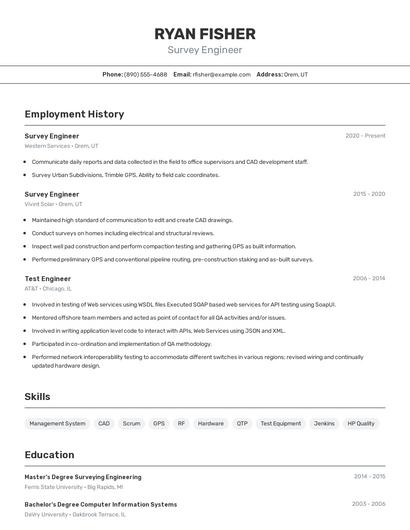
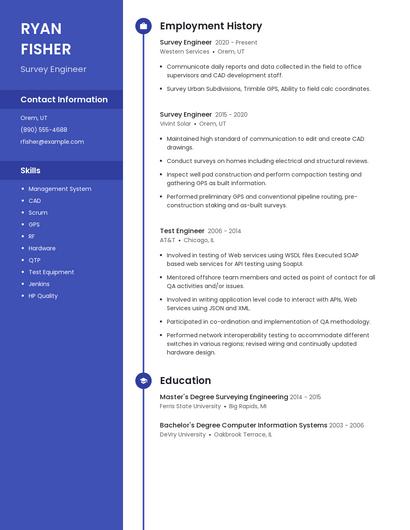
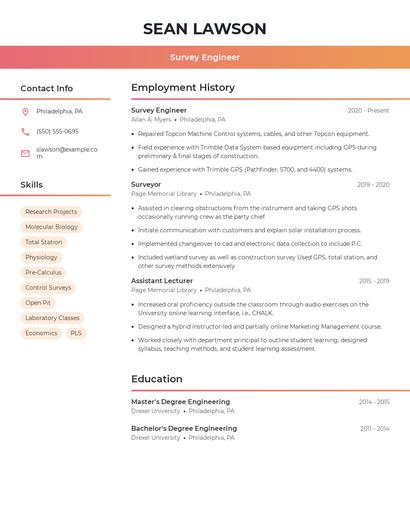
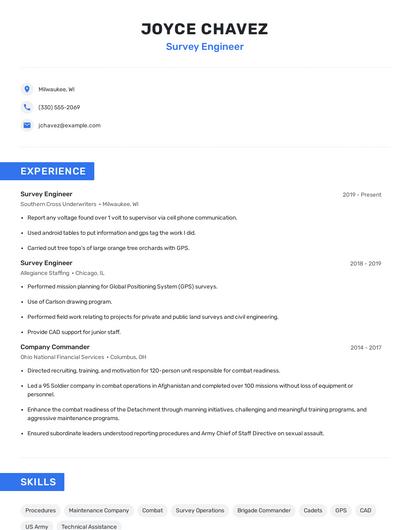
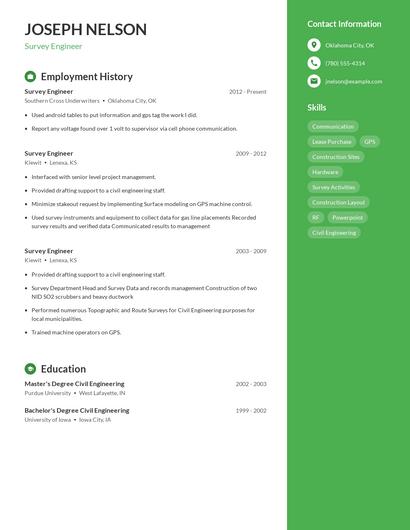
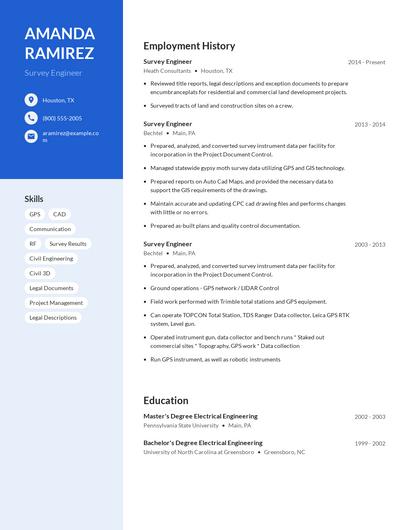
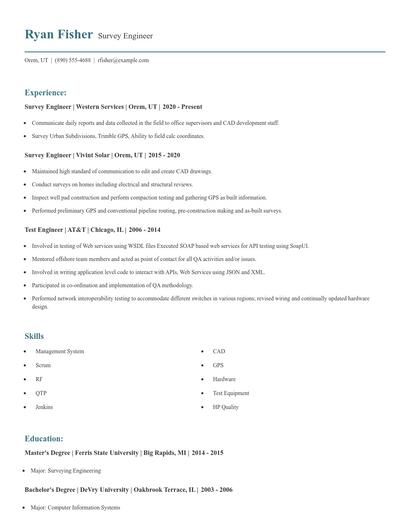
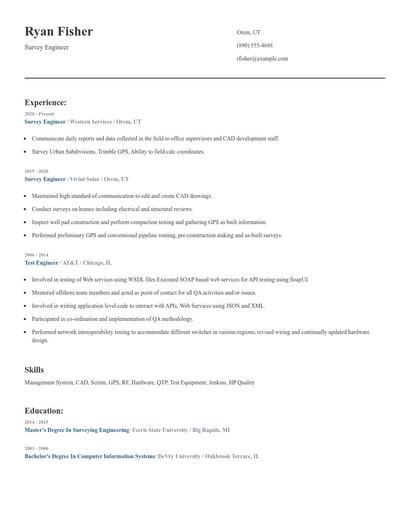
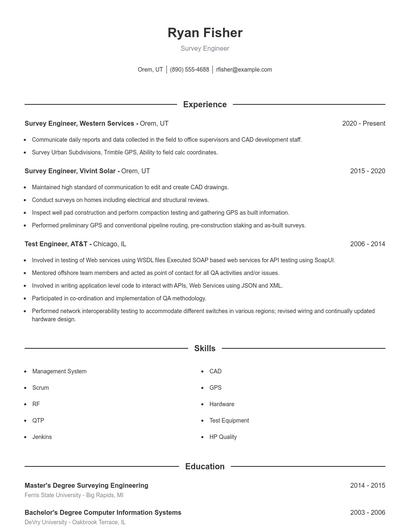
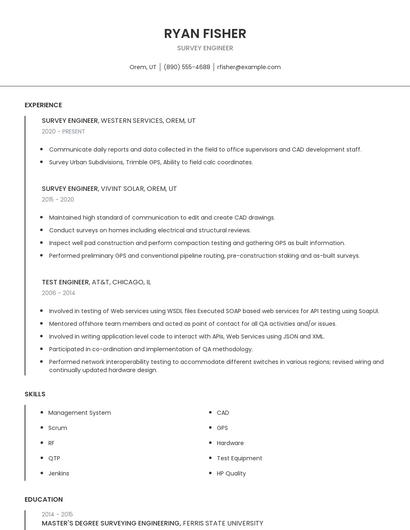
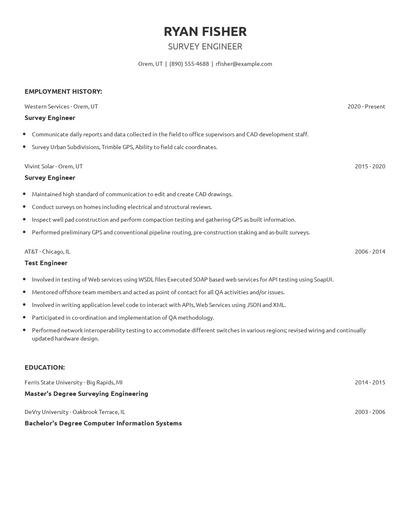
Choose from 10+ customizable survey engineer resume templates
Build a professional survey engineer resume in minutes. Our AI resume writing assistant will guide you through every step of the process, and you can choose from 10+ resume templates to create your survey engineer resume.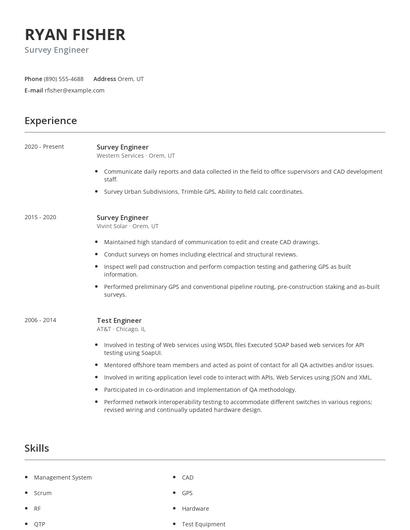
Compare different survey engineers
Survey engineer vs. Representative projects
A Civil Designer plans, scales, and drafts drawings and maps for roads, bridges, and other construction projects. They work with engineers and project managers in determining material, labor, and other costs of the assigned projects.
There are some key differences in the responsibilities of each position. For example, survey engineer responsibilities require skills like "vertical control," "cad," "rf," and "survey data." Meanwhile a typical representative projects has skills in areas such as "construction management," "infrastructure," "osha," and "construction observation." This difference in skills reveals the differences in what each career does.
Representative projects earn the highest salaries when working in the technology industry, with an average yearly salary of $64,096. On the other hand, survey engineers are paid more in the energy industry with an average salary of $76,070.representative projects tend to reach similar levels of education than survey engineers. In fact, representative projects are 0.7% more likely to graduate with a Master's Degree and 0.3% more likely to have a Doctoral Degree.Survey engineer vs. Civil designer
Civil engineer interns work to improve their knowledge about construction and its relevant works. An internship provides them insight into various aspects of construction and how things run at the site. Through an internship, they learn how to differentiate between reality and engineering. Civil engineering interns will typically perform various tasks, including preparing and monitoring documents, working closely with the civil engineer to resolve issues and review complaints, and preparing plans and maps. They are also expected to visit construction sites to do their planning, quality control, documentation, and site execution.
In addition to the difference in salary, there are some other key differences worth noting. For example, survey engineer responsibilities are more likely to require skills like "vertical control," "cad," "rf," and "construction layout." Meanwhile, a civil designer has duties that require skills in areas such as "civil 3d," "civil design," "site design," and "design drawings." These differences highlight just how different the day-to-day in each role looks.
Civil designers may earn a higher salary than survey engineers, but civil designers earn the most pay in the construction industry with an average salary of $74,665. On the other hand, survey engineers receive higher pay in the energy industry, where they earn an average salary of $76,070.civil designers earn lower levels of education than survey engineers in general. They're 7.0% less likely to graduate with a Master's Degree and 0.3% less likely to earn a Doctoral Degree.Survey engineer vs. Civil engineering internship
A Structural Designer designs, develops, and supervises the construction of new buildings and bridges, or extensions to existing properties or other structures. They review and update construction drawings as well as communicate project problems and flaws to managers.
The required skills of the two careers differ considerably. For example, survey engineers are more likely to have skills like "vertical control," "autocad," "cad," and "rf." But a civil engineering internship is more likely to have skills like "civil 3d," "roadway design," "powerpoint," and "construction management."
Civil engineering interns earn the highest salary when working in the construction industry, where they receive an average salary of $65,780. Comparatively, survey engineers have the highest earning potential in the energy industry, with an average salary of $76,070.Most civil engineering interns achieve a similar degree level compared to survey engineers. For example, they're 0.5% less likely to graduate with a Master's Degree, and 1.4% less likely to earn a Doctoral Degree.Survey engineer vs. Structural designer
Types of survey engineer
Updated January 8, 2025
