What does a systems tester do?

A systems tester is an information technology expert who specializes in developing test structures to identify the strengths and weaknesses of systems and software. They primarily work to identify and eliminate bugs to ensure quality and client satisfaction. They may also perform clerical tasks such as preparing reports and findings. Furthermore, as a systems tester, it is essential to recommend solutions against problem areas, all while adhering to the project's budgets and the company's policies and regulations.
Systems tester responsibilities
Here are examples of responsibilities from real systems tester resumes:
- Orchestrate efforts with test leads in hardware, firmware, OS and application labs to optimize program-wide system testing costs.
- Develop web page for achieving documentation and developing a multiple user interface with JavaScript and Perl.
- Used Perl to implement new library API, which allow communication with different types of controllers.
- Build continuous integration system using Jenkins for internal team usage for nightly builds, sanity and regression testing.
- Own the automation test suites for both API and UI testing, updating test suites for product changes each sprint.
- Develop test scenarios, test cases and EDI Unix files, as well as their GUI counterparts for test execution.
- Work with business and development teams to write selenium automation scripts.
- Test C/C++ sensor point application for user space and Linux kernel space.
- Develop coded UI automation to test web base applications running on SharePoint portals.
- Create test suites and test cases in JUnit for various scenarios in the application.
- Upgrade, downgrade, and flash mobile devices firmware and OS to match per test case require
- Work on a team to include coding, debugging, testing and implementation of various testing programs.
- Export requirements, test plan, and test cases in rational quality manager and log defect-using JIRA.
- Experience working with emulators, troubleshooting signals from target board, debugging code with the IDE debugger software.
- Participate in daily scrum meetings with users and developers to report and suggest resolution to issues discover during testing.
Systems tester skills and personality traits
We calculated that 12% of Systems Testers are proficient in Python, Java, and C++.
We break down the percentage of Systems Testers that have these skills listed on their resume here:
- Python, 12%
Developed automation tool in Python.
- Java, 9%
Coordinated with Java and Oracle analysts to emulate, duplicate and validate legacy mainframe execution.
- C++, 7%
Developed and verified pharmaceutical sales software in Visual C++ environment * Developed and executed quality assurance test on software enhancements
- C #, 7%
Configured the .Bat file for all Automated TC # script in order to run them sequentially on test agent machine.
- Test Automation, 5%
Involved with Test automation using Rational Functional Tester to validate application functionality and assure application changes have not impaired existing functionality.
- Selenium, 4%
Introduced automated software testing to PAML by developing tests using Selenium for multiple applications.
Common skills that a systems tester uses to do their job include "python," "java," and "c++." You can find details on the most important systems tester responsibilities below.
The three companies that hire the most systems testers are:
- General Dynamics68 systems testers jobs
- Oracle51 systems testers jobs
- General Dynamics Mission Systems
38 systems testers jobs
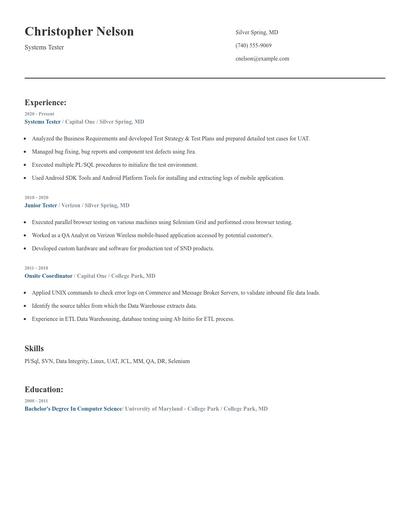
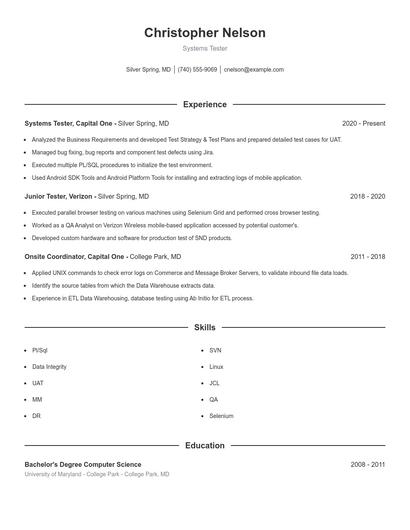
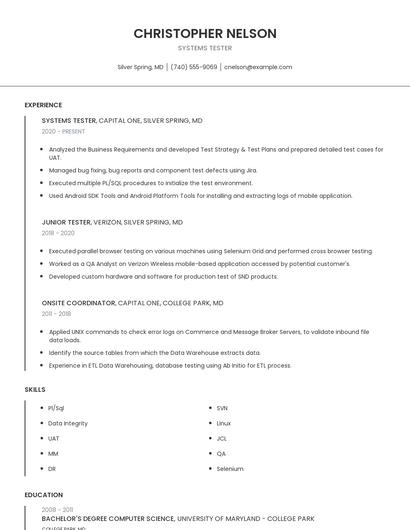
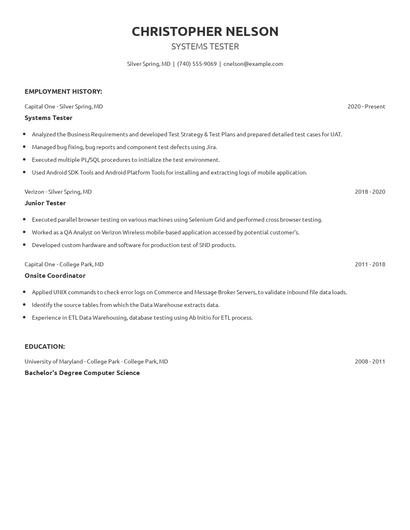
Choose from 10+ customizable systems tester resume templates
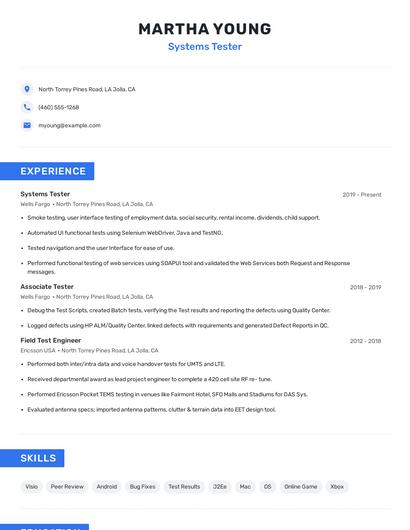
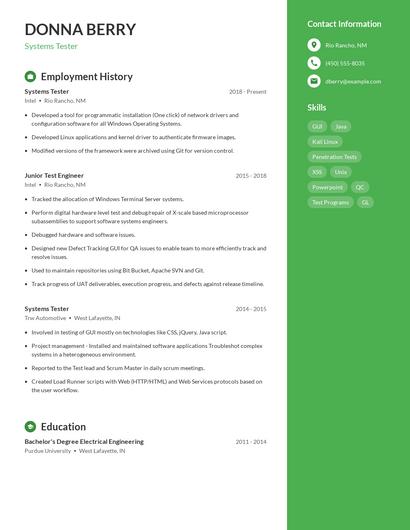
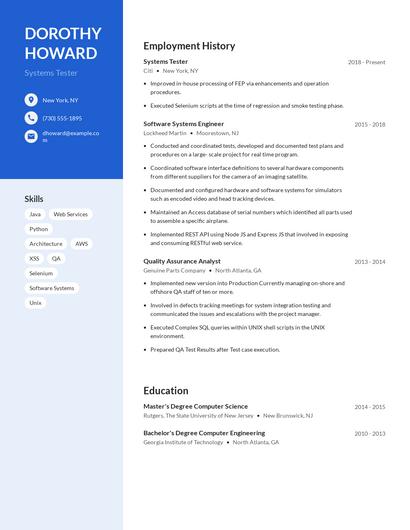
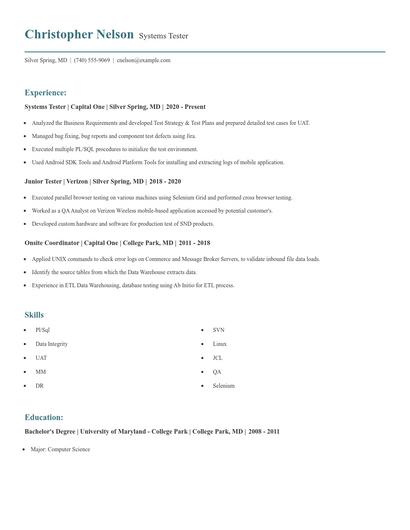
Build a professional systems tester resume in minutes. Our AI resume writing assistant will guide you through every step of the process, and you can choose from 10+ resume templates to create your systems tester resume.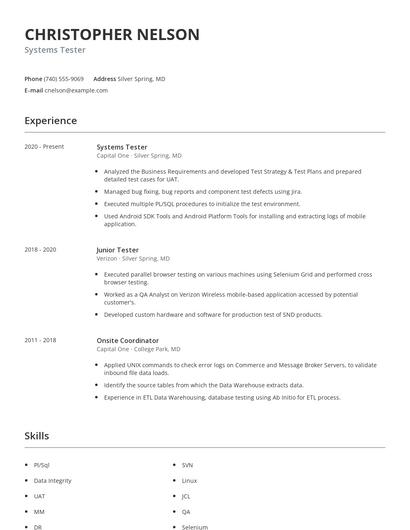
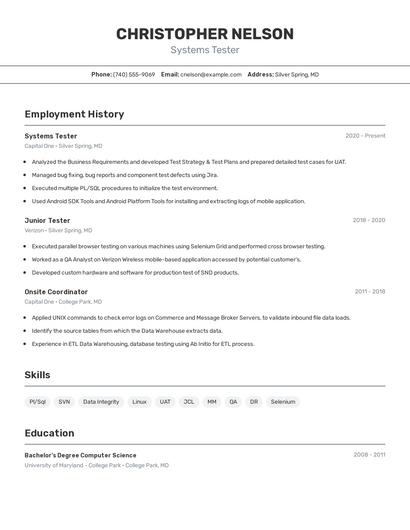
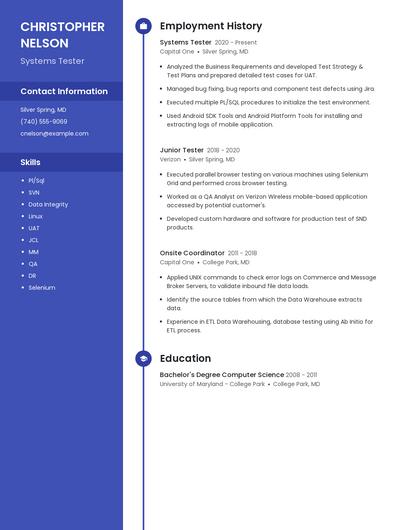
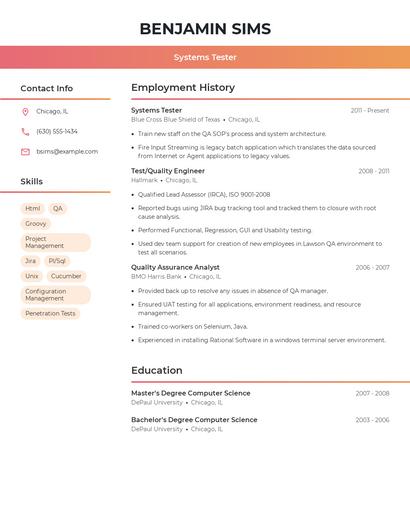
Compare different systems testers
Systems tester vs. Test analyst
The duties of a test analyst depend on one's line of work or industry of employment. In the information technology setting, a test analyst is responsible for testing computer software or hardware to ensure its quality before being released in the market. They participate in the development process to monitor the product specifications, review and analyze documentation, and create test systems, implementing them promptly and efficiently. As a test analyst, it is essential to produce progress reports, prepare presentations, and even give recommendations.
These skill sets are where the common ground ends though. The responsibilities of a systems tester are more likely to require skills like "python," "c++," "c #," and "test automation." On the other hand, a job as a test analyst requires skills like "test plan," "status reports," "selenium webdriver," and "strong problem-solving." As you can see, what employees do in each career varies considerably.
Test analysts really shine in the finance industry with an average salary of $74,197. Comparatively, systems testers tend to make the most money in the finance industry with an average salary of $104,166.test analysts tend to reach similar levels of education than systems testers. In fact, test analysts are 1.9% more likely to graduate with a Master's Degree and 0.2% less likely to have a Doctoral Degree.Systems tester vs. Quality assurance engineer
A Quality Assurance Engineer's role is to oversee the overall production and ensure that the product is cost-efficient and aligns with the company's standards. The responsibility mainly revolves around conducting activities that examine and scrutinize the condition of a product or service to identify issues and come up with possible solutions to resolve the issue or attain stronger customer satisfaction. Furthermore, the Quality Assurance Engineer must also ensure that the product adheres to the government regulations and market guidelines.
In addition to the difference in salary, there are some other key differences worth noting. For example, systems tester responsibilities are more likely to require skills like "test automation," "selenium," "qa," and "test procedures." Meanwhile, a quality assurance engineer has duties that require skills in areas such as "javascript," "git," "selenium web," and "automation scripts." These differences highlight just how different the day-to-day in each role looks.
On average, quality assurance engineers earn a lower salary than systems testers. Some industries support higher salaries in each profession. Interestingly enough, quality assurance engineers earn the most pay in the technology industry with an average salary of $100,740. Whereas systems testers have higher pay in the finance industry, with an average salary of $104,166.quality assurance engineers earn similar levels of education than systems testers in general. They're 2.7% more likely to graduate with a Master's Degree and 0.2% more likely to earn a Doctoral Degree.Systems tester vs. Senior systems software engineer
A senior systems software engineer is an individual responsible for managing a firm's computer network systems. The professional's roles include resolving complex application and network issues through the development of new solutions, overseeing systems developers and other information technology (IT) personnel, and integrating new technology. The job requires proficiency in the MySQL, Python, and Linux programming languages and excellent skills in organizational and time management and communication. The education requirements for the job include a bachelor's degree in electrical engineering, computer science, or a related field.
The required skills of the two careers differ considerably. For example, systems testers are more likely to have skills like "c #," "test automation," "selenium," and "test results." But a senior systems software engineer is more likely to have skills like "software development," "architecture," "c," and "code reviews."
Senior systems software engineers make a very good living in the technology industry with an average annual salary of $125,048. On the other hand, systems testers are paid the highest salary in the finance industry, with average annual pay of $104,166.When it comes to education, senior systems software engineers tend to earn similar degree levels compared to systems testers. In fact, they're 4.7% more likely to earn a Master's Degree, and 1.1% more likely to graduate with a Doctoral Degree.Systems tester vs. Information systems analyst
An information systems analyst specializes in conducting cost-efficient research and analysis to determine how information technology can improve a company's business process and growth. One of their primary responsibilities is to collaborate with information systems experts to develop upgrades and all-new systems, respond to inquiries and concerns, provide corrective measures, and meet the IT needs of employees all over the company. Furthermore, it is essential to run tests on systems and determine areas that need improvement.
Types of systems tester
Updated January 8, 2025
