What does a teaching instructor do?
Teaching instructor responsibilities
Here are examples of responsibilities from real teaching instructor resumes:
- Utilize digital technology for educational purposes by managing blackboard page.
- Assist with creation of course syllabus and require course work.
- Cover the fundamental concepts of chemistry and biology including cell biology, metabolism, microbiology, genetics, evolution and histology.
- Provide clinical experience in various healthcare settings.
- Facilitate internships of senior students in healthcare facilities
- Attend monthly faculty meetings and maintain extensive student record database.
- Create several database queries to streamline reporting procedures and reduce man hours substantially.
- Facilitate laboratory and discussion sections of intro honors biology to ethnically diverse groups of students.
Teaching instructor skills and personality traits
We calculated that 20% of Teaching Instructors are proficient in Mathematics, Political Science, and Lab Reports. They’re also known for soft skills such as Communication skills, Organizational skills, and Patience.
We break down the percentage of Teaching Instructors that have these skills listed on their resume here:
- Mathematics, 20%
Received among the highest marks for student evaluations in the Mathematics Department.
- Political Science, 13%
Mentored Undergraduate students in Political Sciences.
- Lab Reports, 9%
Provided assistance to students on Digital Circuits Design and Microelectronics Circuits Design problems -Tested PCB and components -Graded assignments and lab reports
- Course Curriculum, 8%
Designed and implemented course curriculum, structure, midterm and final examinations for each course taught.
- Fine Arts, 6%
Developed curriculum for Bachelor of Fine Arts undergraduate level students (juniors and seniors).
- Undergraduate Courses, 6%
Graduate courses: Introduction to Data Analysis Undergraduate courses: Quantitative Research Methods; Introduction to Comparative Politics; Environmental Public Policy
Most teaching instructors use their skills in "mathematics," "political science," and "lab reports" to do their jobs. You can find more detail on essential teaching instructor responsibilities here:
Communication skills. To carry out their duties, the most important skill for a teaching instructor to have is communication skills. Their role and responsibilities require that "career and technical education teachers must explain concepts in terms that students can understand." Teaching instructors often use communication skills in their day-to-day job, as shown by this real resume: "instructed 9th and 10th graders in literature, grammar and verbal communication. "
Organizational skills. Many teaching instructor duties rely on organizational skills. "career and technical education teachers must coordinate their time and teaching materials.," so a teaching instructor will need this skill often in their role. This resume example is just one of many ways teaching instructor responsibilities rely on organizational skills: "assisted instructor in organizational tasks such as grading weekly homework assignments, developing the final examination, and maintaining student grades. "
Patience. Another skill that relates to the job responsibilities of teaching instructors is patience. This skill is critical to many everyday teaching instructor duties, as "working with students of different abilities and backgrounds can be difficult." This example from a resume shows how this skill is used: "embodied and honored the instructor s code of ethics of professionalism, patience, rapport, respect, and admission. "
The three companies that hire the most teaching instructors are:
- Rutgers University8 teaching instructors jobs
- Marquette University3 teaching instructors jobs
- Florida Institute of Technology2 teaching instructors jobs
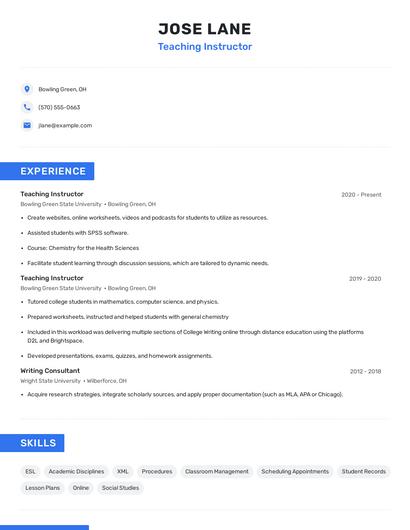
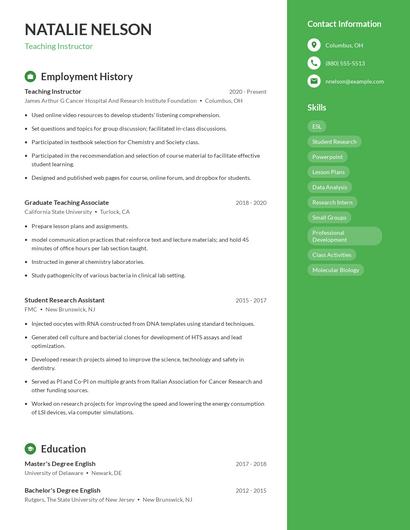
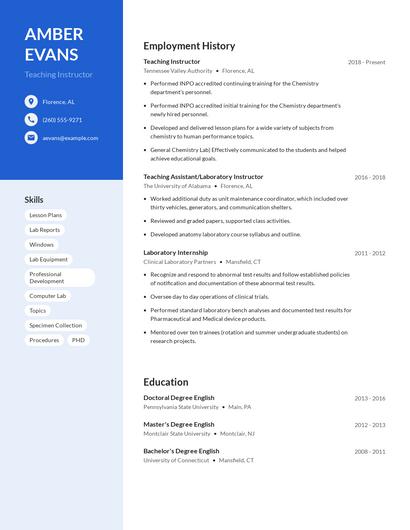
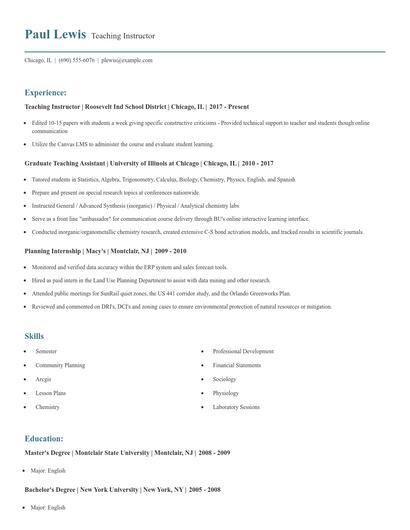
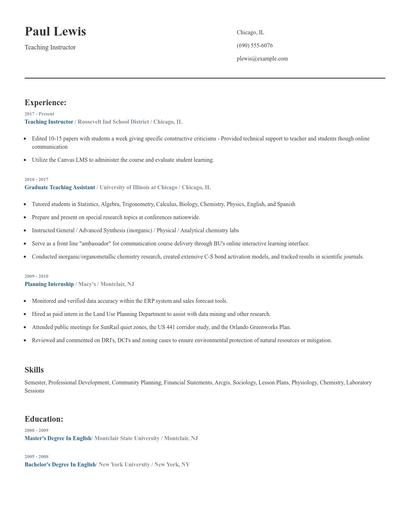
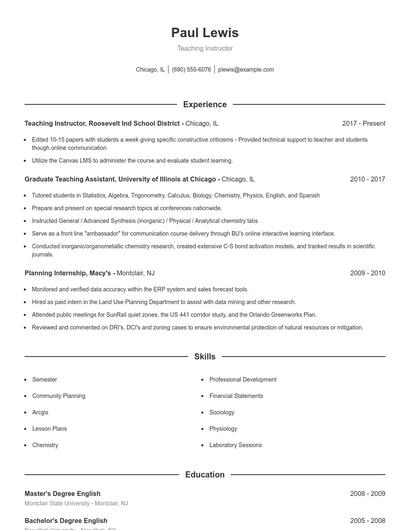
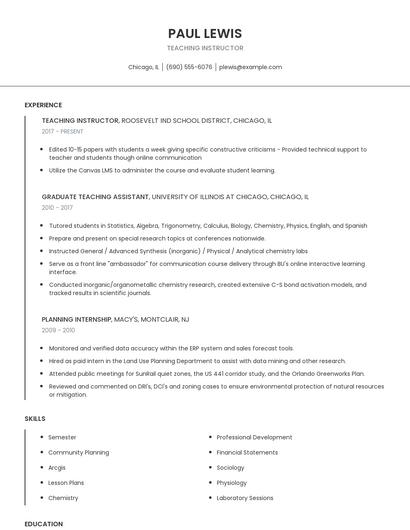
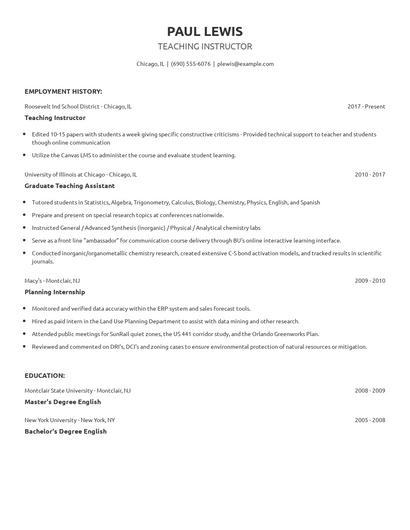
Choose from 10+ customizable teaching instructor resume templates
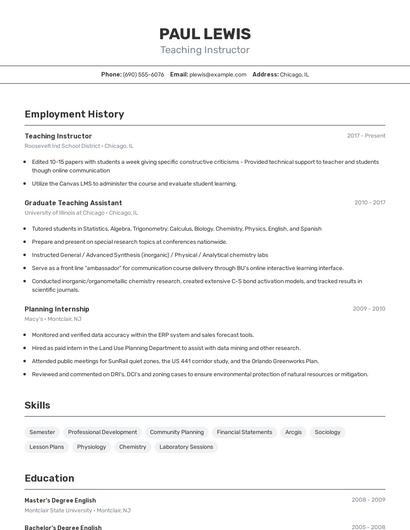
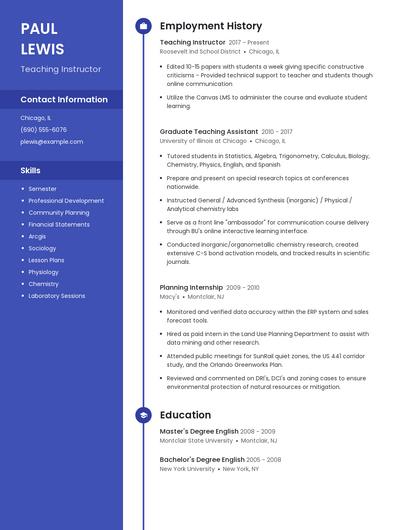
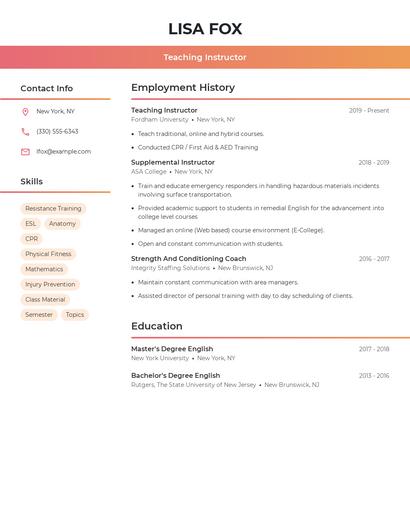
Build a professional teaching instructor resume in minutes. Our AI resume writing assistant will guide you through every step of the process, and you can choose from 10+ resume templates to create your teaching instructor resume.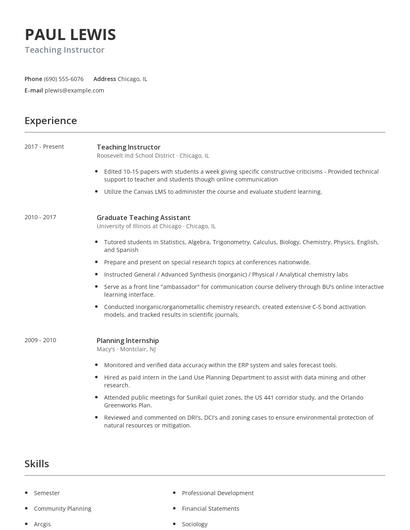
Compare different teaching instructors
Teaching instructor vs. Adjunct lecturer
An Adjunct Lecturer is responsible for teaching college classes. They prepare course guides, teach content that matches courses standards, and assist students with inquiries outside of class.
While similarities exist, there are also some differences between teaching instructors and adjunct lecturer. For instance, teaching instructor responsibilities require skills such as "lab reports," "language," "video production," and "ecu." Whereas a adjunct lecturer is skilled in "c++," "excellent interpersonal," "rehabilitation," and "course syllabus." This is part of what separates the two careers.
Adjunct lecturers tend to make the most money working in the education industry, where they earn an average salary of $95,827. In contrast, teaching instructors make the biggest average salary, $58,397, in the professional industry.On average, adjunct lecturers reach higher levels of education than teaching instructors. Adjunct lecturers are 12.7% more likely to earn a Master's Degree and 4.2% more likely to graduate with a Doctoral Degree.Teaching instructor vs. Instructor, adjunct faculty
An adjunct faculty member works in a state university or college. They typically work on a part-time or contractual basis. Although they work in a university, they have limited responsibilities compared to those who work as a regular instructor, but they still need appropriate work etiquette and a love of teaching and working with students. Like any other instructor, they develop learning material, conduct lectures, prepare exams, and assess students' grades.
Each career also uses different skills, according to real teaching instructor resumes. While teaching instructor responsibilities can utilize skills like "political science," "lab reports," "language," and "literature," instructors, adjunct faculty use skills like "course syllabus," "learning outcomes," "learning environment," and "professional development."
Instructors, adjunct faculty earn a lower average salary than teaching instructors. But instructors, adjunct faculty earn the highest pay in the education industry, with an average salary of $54,888. Additionally, teaching instructors earn the highest salaries in the professional with average pay of $58,397 annually.Average education levels between the two professions vary. Instructors, adjunct faculty tend to reach higher levels of education than teaching instructors. In fact, they're 6.3% more likely to graduate with a Master's Degree and 4.2% more likely to earn a Doctoral Degree.What technology do you think will become more important and prevalent for teaching instructors in the next 3-5 years?
Helen Callus
Professor of Viola, Northwestern University
I imagine this might become part of the framework that we offer in the future. Students should understand how to present themselves in these situations, understanding sound and picture quality devices (what microphones and cameras are best), internet speeds, ethernet cables, router devices, lighting, etc. But it is an excellent opportunity to understand the media of film/video and how to create best a sound video recording for competitions, summer festivals, or college applications. We were already using that medium for prescreens, so this is a chance to refine that skill as, without doubt, that will be a part of our future.
Teaching instructor vs. Instructor of spanish
A Spanish Instructor specializes in teaching the Spanish language in a classroom or one-on-one setting. Their responsibilities typically include preparing lesson plans according to the students' needs and capacity, researching and creating learning materials, facilitating discussions, conducting quizzes and examinations, organizing activities to enhance their language skills, grading the students' performances, and assisting students as necessary. Spanish Instructors monitor the students' progress while maintaining a safe and healthy learning environment for everyone.
Some important key differences between the two careers include a few of the skills necessary to fulfill the responsibilities of each. Some examples from teaching instructor resumes include skills like "mathematics," "political science," "lab reports," and "course curriculum," whereas an instructor of spanish is more likely to list skills in "classroom management," "teaching methodologies," "professional development," and "language acquisition. "
Instructors of spanish earn the best pay in the manufacturing industry, where they command an average salary of $61,981. Teaching instructors earn the highest pay from the professional industry, with an average salary of $58,397.When it comes to education, instructors of spanish tend to earn higher degree levels compared to teaching instructors. In fact, they're 5.4% more likely to earn a Master's Degree, and 2.4% more likely to graduate with a Doctoral Degree.Teaching instructor vs. Teaching fellow
An individual who works at an institution to foster the students' academic strive is known as a teaching fellow. They are known as a self-motivated and education-based counselor. They help to pursue a better career perspective in an individual's academic endeavors.
Types of teaching instructor
Updated January 8, 2025
