Explore jobs
Find specific jobs
Explore careers
Explore professions
Best companies
Explore companies
Job outlook for technician system specialists in the United States
Technician system specialist job growth summary. After extensive research, interviews, and analysis, Zippia's data science team found that:
The projected technician system specialist job growth rate is 10% from 2018-2028.
About 83,100 new jobs for technician system specialists are projected over the next decade.
Technician system specialist salaries have increased 9% for technician system specialists in the last 5 years.
There are over 314,067 technician system specialists currently employed in the United States.
There are 87,806 active technician system specialist job openings in the US.
The average technician system specialist salary is $80,694.
Are technician system specialist jobs in demand?
Technician system specialist job and salary trends over time
Technician system specialist jobs over time
Technician system specialist job growth rate over time
| Year | # of jobs | % of population |
|---|---|---|
| 2021 | 314,067 | 0.09% |
| 2020 | 393,810 | 0.12% |
| 2019 | 248,731 | 0.07% |
| 2018 | 210,041 | 0.06% |
| 2017 | 207,404 | 0.06% |
Average technician system specialist salary over time
Technician system specialist salary by year
| Year | Avg. salary | Hourly rate | % Change |
|---|---|---|---|
| 2026 | $80,694 | $38.80 | +3.4% |
| 2025 | $78,035 | $37.52 | +2.3% |
| 2024 | $76,268 | $36.67 | +1.5% |
| 2023 | $75,116 | $36.11 | +1.7% |
| 2022 | $73,889 | $35.52 | +1.6% |
Technician system specialist jobs by state
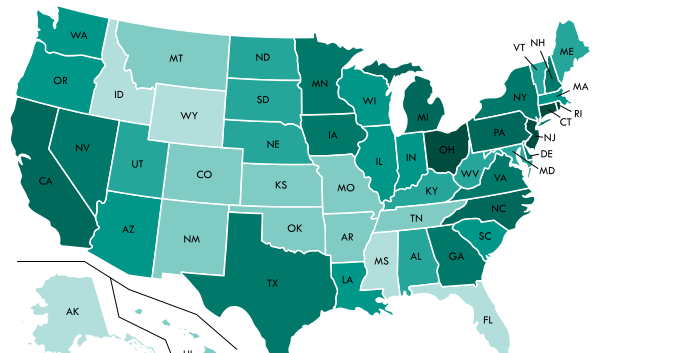
Most common states for technician system specialists
| Rank | State | Population | # of jobs | Employment/ 1000ppl |
|---|---|---|---|---|
| 1 | District of Columbia | 693,972 | 549 | 79% |
| 2 | Maryland | 6,052,177 | 1,585 | 26% |
| 3 | Vermont | 623,657 | 160 | 26% |
| 4 | Virginia | 8,470,020 | 2,104 | 25% |
| 5 | Massachusetts | 6,859,819 | 1,555 | 23% |
| 6 | Delaware | 961,939 | 211 | 22% |
| 7 | Alaska | 739,795 | 159 | 21% |
| 8 | Colorado | 5,607,154 | 1,100 | 20% |
| 9 | Utah | 3,101,833 | 607 | 20% |
| 10 | New Hampshire | 1,342,795 | 272 | 20% |
| 11 | Rhode Island | 1,059,639 | 209 | 20% |
| 12 | North Dakota | 755,393 | 152 | 20% |
| 13 | Minnesota | 5,576,606 | 1,036 | 19% |
| 14 | Nebraska | 1,920,076 | 336 | 17% |
| 15 | Arizona | 7,016,270 | 1,126 | 16% |
| 16 | Oregon | 4,142,776 | 677 | 16% |
| 17 | Montana | 1,050,493 | 170 | 16% |
| 18 | North Carolina | 10,273,419 | 1,493 | 15% |
| 19 | Maine | 1,335,907 | 202 | 15% |
| 20 | Iowa | 3,145,711 | 456 | 14% |
Most common cities for technician system specialists
| Rank | City | # of jobs | Employment/ 1000ppl | Avg. salary |
|---|---|---|---|---|
| 1 | Columbus | 3 | 6% | $81,474 |
| 2 | Bangor | 1 | 3% | $72,152 |
| 3 | Sugar Land | 2 | 2% | $87,381 |
| 4 | East Hartford | 1 | 2% | $100,738 |
| 5 | Cambridge | 1 | 1% | $82,096 |
| 6 | Eugene | 1 | 1% | $85,055 |
| 7 | Folsom | 1 | 1% | $97,913 |
| 8 | Palmdale | 1 | 1% | $91,233 |
| 9 | Pueblo | 1 | 1% | $69,306 |
| 10 | Washington | 2 | 0% | $84,620 |
| 11 | Chandler | 1 | 0% | $78,529 |
| 12 | Denver | 1 | 0% | $68,076 |
| 13 | Indianapolis | 1 | 0% | $81,875 |
| 14 | New York | 1 | 0% | $91,039 |
| 15 | San Francisco | 1 | 0% | $99,395 |
Technician System Specialist job outlook: Expert opinions
Our panel of technician system specialist experts
Governors State University
Palm Beach State College
University of New Haven
Western Illinois University

Grand Valley State University
Tiffin University

California State University - Long Beach

Bakersfield College
Purdue University

Grantham University
Utah Valley University
Dominican University
Loyola University Chicago

Kennesaw State University

Rowan University

The University of Texas at Arlington

The Ohio State University at Lima
North Carolina Central University

Idaho State University
What general advice would you give to a Technician System Specialist?
Rich Manprisio MPM, PMP: Soft skills are necessary always but in regard to technical skills I see AI having a more prevalent role in IT. Graduates will need to look for ways both to leverage AI to help deal with cybersecurity related issues in addition on how AI can aid in complete infrastructure tasks
What Technician System Specialist skills would you recommend for someone trying to advance their career?
Rich Manprisio MPM, PMP: Make sure you stay on top of the latest developments with technology. With the fluidity of technology, students today need to have the solid groundwork of a degree in IT but also understand things are continually changing and this need to always be continuing their learning and professional development.
What will help Technician System Specialists increase their earning potential?
Rich Manprisio MPM, PMP: Certifications help set you apart from other graduates. When just starting out focus on vendor neutral certifications that can show potential employers that you are willing to get the necessary additional certifications that are prevalent in the IT field.
Laura Kier
Network Design and Administration InstructorWhat general advice would you give to a Technician System Specialist?
Laura Kier: Students graduating from the Computer Network Design and Administration program will enter the job market with a solid foundation in networking technologies. Above that they should also be able to develop and demonstrate excellent communication and interpersonal skills. Networking has a strong emphasis on teamwork and being able to communicate well with customers, co-workers and teammates is vital. Attaining certifications in Cisco, Linux, Windows, and security will also help the student stand out within the industry (classes in the program help to learn the knowledge needed to attain certifications). Students should participate in any local or online communities and groups to enhance skills and knowledge and find networking opportunities.
What Technician System Specialist skills would you recommend for someone trying to advance their career?
Laura Kier: Computer Networking is a dynamic field with a wide variety of opportunities in many different industries. Some skills that will be more important in general are skills in software defined networking and automation. Skills in the DevOps field will be necessary, as well as skills leveraging AI tools. Cybersecurity is always important and using AI tools to enhance security and monitoring is necessary.
What will help Technician System Specialists increase their earning potential?
Laura Kier: Learn to present your skills well from the interview and into your career. Those communication skills count! Industry certifications like CCNA matter. They help you demonstrate a willingness to grow and learn beyond what was required for your degree. Be willing to take on new challenges with your new job and keep learning new skills. It is really important for graduates to understand that talented IT professionals can move up quickly in a company, but they often must start at the bottom to showcase their technical and soft skills. Because of that, they should not shy away from entry level jobs if there is potential for growth.
Dwight Elliot
Professor: Information Management, Cybersecurity & LawPalm Beach State College
Homeland Security
What will help Technician System Specialists increase their earning potential?
Dwight Elliot: Combination of Theoretical and Practical Knowledge: Ensure that you have a strong
combination of theoretical knowledge and practical hands-on skill sets. You must be able
to articulate your knowledge and experience well in an interview and demonstrate what
you are able to do. Be prepared to show examples of precious work that you have
produced or created.
b) Job Research: Always engage in continuous job search Online and in-person. Read
carefully the job description and determine how your background, knowledge and
experience fits best with the job you are reviewing. Customize your resume to that job if
you feel you have the appropriate matching skill sets. If you do not have all the skills sets
at the time, be willing to set mini-goals to gain those skills and update your resume when
you do add additional skills, then reapply to the appropriate jobs available.
c) Online Job Database: Gradually build your profile on various IT and Cybersecurity jobs
such as: www.dice.com, www.monster.com, and www.cyberseek.org and also at the
organizational and company website. Once you setup an Online profile it will make it
easier to reapply in the future for other jobs that are related to your background.
d) Keywords: Make sure you list certain keywords on your resume that matches the jobs, if
you have those skills, so when a HR representative reviews resumes you have the
appropriate terms on your resume that match the job and the algorithms can identify your
skill set. Only do this if you have the actual knowledge and skill can explain yourself in
an interview. Do not do this if you do not have the actual knowledge and skill, since
being asked a question in an interview that you are unqualified to answer is not a good
look for your career and could be detrimental.
e) Continuous Learning: Be willing to engage in continuous learning, studying beyond
your degree accomplishments, since learning never stops and technology continues to
change. Maybe also pursue certifications.
f) Professional Online Business Portfolio and Brand: Continue to build a strong Online
IT, Networking and Cybersecurity Portfolio, through websites such as Linked in for
example, and also your own secure website that shows demonstrations of the creative
work that you have done in the past for clients and other jobs.
g) IT , Networking and Cybersecurity Events, Seminars and Conferences: Be willing to
always continue to attend events, seminars and conferences (in person and virtual) and
actually meet industry professionals. Do a search these events Online at all times.
What general advice would you give to a Technician System Specialist?
Dwight Elliot: In addition to the following 10 best practices from the article below, I would like to share the
following approach to career and job success that leads to maximization of salary during a
career:
a) Employers' Vision and Mission: Focus on understanding the vision and mission of the
organization you work for and what is important to them. If the idea, concept, or project
is important to them then it is important to you. Understand the history and background
of the company, the current project, financial and financial growth goals of the company,
who their competitors are, and what competitive edge the company have or some that you
can suggest. Do not just concentrate on what you want from the job (such as a good
salary, everyone says this). Make sure you are providing the employer with value, what
they want and need from you and in return you are laying the foundation and a strong
case for what you want and need from the job. This is an essential component of making
yourself valuable and marketable for salary increases and promotions based on your
performance and your measurable growth contribution to the organization.
b) Environmental Awareness and Communication with Stakeholders: Be sure you take
the time to learn the different internal and external stakeholders within the organization.
Understanding and respecting organizational structures as well as hierarchies and
following processes and communication protocols matter in an organization. You must
know who to speak to about what, when , where and how. Know your job well and how it
is related to the job of other people on your team. Understand and respect the role of all
individuals within the organization, especially those who are above you. If you do not yet
know their role within the organization begin to ask questions nicely of someone who
does know the players well and the history behind certain key positions. Get to learn the
written and unwritten rules. Saying the wrong thing to the wrong person could cost you a
job or be detrimental to your career in the long term. In the alternative, making a good
impression by communicating properly with the right person could open doors for you
now and in the future. This is an essential component of making yourself valuable and
marketable for salary increases and promotions based on your performance and your
measurable growth contribution to the organization.
c) Employer's View: Are You An Asset or Liability? Try your best to understand the
employer's point of view versus your own. Engage in micro level vs. macro level
comparative analysis as best you can. This means you make a concerted effort to think
about what is important to your employers or clients and how you can be instrumental in
meeting their needs at the highest level of performance, then think of how you can benefit
based on your valuable contribution. Ask yourself each day whether you are an asset to
the company or liability?, and be truly honest with yourself. What unique value do you
bring to the team, such as advanced data analytics skills, advanced accounting skills,
advanced technological skills, etc. Is there anything that you are doing that detracts from
this value that can make this valuable asset that you bring non-useful or non-impactful?
This is an essential component of making yourself valuable and marketable for salary
increases and promotions based on your performance and your measurable growth
contribution to the organization.
d) Be Present Physically, Mentally and with Positive Energy: Please be sure that you are
showing up to work ahead of time or at least on time.
a. Physically Present: Many individuals lose job opportunities just based on their
inability to be present and accountable for work on time. High level employees
actually show up to work 30 minutes to an hour early on a consistent basis.
b. Mentally Present: While you are at work you need to be fully engaged in work
related activity. This means that you do not spend an inordinate amount of time on
your cellphone looking at non work related messages, such as social media and
non-work related text. This is not fair to the employer and you will not allow you
to maximize your contribution to the organization or put in the work necessary to
make yourself a valuable asset to the company. What you do with your time is
what you become.
c. Energy, Communication and Positive Presence: Be sure that your energy level
is monitored and you positive in your communications, since this ultimately
affects profits and losses if a customer does not return to do business with you or
an employer because of how they were treated. Your outlook and energy affect
your overall job performance, business and career growth and ultimately your
profits. All your roles within an organization require good communication and
customer service skills. Be sure that your energy level is uplifting, positive and
creates an atmosphere where customers and colleagues feel welcome to do
business with you. This is a "little" thing that can make a big difference.
e) E) Respectful: Ensure that you are respecting others in the same way and even more than
you want them to respect you. Give as much or more than you receive, and your career
will be even more fulfilling. Ultimately a person's attitude determines their altitude in
life.
These are essential components of making yourself valuable and marketable for salary
increases and promotions based on your performance and your measurable growth
contribution to the organization..
f) Documentation of Biography, Website, Linkedin Portfolio and GitHub: Please be
sure that your are consistently updating you BIO, resume, LinkedIn, website or any other
form of professional documentation that ensures your accomplishments, achievements
and status is current and up to date. As you engage in professional development trainings,
gain certifications or additional degrees, and add additional experiences be sure to update
your profile so that you are maximizing your value.
Implementing these best practices consistently will help position you for salary increases and
promotions based on your performance and measurable growth contribution to the organization.
What Technician System Specialist skills would you recommend for someone trying to advance their career?
Dwight Elliot: Core Skills Areas: data security, networking, software development, cybersecurity, systems
engineering, AI, data analytics, financial and risk analysis, security intelligence, GDPR
Certifications (some important ones):
1) CompTIA A+, Network+, Security+
2) Microsoft Certified: Security, Compliance, and Identity Fundamentals
3) Certified Information Systems Security Professional (CISSP)
4) Certified Information Security Manager (CISM)
5) Certified Information Systems Auditor (CISA)
6) Cisco Certified Internetwork Expert (CCIE)
7) Cisco Certified Network Associate (CCNA)
Soft Skills: honesty, integrity and trust, compliance, communication (in-person and live) then
virtual, patience, accountability and dependability, transparency, trainable and coachable,
teamwork, discipline, commitment, dedication, humility, time management, project management
Adrian Rusu
Professor, Alice E. and Michael J. Fisher Teaching Chair in Computer ScienceUniversity of New Haven
Computer Science
What general advice would you give to a Technician System Specialist?
Adrian Rusu: By getting involved in internships, co-ops, or other potential real-world experiences in their field of interest, so they can obtain real-world experience beyond classroom during their studies. Generally, employers value graduates who already have relevant real-world experience and who therefore can easier adapt to job requirements.
What Technician System Specialist skills would you recommend for someone trying to advance their career?
Adrian Rusu: Soft skills will be important as graduates will have the opportunity to interact with a variety of professionals and customers. Relating to and understanding customers' point of view is critical to their ability to deliver technical solutions that meet customers' needs.
In addition to soft skills, technical skills in high demand and emerging areas of interest will be important. Whether graduates have interest in developing information technology infrastructure, providing information security services, or getting involved in business analysis, they would need to deepen their technical skills in those areas.
What will help Technician System Specialists increase their earning potential?
Adrian Rusu: Since an Information Systems degree covers a variety of different types of jobs, a graduate beginning their career has a variety of opportunities. My advice is to follow their interests and pursue jobs in their area of interest.
Hoyet Hemphill Ph.D.
IDT Program Coordinator and Graduate Advisor, Instructional Design and TechnologyWestern Illinois University
School of Engineering and Technology
What skills stand out on Technician System Specialist resumes?
Hoyet Hemphill Ph.D.: The next K12 job mostly advertised is Technology specialist, and the majority of the skills include knowledge of data visualization tools like google data studio, strong spreadsheet skills. (Google Sheets is preferred.), ability to collect, organize, analyze, and disseminate significant amounts of information with attention to detail and accuracy, excellent communication and analytical skills, knowledge of data analytics, ability to troubleshoot data questions, excellent organizational skills including attention to detail and multi-tasking skills, excellent client-facing and internal communication skills. Duties most seen include interpreting, summarizing, and communicating data analyses to clients, ability to create forms and strategies to help schools efficiently and effectively collect data, download, review, and interpret school-related data from assessment providers, school spreadsheets, and other systems.
The skills required majorly for the curriculum designer position include understanding by design principles for curriculum design, excellent interpersonal and communication skills, excellent writing skills, ability to create effective and fair assessment methods. The duties include collaborating effectively and extensively with internal and external partners, including content and specialty teams to ensure the curriculum is developed in accordance with all articulated quality standards, overseeing the review/feedback process for all subject curriculum, including coordination of teacher review teams, consensus building, conflict resolution, planning, and decision-making, etc.
What technical skills for a Technician System Specialist stand out to employers?
Chirag Parikh Ph.D.: If you ask me, I consider valuable experience over good paycheck. Once you have gained that experience the paycheck will follow. As soon as you are out of college, the knowledge gained is very fresh and raring to go. If put into the right place can enhance your technical skills and you can do wonders.
As a Computer Engineering professor, I would say the job opportunities are tremendous for students out of college as they can venture into hardware field (technical support, hardware engineer, test engineer and much more) as well as software field (software engineer, software developer, software tester and much more). The possibilities are endless.
With COVID and employees working remotely there is still ample opportunity to enhance your technical and interpersonal skills as I believe remote working might stay for a while till things get back to normal.
What type of skills will young Technician System Specialists need?
George Miller: Many organizations realize graduates cannot learn everything in college about their major but want the graduate to have a solid foundation on their field of study. The organization wants to mold the graduate to their company environment with how they do things related to the field of study. Most companies want college graduates to have good communication skills (both oral and written), critical thinking skills and be able to work well in teams. These skills have been a staple for graduates since I can remember. This is why a college graduate takes many general education courses related to these skills and many of their major courses emphasize these skills.
Going back to the previous answer I believe graduates in all fields of study will need a better knowledge of technology and easier adaptability to changing technology. Again, an IS degree is already preparing students for this.
What are the biggest trends we'll see in the Technician System Specialist job market given the pandemic?
Dr. Lesley Farmer: Many employees have trouble pivoting to online work so in the short term, tech support and instructional design jobs are in high demand. Data privacy and security are also hot topics and need ed tech expertise. Tech maintenance, including cloud services and networks, continue to be needed, rather like car maintenance. Thinking forward, software development is another area of need, particularly with more online-based education. If grads have data analytics expertise, they can find jobs on data management and learning analytics.
Disabilities continue to be an issue, particularly in terms of equity, so jobs dealing with assistive technology and other ed tech supports are possible. Finally, grads should broaden their concept of educational settings; informal education is more important than ever: in business/HR, libraries and museums, recreational and youth-serving clubs, mass media, government and non-profit agencies. All of these entities are involved in training, outreach, PR, and public awareness/education. Be creative and persistent.
What Technician System Specialist skills would you recommend for someone trying to advance their career?
Dr. Lesley Farmer: Internships are probably the best option, even if unpaid. Some institutions provide career placement services, and grads could contact their instructors about possible options. Companies, professional associations, and non-profits also advertise internships.
What general advice would you give to a Technician System Specialist?
Dr. Lesley Farmer: Get to know the site before interviewing, and remember that even interviews are an opportunity to practice communication skills-and to see if there's a good match between you and the site. Once hired, learn about the organizational culture and develop trustful relationships. Make one memorable contribution the first month, but focus on becoming an expert before changing others. In addition, join a local and national professional association to keep current and network.
What are the biggest trends we'll see in the Technician System Specialist job market given the pandemic?
Maryam Farahani: In my opinion, technology will play a much bigger role in our day-to-day life compared to the pre-pandemic world. Artificial intelligence and robotics will have a boost in employment numbers. Companies like Amazon, Walmart, Targets and etc, will need more IT and technology specialists to meet their customer's need for online shopping and supplying/delivering products to their customers. Jobs like programmers, data analysts, and technology support positions will have a rise in response to the change in the market due to pandemic.
For so many of the jobs, the need for a physical office is under question now, many employees are working from home and managing/coordinating their projects virtually. This will change the job market forever and job seekers need to learn new skills to adjust to this change.
Right now, healthcare-related job opportunities are growing in response to the rising need. In addition to doctors and nurses, there will be needs for management roles, accountants, technology supports, and lab technicians in health care industry.
What are the biggest trends we'll see in the Technician System Specialist job market given the pandemic?
Jennifer Richardson Ph.D.: The need for problem-solving abilities and adeptness at technology use for communication and training opportunities. If we've learned anything from 2020 it is that we need to be able to pivot at a moment's notice.
Are there any particularly good places in the United States for Technician System Specialists to find work opportunities?
Jennifer Richardson Ph.D.: In our field, Learning Design or Instructional Design, there is no shortage of places, anywhere there are corporations and higher education institutions provides opportunities. Military and non-profits also provide opportunities for designers looking in those directions. When it comes to K-12 it is more the skills of technology coordinators and trainers that are sought out, a different balance than other instructional designers might encounter.
What skills stand out on Technician System Specialist resumes?
Jennifer Richardson Ph.D.: Always the soft skills - they stand out I think first and foremost regardless of where you are coming from and where you are going to. Without the ability to communicate, collaborate, facilitate, and problem-solve it is tough to succeed in today's environment. Experience is also key no matter the position; without prior experience to demonstrate the skills you are indicating you have trained for it is hard for those doing the hiring to know if you have learned the skills or if you have learned and experienced (or applied) those skills. Students should seek out opportunities to apply their skills while still working through their program. I believe going forward with K-12 educators we will see that those that have training or professional development with teaching at a distance will go a long way. Before COVID-19 hit we were already planning a new offering for virtual instruction licensure, it is now garnering a lot of attention.
What experience really stands out on Technician System Specialist resumes?
Lisa Sietstra: The job seeker's experiences will stand out when they've described previous accomplishments and shown a potential employer the value they have added in the past. Students/recent graduates (or really any job seeker at all) need to include quantifiable data in their statements; clearly painting a picture of achieved results. Connect the dots for the recruiter or hiring manager and really show that you have the potential to join the team and immediately contribute in positive ways.
Add details about academic projects if you do not yet have work experience in your field. Include a section of highlights from your coursework that applies to what the company is asking for in the job description.
Curtis Welborn
ProfessorUtah Valley University
Computer Science Department
Will there be an enduring impact of the coronavirus pandemic on Technician System Specialists?
Curtis Welborn: Not that I can see. The high tech sector and jobs for CS students remains very strong, and as the economy recovers, these areas will continue to grow as they have over the past 40 years.
What type of skills will young Technician System Specialists need?
Curtis Welborn: First, they need a strong fundamental understanding of Computer Science. People think they have to learn language X or environment Y or this thing or that thing because it is hot. Well, the thing to know about Computer Science jobs is there is always some new thing, always some new language better than the last, always something that is hot. Learning the hottest new thing might get you a job today, but it will not keep you a job tomorrow.
Having strong fundamental skills in Computer Science will equip you to learn ANY new thing. A good fundamental education in CS includes knowledge of programming languages, data structures, database, computer architecture, internet programming and networking, incremental design and development, and some advanced topic, which can vary based on a person's interest. Beyond this, everyone should have a basic understanding of math and the ability to write clearly because you always have to write something.
What experience really stands out on Technician System Specialist resumes?
Curtis Welborn: That can really depend upon the company. Some companies want people with a strong background in machine learning right now. But I've met people who shy away from hiring people with too much machine learning on their resume even when the company wants someone to do machine learning because too many of these people only want to, or only can, do machine learning. They don't have a strong fundamental understanding of Computer Science (see No. 2). Our students who complete the Compiler course get jobs, not because companies are building a compiler but because companies know that someone who can build a compiler can most likely do anything they would want done. So people should not focus on finding that thing that makes their resume look good today. Just be great at everything you do. Take hard classes, and excel at them. Learn EVERYTHING you can, and companies will want you.
What are the biggest trends we'll see in the Technician System Specialist job market given the pandemic?
Kate Marek Ph.D.: Probably an acceleration of existing trends - remote working, skill-set based job openings (rather than degree-specific), along with an ongoing need for necessary skills such as writing, problem-solving, collaboration, and project management.
What Technician System Specialist skills would you recommend for someone trying to advance their career?
Kate Marek Ph.D.: If possible, find a paid internship in your area of interest, which will help expand your professional network and build your skillset. Use this time to keep scanning job ads to identify skill sets in demand; look for online mini-courses to make those skill sets.
What general advice would you give to a Technician System Specialist?
Kate Marek Ph.D.: Choose an organization in tune with one's values. Look for a job in growth areas, such as data asset management, data analysis, etc.
What type of skills will young Technician System Specialists need?
Peter Dordal Ph.D.: I'm leaving off software developers, and answering about our Information Technology graduates.
IT students entering the business world will need to know how to get the maximum leverage out of business systems. In many cases, this will mean writing their own specialized queries to extract the precise business intelligence needed; general-purpose "canned" queries just won't cut it. They will need a broad understanding of what software can accomplish for the enterprise and how to deploy new software effectively; this applies to software used in the office as well as to software used in manufacturing and shipping. And they will need to understand how to lease storage and computing resources from the cloud to meet not only predictable, long-term demands but also sudden short-term business projects.
Students working in database administration and management will need to be able to manage much larger volumes of data than a few years ago. They will need to be familiar with the great variety of new databases in order to pick the best tool for the job.
Students working in network management will need to be able to ensure that everyone has the bandwidth and server access they need, as those demands expand to include extensive video, low-latency real-time connectivity, and the regular transfer of huge amounts of data.
Students in cybersecurity will need to be fully acquainted with all the recommended best practices. However, they will also have to be able to anticipate and guard against potential new vulnerabilities. "By the book" protection is no longer sufficient.
What experience really stands out on Technician System Specialist resumes?
Adeel Khalid Ph.D.: It is the age of diversity. A graduate can stand out when their resume shows a broad portfolio of experiences. In addition to a solid academic record, students who demonstrate that they can take on challenging tasks and work beyond a degree's basic requirements are more likely to be successful. I advise students to get involved in various activities, including undergraduate research projects, student design competitions, student organizations, internships, co-ops, etc. All of these should be highlighted on the resume. When a recruiter sees an overview of a student that shows relevant work experience in the form of work-study, internships, or co-op or research, their resume automatically comes to the top of the pile.
Dr. Kate Seltzer Ph.D.
Assistant ProfessorRowan University
Department of Language, Literacy and Sociocultural education
How would you rate the starting salaries for Technician System Specialists, as well as the prospects for salary advancement?
Dr. Kate Seltzer Ph.D.: Educators are not paid nearly enough. However, working in a state with strong teachers' unions helps to ensure a starting salary that recent graduates can live off of and growth opportunities, albeit modest, over their careers.
Will there be an increase or decrease in demand for Technician System Specialists in the next 5 years?
Dr. Kay-Yut Chen Ph.D.: I would predict an increase in demand for graduates in information sciences and related fields in the next few years. The growth has already been strong before the pandemic, as more and more companies were going through or planning to go through digital transformation to stay competitive. While the epidemic did seriously reduce the prospects and investments of some sectors of the economy (such as mall operators), it helps others. The performance of the stock market seems to indicate that the balance is on the positive.
Also, once a safe and effective vaccine is developed (and we have been receiving positive news lately in that regard), the recovering economy will certainly further stimulate the demand for information science.
What are the best companies to work for a Technician System Specialist?
Dr. Kay-Yut Chen Ph.D.: The pandemic has changed, probably in the long run, of consumer behavior in the U.S. It accelerates the adoption of online shopping and further shifted demand from offline to online. The pandemic has also changed work modality and encouraged working from home. As a result, online retailers and delivery services, like Amazon, Doordash, and Instacart, are experiencing tremendous growth. Note that this shift was going to happen, even without the pandemic. The pandemic only accelerated this trend.
Hence, the best companies to work for are the ones with products and services more in demand. Amazon, Doordash, Instacart on the frontline, and all the technology suppliers, such as HP Enterprise, on the backend. As people are stuck at home, and digital entertainment (video games + streaming) is also becoming more in-demand. That will be another employment growth area, mainly when theaters and large scale in-person entertainment events will be stuck in limbo for a while.
Are there any particularly good places in the United States for Technician System Specialists to find work opportunities?
Dr. Kay-Yut Chen Ph.D.: The traditional tech hubs, such as the SF Bay Area, will still be a magnet for tech opportunities. However, the pandemic has created a work-from-home trend. Many companies, such as Twitter, are allowing employees to work-from-home permanently.
As a result, having all the tech talent to assemble in a few regions is no longer necessary. Living standards, lower taxes, and affordable cost of living will become more critical than before. Places like the Dallas Fort-Worth metroplex, with no state income tax, lower living costs than the SF Bay Area, particularly in real estate. Still, good infrastructure and a vibrant and diverse population will become more attractive.
I would also expect graduates' location will become a less important factor, relatively, compared to skills, talent, and motivation, of finding exciting information science careers as time goes on.
Are there any particularly good places in the United States for Technician System Specialists to find work opportunities?
Leah Herner-Patnode: Usually, urban areas of bigger cities and southern states, such as North Carolina, have many openings. Maine, Florida, California, Hawaii, Washington, and Texas are the most open positions.
Elisha Blankson
Program Director NCCU, Assistant ProfessorNorth Carolina Central University
Communication Disorders Department
What type of skills will young Technician System Specialists need?
Elisha Blankson: Graduates will need a skill set about the field in which they received training and additional skills useful to the job market. For example, with the changing demographics in the United States, extra skills in information technology and foreign languages will be a plus when entering the job market.
What experience really stands out on Technician System Specialist resumes?
Darren Leavitt: Civil Engineering technician students have the following skills, which stand out on a resume, especially for those looking to hire these students: the ability to efficiently use the latest technology in the surveying industry, such as GPS, 3D scanning, and unmanned aerial systems, an understanding of Autocad Civil 3D software and road design standards, and certifications as materials testing technicians in the areas of aggregate, concrete, compaction, and asphalt.
What Technician System Specialist skills would you recommend for someone trying to advance their career?
Darren Leavitt: For the items mentioned above, skills are best enhanced by working in an industry where there currently resides many positions.
What technology do you think will become more important and prevalent for Technician System Specialists in the next 3-5 years?
Darren Leavitt: Technology is ever-changing and improving. We expect to see 3D scanning and unmanned aerial systems prevail as the most advancing technology shortly.